

Hedera continues to expand its presence in the enterprise market. The network has completed its integration with Utila, a digital asset custody and wallet infrastructure provider, to expand custody support for HBAR and Hedera Token Service (HTS) tokens to institutional clients.
Utila provides institutional-grade hosting capabilities.
The focus of this integration is to connect Hedera ecosystem assets to a custody system more suitable for institutional use. According to the disclosure, Utila provides a multi-party computation (MPC) wallet, customizable policy controls, and enterprise-oriented APIs, primarily serving institutional clients requiring compliance, access management, and operational control.
For businesses looking to configure HBAR or issue and manage HTS tokens, this type of infrastructure helps lower the barrier to entry. Especially in regulated markets, custody security, internal approvals, and compliance processes are often prioritized over market hype.
- Utila has raised approximately $51.5 million in total funding.
- The platform has processed over $200 billion in transactions.
- The new integration covers HBAR and HTS tokens.
Cooperation extends to Australia's digital currency pilot program
This collaboration goes beyond custody. Utila also participated in the Reserve Bank of Australia's digital currency pilot project, Acacia, and provided related infrastructure along with Hashgraph and HashSphere.
This project runs on a private network based on Hedera technology, allowing Hedera to further enter officially supported financial testing scenarios. For Hedera, the significance of such projects lies in validating whether its network is suitable for more demanding financial and government-level applications, rather than just targeting native crypto users.
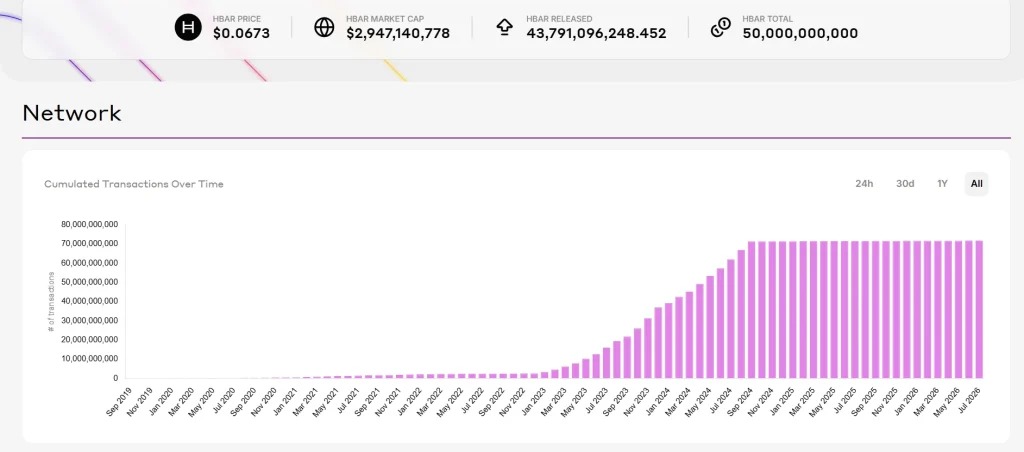
The cumulative transaction volume is close to 72 billion.
Hedera also mentioned that the network's cumulative transaction volume has approached 72 billion transactions. This figure better reflects sustained usage than short-term spikes in data.
In this context, integrating with Utila is more of a supplement to supporting infrastructure than a simple cooperation announcement. As enterprise and institutional use cases increase, hosting, access control, and system interface capabilities are becoming fundamental requirements for public blockchains when attracting financial clients.
Overall, Hedera is attempting to strengthen its enterprise-grade blockchain positioning through transaction volume, institutional infrastructure, and pilot project participation.