

After ASTER launched its XEC perpetual contract, market trading quickly heated up, driving the token's price up significantly within a single trading day. The price rose from $0.0000062 to $0.0000100, a single-day increase of over 55%, with both open interest and trading volume in the derivatives market also increasing accordingly.
Open interest rises to new high
The immediate catalyst for this volatility was ASTER's addition of XEC perpetual contract trading, offering up to 5x leverage. The platform also launched a promotion offering 1.2x trading points until July 25th, further fueling short-term trading activity.
Data shows that XEC derivatives open interest rose to $2.3 million, a record high. Intraday derivatives trading volume increased to $4.51 million, an 85% increase from the previous day; open interest rose by 24%, indicating that new funds and leveraged positions are entering the market.
- Open interest: $2.3 million
- Intraday derivatives trading volume: $4.51 million
- Open interest increased by 24% intraday.
Leveraged funds amplify market movements
From a market structure perspective, this surge is not merely a one-sided rise in spot prices; the simultaneous expansion of derivatives data indicates that more traders are participating through leverage. The simultaneous increase in open interest and trading volume typically reflects heightened market attention and can amplify short-term volatility.
For small-cap or low-priced tokens, the launch of perpetual contracts often rapidly alters the trading rhythm. The liquidity and leverage brought by new products can amplify price fluctuations in a short period, making prices more sensitive to changes in sentiment and position.
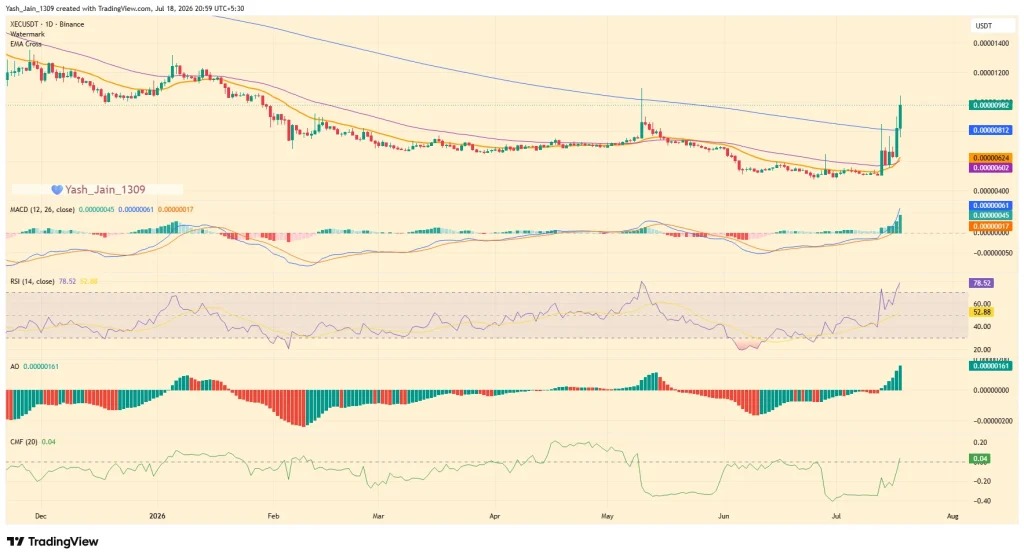
Short-term momentum is strengthening, but volatility risk is rising.
The article mentions that XEC has broken through the 200-day exponential moving average, and the 20-day moving average has also crossed above the 50-day moving average, indicating an improvement in the short-term trend. Meanwhile, the MACD remains bullish, suggesting that buying momentum continues.
However, the RSI has risen to 78, entering the relatively high range. This usually means that after a rapid short-term rise, the market is more likely to see profit-taking or a pullback. If buying continues, price momentum may continue; but if selling pressure increases at higher levels, volatility could also increase significantly.