- Charles Hoskinson warned Cardano could lose its scientists if a 32.9 million ADA research proposal fails.
- The proposal funds post-quantum cryptography, scalability, and zero-knowledge proof research through IOG and partner universities.
- Current on-chain voting heavily opposes the proposal, leaving it far below Cardano’s required approval threshold.
Cardano founder Charles Hoskinson is sounding the alarm over what he believes could become a major turning point for the blockchain’s future. According to Hoskinson, Cardano risks losing a significant portion of its scientific research foundation if a controversial 32.9 million ADA treasury proposal fails to pass. He warned that the network’s core research lab may shut down before the current voting process even wraps up on June 8.
The proposal itself focuses on funding advanced blockchain research tied to post-quantum cryptography, scalability improvements, and zero-knowledge proof development through Input Output Global (IOG) and several university partners. But despite the long-term ambitions behind the plan, resistance from delegates — especially in Japan — has created a surprisingly intense governance battle inside the Cardano ecosystem.
Hoskinson specifically addressed Japanese delegated representatives, or dReps, many of whom reportedly voted against the proposal despite Japan playing a major role in Cardano’s early community growth during its original voucher-based ICO phase. His message felt unusually direct, even emotional at times, as he urged ADA holders to delegate voting power toward representatives supporting the research initiative before the deadline arrives.
Hoskinson Says Cardano’s Identity Is at Risk
In his public comments, Hoskinson framed the vote as something much larger than a normal treasury disagreement. To him, this isn’t just about budget allocations or operational funding. It’s about protecting what he believes makes Cardano fundamentally different from most crypto projects in the first place.
“We are deeply saddened that some Japanese dReps voted against our research proposal,” Hoskinson said. “If this proposal does not pass, Cardano will lose its scientists, and our lab will be forced to close.”
That statement hit hard across the community because Cardano has spent years branding itself as the “science-first” blockchain. Academic peer review, formal verification, and research-driven development have always been central to the project’s identity. Hoskinson argued that billions in ecosystem value and more than a decade of work helped build that reputation, and abandoning the research structure now would risk damaging the very core of Cardano’s image.
He doubled down later, saying the proposal “has nothing to do with me” personally and everything to do with preserving the ecosystem’s scientific backbone. Whether the community agrees with that framing though, is another question entirely.
Treasury Vote Remains Deeply Divided
At the moment, on-chain voting data paints a pretty difficult picture for the proposal. Roughly 81% of active dRep stake has voted against the funding request, while only around 18% currently supports it. Under Cardano’s Voltaire governance model, proposals require a 67% approval threshold to pass, leaving this one far from success unless sentiment changes dramatically before June 8.
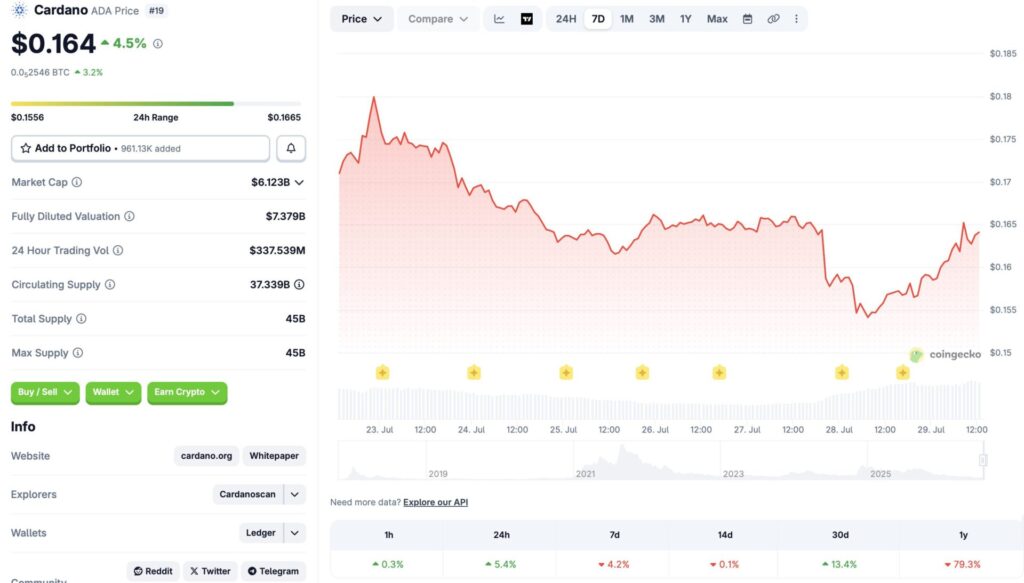
The proposal seeks 32.9 million ADA, currently valued around $7.9 million based on market prices near $0.2519. Funding would support research into Ouroboros Leios scalability upgrades, post-quantum cryptographic systems, and zero-knowledge proof infrastructure. The initiative is led by IOG chief scientist Aggelos Kiayias alongside research teams connected to universities in Edinburgh, Oxford, Tokyo, and Buenos Aires.
Still, critics argue the proposal lacks enough accountability and structure. Some dReps claim the request reads more like a broad yearly operating budget instead of a tightly defined set of measurable milestones. Others want Cardano to introduce competitive bidding processes through open requests for proposals rather than simply renewing IOG-led research funding automatically.
That tension has sparked broader conversations around whether Cardano’s governance system is truly decentralized or simply evolving into what some critics now call “governance theater.” The debate has become about more than funding alone — it’s become a referendum on how Cardano intends to govern itself moving forward.
The Outcome Could Reshape Cardano’s Future
If the proposal ultimately fails, IOG may need to pursue alternative funding methods, restructure the proposal into smaller deliverables, or reduce the scale of its research operations altogether. Any of those outcomes could significantly reshape how Cardano supports the academic infrastructure behind its blockchain development model.
That’s why this vote feels unusually important compared to typical treasury discussions. The decision doesn’t just affect one product cycle or feature roadmap. It potentially impacts the future pipeline of scientific innovation tied directly to Cardano’s consensus architecture and long-term ecosystem identity.
For now, the community remains sharply divided. Some see the proposal as essential for protecting Cardano’s research advantage in an increasingly competitive blockchain industry. Others believe decentralized governance means even legacy contributors like IOG should face stricter oversight and competition for treasury funding.
Either way, June 8 is becoming a date the entire Cardano ecosystem is watching very closely.