

Polkadot recently passed two staking governance proposals, bringing market attention back to DOT. From July 1st to July 6th, DOT rose by approximately 12%, reaching a price of $0.89, a recovery from its previous low of nearly $0.80.
Both proposals have been passed.
The two proposals, Referenda 1909 and 1910, were first submitted on June 23 and approved on July 6. The adjustments primarily focused on validator security requirements and staking efficiency.
Version 1909, building upon the previously approved requirement that "validators must self-stake at least 10,000 DOT," further adds self-staking rewards, 0% commission, and a permissionless chilling mechanism for validators with insufficient staking. Version 1910 eliminates nominator staking penalties and shortens the nominator unbinding period from approximately 28 days to approximately 48 hours.
Significantly improved pledging flexibility
From a mechanism perspective, the new proposal, on the one hand, continues to increase the constraint of validators' own funds, and on the other hand, reduces the time cost for nominators to participate in staking. In particular, with the unbinding period significantly shortened, liquidity will be significantly improved.
Such adjustments typically help increase staking participation and may also improve how the network constrains validator behavior. For Polkadot, this means its staking system is shifting towards greater efficiency.
Price recovery and divergence in on-chain activity
However, the price rebound has not been reflected in on-chain activity. Latest data shows that the number of active independent accounts on Polkadot remains very low, with only 5 active accounts on July 4th and dropping to 1 on July 5th.
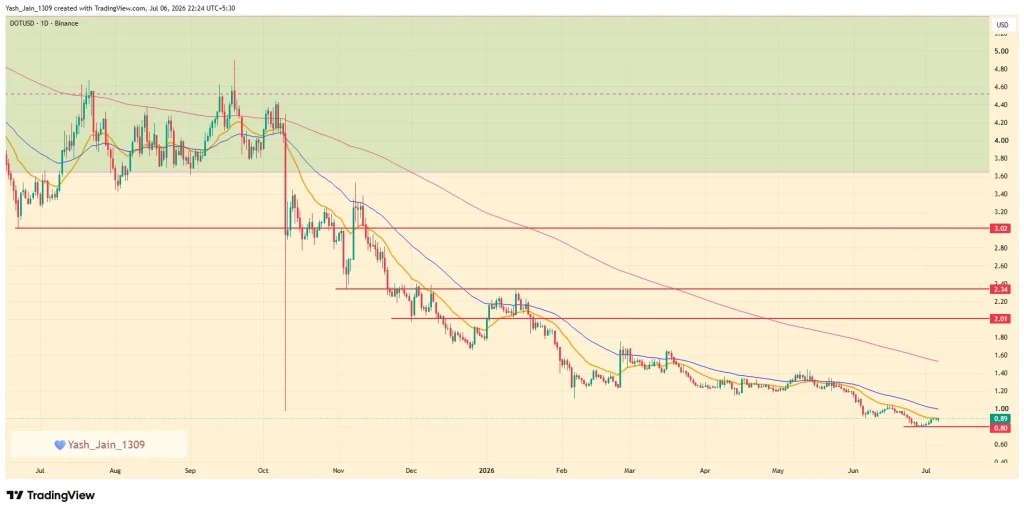
This means that the current rise in DOT is more of a short-term market reaction to governance upgrades, with no corresponding improvement in actual network usage. Only if on-chain activity, staking participation, and capital inflows continue to recover will the market be able to more easily determine whether this rebound is sustainable.