

On the same day, two new developments emerged in the Arbitrum ecosystem, shifting market focus from token price to on-chain business revenue and the tokenization of real-world assets. Although ARB's overall performance this year has been weak, these new developments at the ecosystem level indicate that network usage and project development are still progressing.
Robinhood Chain Revenue Repatriation
Robinhood Chain announced that it has generated over $2 million in revenue since its launch. According to the disclosure, $200,000 of the AEP (Automatic Prepaid Equity) fees will be returned to Arbitrum to support long-term ecosystem development.
This means that once applications built on this chain generate revenue, a portion of that revenue will return to the Arbitrum ecosystem, rather than remaining solely at the protocol level. For public chains and Layer 2 networks, this revenue repatriation mechanism helps enhance the ecosystem's sustainable operational capabilities.
- Cumulative income exceeds $2 million
- The $200,000 fee will flow back into the ecosystem.
- The funds will be used for long-term construction projects.
City Protocol promotes RWA
Another noteworthy development comes from City Protocol. The project stated its plans to advance the next phase of developing real-world asset tokenization products on Arbitrum.
According to its statement, after completing the early infrastructure phase, on-chain finance will next shift more towards structured products, including fixed-income strategies, private lending, diversified funds, and yield-based products. This allows Arbitrum to further penetrate RWA-related application scenarios beyond traditional DeFi.
ARB remains consolidating at low levels.
In terms of price, although ARB has rebounded from its all-time low of $0.0711, it is still significantly lower than the recovery level previously expected by the market. The original text mentioned that the token currently faces major resistance near the 200-day EMA, around $0.1339.
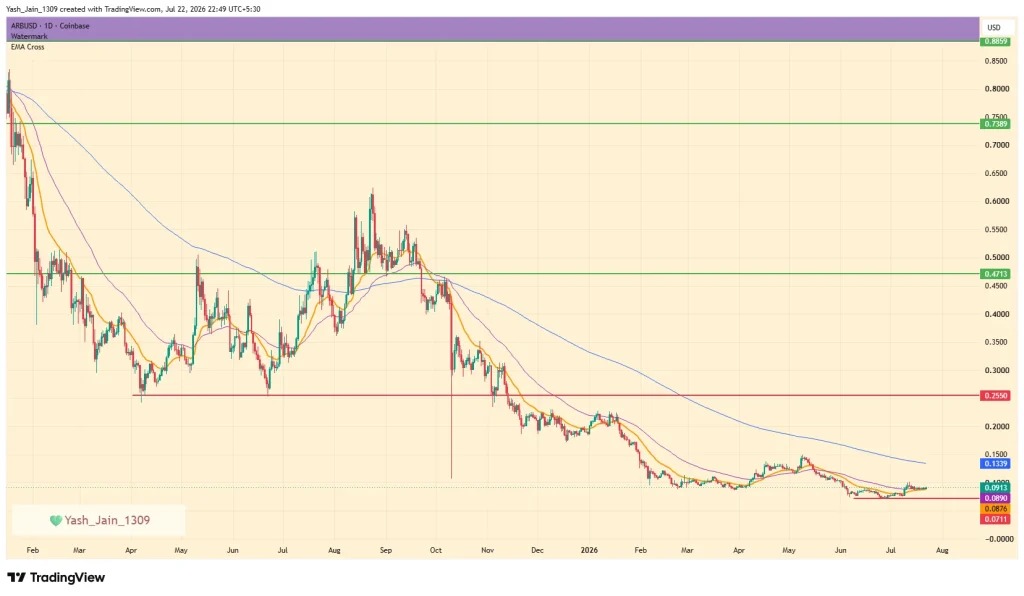
From a market perspective, ARB is still in a low-level consolidation phase. Whether ecosystem data and project progress can continue to improve remains a key factor for the market to observe future price performance.