

In the past, when traditional commodity markets were closed for the weekend, traders could only reduce their positions before the close on Friday to minimize the risk of unforeseen events within the two days. Now, with crypto platforms offering 24-hour perpetual contracts, this practice is beginning to change.
Trading volume surged on weekends in March.
In March of this year, escalating tensions between Iran and Israel led to a significant increase in demand for crude oil-related trading over the weekend. With traditional commodity markets closed at the time, some traders turned to cryptocurrency platforms to trade perpetual crude oil contracts.
CoinDesk reported that the total open interest on decentralized exchange Hyperliquid reached a record high of $1.2 billion on Sunday, March 8.
WTI discounts may narrow on Friday.
For a long time, crude oil options traders have faced the same problem on Fridays: if war breaks out over the weekend, election results are announced, or there are unexpected news from OPEC, their positions cannot be adjusted in time. As a result, many short-term options traders will proactively reduce their positions before the close of trading on Friday.
Energy Aspects, an energy and macro research firm, believes this habit may change due to continuous trading on crypto platforms. The firm points out that short-term West Texas Intermediate (WTI) crude oil options have historically shown an implied volatility discount on Fridays, precisely because traders are unwilling to pay higher costs for risks they cannot manage over the weekend.
If traders can continue to hedge their crude oil exposure over the weekend using perpetual contracts, they may be more willing to retain or even increase option positions that they would otherwise sell on Friday. This means that the long-standing "weekend effect" of WTI short-term options may narrow.
Institutions are still observing liquidity.
Martin Lee, head of market research at DWF Labs, said that over the past three months, weekday trading volume for crude oil perpetual contracts on Hyperliquid has averaged about two to three times that of weekends, but since March, weekend trading has still accounted for about 25% of total trading volume.
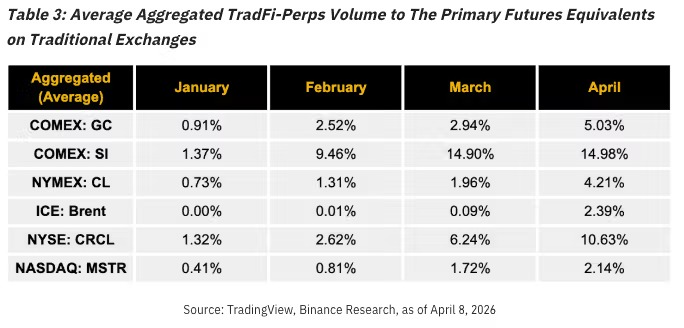
Data from Binance Research also shows that in March and April, the trading volume of crude oil perpetual contracts was equivalent to approximately 2% and 4% of the trading volume of mainstream crude oil futures contracts on traditional exchanges, respectively. By Wall Street standards, this is still not a large scale, but it demonstrates that on-chain markets are filling the gaps left by traditional market closures.
Bitget CEO Gracy Chen stated that institutional clients have shown some interest, but currently the majority of trading volume still comes from the retail market. She believes that the current profit margins and liquidity depth are still insufficient to attract large institutions to enter the market on a large scale.
Additional information:The CME Group recently announced plans to launch smaller 24-hour contracts for WTI crude oil and gold, indicating that traditional markets are also trying to reduce weekend risk exposure.