

As the scale of the AI data center continues to expand, the market's discussions about NVIDIA's competitive advantages are also changing. According to a comment by foreign media TechCrunch, investors used to be more concerned about whether GPU would be weakened by cloud vendors' self-developed chips. However, after the latest financial reports, the market has begun to shift its focus to another question: who can make the entire AI system operate efficiently.
The focus of competition shifts to systems.
The article argues that the deployment of computing power for AI is moving towards higher wattage and larger clusters, and looking solely at GPU is no longer sufficient to explain the competitive landscape. The larger the data center, the more complex the coordination between data, storage, network, and computing becomes. GPU remains a core component, but what truly determines efficiency is increasingly the system capabilities beyond GPU.
This is also at the core of NVIDIA's current narrative shift. Even as large cloud providers such as Amazon and Google continue to advance their own chip development, NVIDIA is still building a more comprehensive infrastructure ecosystem around GPU. The article summarizes it as follows: if GPU is the engine, then the rest of the system is the car itself.
Vera Rubin Covers More Links
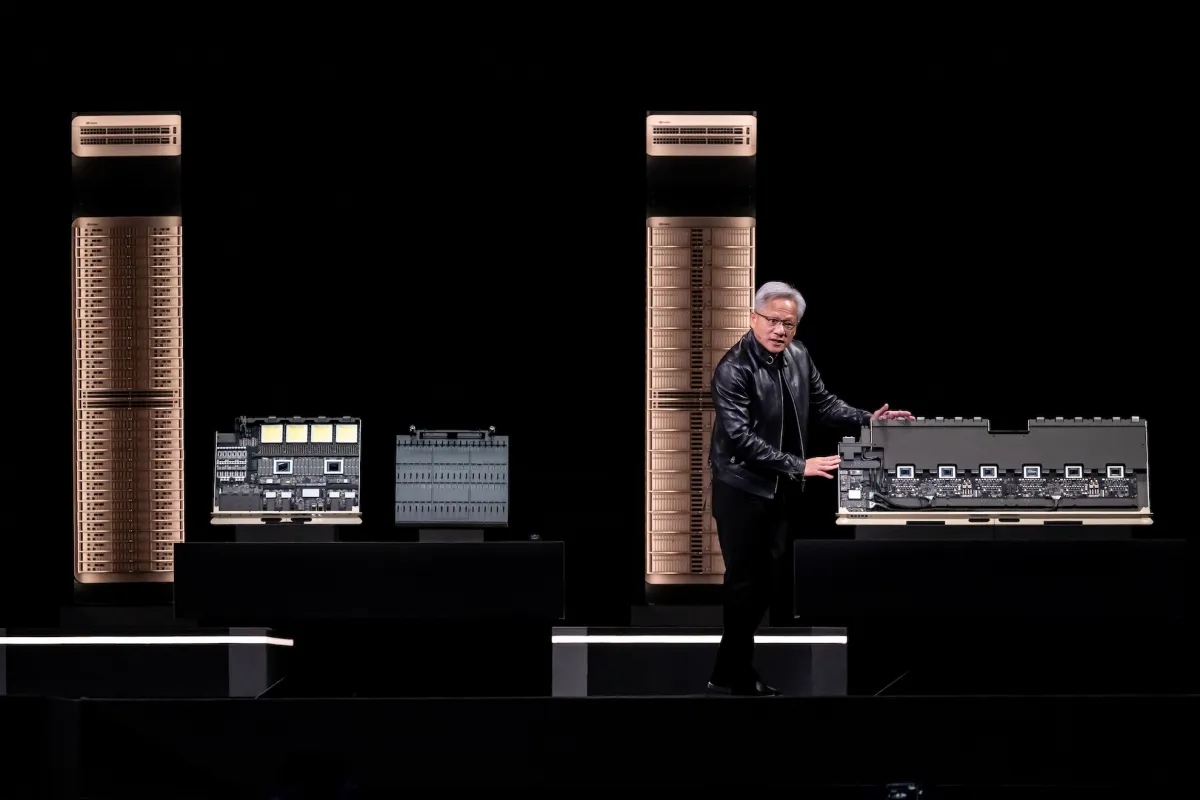
TechCrunch mentions that NVIDIA is advancing the Vera Rubin architecture. This architecture not only includes Rubin GPU, but also comes with Vera CPU as well as rack-level systems for storage, networking, and other aspects. The article argues that the significance of these products lies in the fact that they are not directly responsible for generating token, but rather aim to minimize performance losses outside of GPU.
Among them, Vera CPU is described as an important part of data scheduling. Jason Hardy, the Vice President of Storage Technology at NVIDIA, stated that the amount of memory that a single server or computing platform can accommodate is limited. Therefore, how to deliver data to GPU at the right time has become the key to system efficiency.
Data has become a new battlefield.
The article cites the statement from Hardy that in some related operations, the acceleration effect brought by Vera CPU can reach about 3 times. This means that hardware resources such as flash memory can be utilized more fully, and there is also a chance for system bottlenecks to be reduced.
The article also mentions that similar issues are not unique to the NVIDIA ecosystem. OpenAI When introducing the Jalape chip earlier, reducing data transfer and communication latency was also listed as a key goal. The approach is to keep the entire workload within one interconnected system as much as possible to minimize losses caused by cross-module transmissions.
From the perspective of TechCrunch, this indicates that the infrastructure competition in AI is entering a new phase. Enterprises are no longer just competing in processor power; it also includes how data flows, how storage works together, and how networks can avoid congestion. In other words, the level of competition is shifting from "who has the stronger GPU" to "who can make the entire system operate more efficiently."
The article argues that this change does not mean that NVIDIA has already secured a victory. It still has to face competition from other chip manufacturers and large cloud service providers. However, at this stage, NVIDIA appears to be ahead in terms of system integration and scheduling capabilities, which is also an important reason why the market is re-evaluating its AI advantages.