

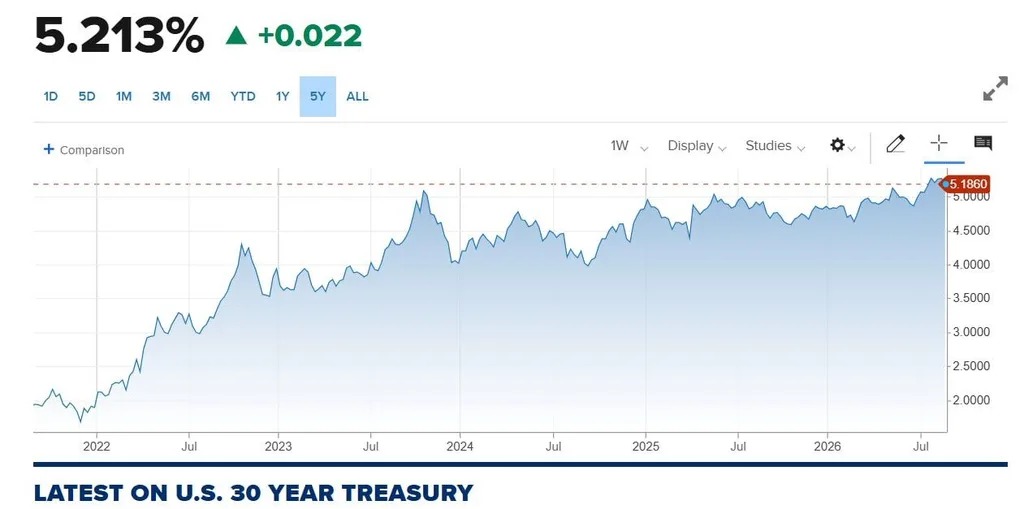
The speech of Federal Reserve Chairman Kevin Warsh at the Jackson Hole Conference has prompted the market to reprice interest rate paths. After investors increased their bets on a rate hike in September, U.S. Treasury yields moved higher across the board, with the 30-year yield remaining above 5%, approaching its highest level since 2007.
Long-term interest rates remain high, indicating that the costs of US mortgages, corporate bond issuance, and other long-term financing are still under pressure. The market's focus is no longer just on policy interest rates themselves, but also includes the stickiness of inflation, the pressure of financing fiscal deficits, and the impact of increased supply of long-term government bonds.
September interest rate hike expectations are heating up
Warsh indicates that inflation is still above the Federal Reserve's target of 2%. Decision-makers need to see a potential decline in inflation at a "clear and sufficiently rapid" pace before they have reason to relax their vigilance. He also stated that the current overall financial environment is not considered tight.
After the speech, the implied probability of a rate hike in September rose to 55.7%, higher than the previous day's 35.4%. This change was first reflected in short-term U.S. Treasury bonds, as the yield on 2-year bonds is most sensitive to expectations regarding monetary policy.
- The yield of 2-year U.S. Treasury bonds rose by 12.79 basis points to 4.36%.
- 10-year U.S. Treasury yield rises 5.6 basis points to 4.728%
- The yield on 30-year U.S. Treasury bonds rose by 2.19 basis points to 5.2129%.
The 30-year rate is still above 5%.
In addition to the expectation of interest rate hikes, long-term yields are also supported by a broader range of factors. Investors demand higher returns to compensate for inflation risks, the risks associated with holding bonds over the long term, and the continuously expanding financing needs of the U.S. Treasury Department.
Report citing a statement by Citibank strategist Dirk Willer says that the increase in term premiums is driving up long-term financing costs, and the scale of government deficits remains an important source of pressure on long-term interest rates. Previously, the yield on 30-year U.S. Treasury bonds rose to 5.327%, reaching the highest level since 2007, before falling back to around 5.20%.
The U.S. Treasury Department is also attempting to improve long-term liquidity. Starting from September 9th, the Treasury Department will increase the maximum supportive repurchase amount for 10- to 20-year and 20- to 30-year Treasury bonds from $2 billion per time to at least $4 billion.
US stocks and Bitcoin both fell in tandem
The rapid increase in yields quickly spread to other assets. On Friday, the main U.S. stock indices fell, with smaller-cap stocks, which are more sensitive to interest rates, experiencing even greater declines, while the U.S. dollar index strengthened accordingly.
- The S&P 500 index fell by 0.25%.
- The Nasdaq Composite Index fell by 0.52%.
- The Russell 2000 Index fell by 1.4%
Currencies weakened similarly to precious metals. Bitcoin fell by 3.34%, trading at around $77,414; spot gold declined by 3.19%, and silver by 4.3%. The US Dollar Index rose by 0.61%.
Next, the market will continue to observe whether U.S. employment and inflation data will further support the expectation of a rate hike in September. If the yield on 30-year U.S. Treasury bonds rises above 5.30% again, the pressure on long-term financing costs may increase once more; if it continues to fall below 5%, it would indicate that the previous upward pressure has begun to ease.