

Ripple is working in advance to lay out anti-quantum upgrades for XRP Ledger. The goal is to establish the migration path and testing framework before quantum computing truly threatens the existing encryption systems. According to their disclosure, this is not an emergency response to current attacks, but rather a transformation of the underlying infrastructure for the next few years.
Targeting post-quantum signatures
The so-called “Q-Day” usually refers to the point in time when quantum computing capabilities are strong enough to crack the currently widely used public key encryption systems. Once such capabilities are truly realized, attackers could theoretically use public information to deduce private keys, thereby gaining control over wallets or transferring assets.
This risk is not unique to XRP. Bitcoin, Ethereum, as well as traditional financial systems such as banks, also rely heavily on cryptographic schemes established before the advent of quantum computing. The judgment of Ripple is that the real risk lies not in today, but in the fact that if preparations are delayed, the costs of future upgrades will significantly increase.
To be implemented in phases
According to the roadmap, in the second half of 2026, the candidate post-quantum signature schemes will run in parallel with the existing elliptic curve signatures on the development network. Ripple is also collaborating with Project Eleven to advance verifier testing, performance benchmarking, and the development of post-quantum managed wallet prototypes.
According to the plan, in the final stage, native post-quantum signatures will be introduced into the XRPL mainnet around 2028. This step will most likely require a network amendment and will be coordinated and advanced by independent verifiers.
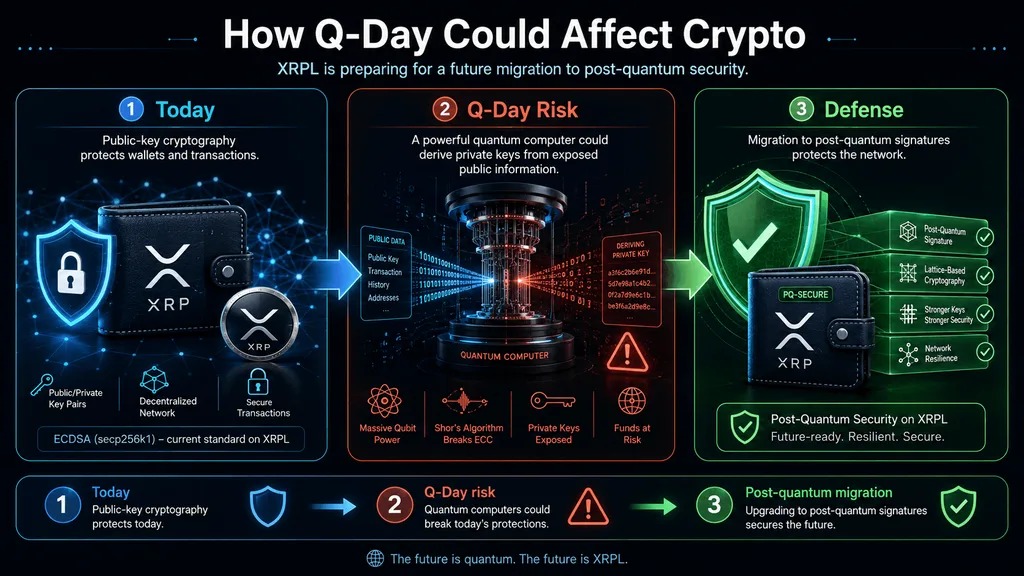
The article mentions that the XRPL account can update its control key without having to change the underlying account. This means that in the future, if migration is necessary, users may not have to switch to a completely new address system, and the overall transformation process could be smoother than on some blockchain networks.
Network expansion enhances the necessity for upgrades
Ripple At this time, the advancement of related preparations is also related to the scale of use of XRPL in recent years. Reports mention that the network has accumulated over 5 billion transactions, and activities surrounding the tokenization of real-world assets and payments are also increasing. As more value moves onto the blockchain, the long-term security of the underlying signature system becomes even more important.
At the same time, discussions on quantum risks have also been driven by recent research progress in AI. In July, researchers from Anthropic used a Claude model to find more efficient attack methods for the experimental post-quantum signature scheme HAWK. Although this research does not involve production systems that are already in use, it demonstrates that AI could potentially speed up the discovery of cryptographic vulnerabilities.
There is currently no evidence to suggest that quantum computers are capable of cracking the key systems of XRP Ledger on a large scale, and Ripple has not described “Q-Day” as an imminent event. The underlying approach seems more like preparing in advance, rather than hastily migrating once the risk becomes a reality.
If quantum computing crosses the threshold of practical usability in the future, networks that have already completed testing and have a path for upgrading will be in a significantly better position than projects that are just starting out temporarily.