

U.S. long-term Treasury yields have recently risen, once again pushing AI and tech stocks into a region sensitive to interest rates. According to foreign media, the yield on 10-year U.S. Treasuries approached 4.8% at the beginning of September, while the yield on 30-year Treasuries has surpassed 5%. For companies that rely on future growth expectations to support their valuations, a slight increase in long-term interest rates could also lead to more significant stock price fluctuations.
Valuation under pressure first
The article argues that the most direct impact comes from discounting. Stock prices essentially depend on the value of future cash flows discounted to today, and the yield on U.S. Treasury bonds is generally regarded as the risk-free benchmark rate in this calculation.
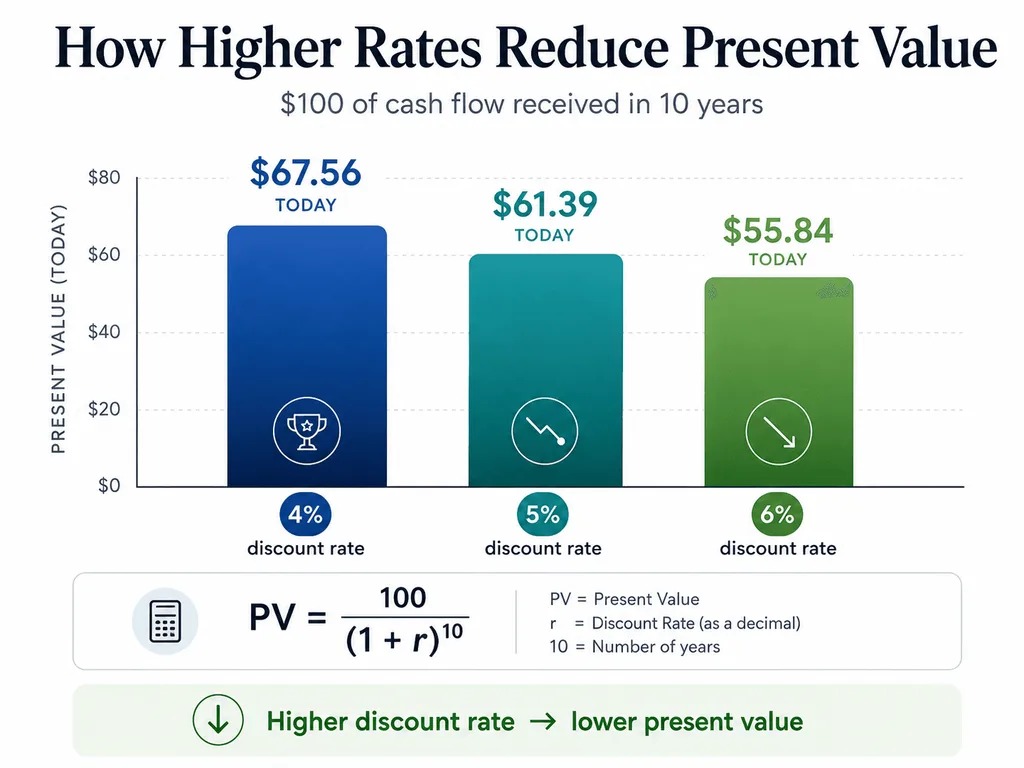
If a company generates $100 in cash flow in 10 years, its current value at a discount rate of 4% is approximately $67.56; if the discount rate rises to 6%, the current value will drop to about $55.84. The future cash flows themselves remain unchanged, but the present value significantly decreases.
This is also why AI and high-growth tech stocks are more vulnerable to shocks. Profits in mature industries come more from current or short-term cash flows, whereas the current valuations of AI companies are often based on profit expectations for 2030 or even further into the future, making them more sensitive to changes in long-term interest rates.
Bond attractiveness increases
As yields rise, the attractiveness of bonds to funds also increases. The article states that when the yield on 10-year U.S. Treasury bonds is around 2%, investors are more willing to take stock market risks in pursuit of higher returns; however, when yields approach 5%, risk-free assets can already provide relatively high nominal returns, and funds' tolerance for overvalued stocks decreases.
This will directly compress the valuation multiples of tech stocks, especially for companies that already have high price-earnings ratios or price-sales ratios. Nvidia, Broadcom, AMD, and other AI companies in the industry chain remain the focus of the market, but if long-term interest rates continue to rise, investors may no longer be willing to pay the same high prices for such high growth expectations.
AI Expansion costs are also on the rise.
The article also mentions that the infrastructure construction of AI itself is highly dependent on capital investment. Training and deploying advanced models require GPU, network equipment, data centers, cooling systems, and a large amount of electricity. The related expenditures have expanded from chip companies to data center, public utility, and network infrastructure enterprises.
In this context, an increase in long-term government bond yields often leads to higher borrowing costs for businesses. Corporate bonds are typically priced by adding a margin to government bond yields. If financing rates rise from 4% to 6% or 7%, companies will need to allocate more cash to pay interest, which reduces the available funds that could be used for investment, dividends, or share repurchases.
The article argues that this means the AI sector is facing dual pressures: on one hand, the present value of future profits is declining; on the other hand, the costs of the infrastructure required to generate these profits are also rising.
Not every upward movement is negative.
However, this relationship is not always linear. If the increase in yield is due to simultaneous improvement in economic growth and corporate profits, stronger performance may offset some of the valuation pressures.
In contrast, what is more challenging for tech stocks is another scenario: yields rise due to inflation stickiness, fiscal concerns, or an increase in government bond supply, but economic growth does not improve accordingly. The article argues that in such an environment, high-valued growth stocks typically face greater pressure.