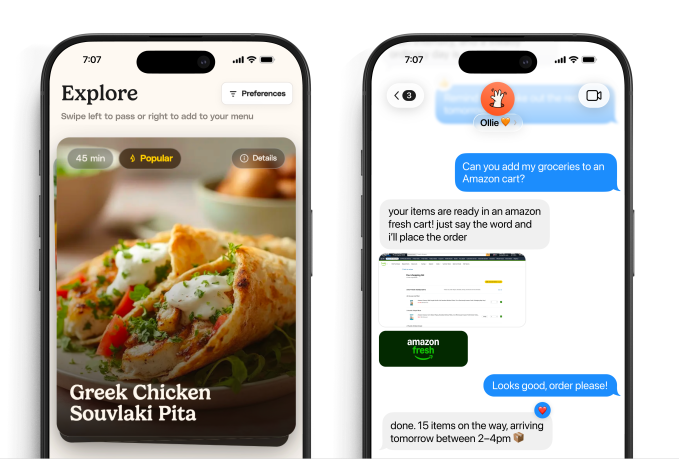


The competition among AI assistants aimed at family scenarios is intensifying. According to a report by TechCrunch, Ollie, headquartered in San Diego, is focusing on "privacy protection" as its main selling point, hoping to distinguish itself from a group of AI assistants that primarily assist with text messages and daily tasks.
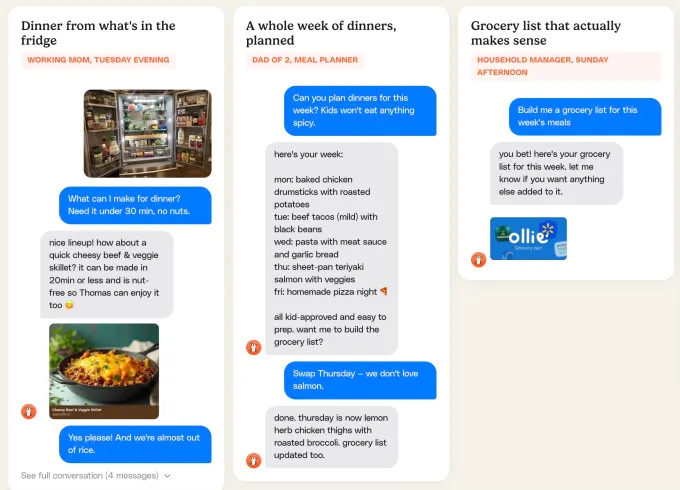
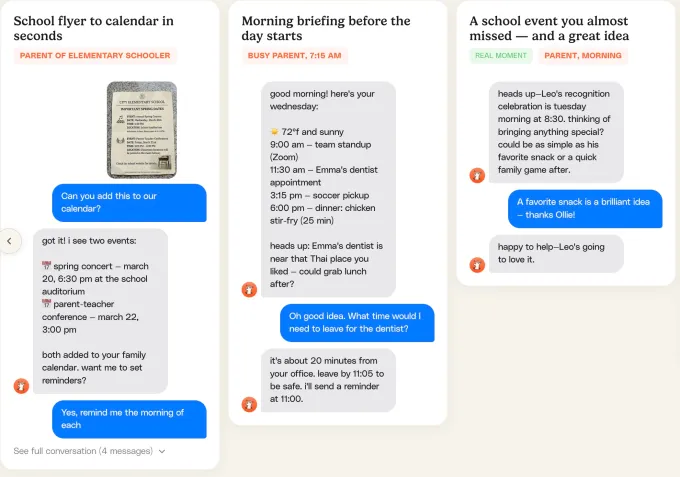
Ollie currently focuses on family scheduling and lifestyle management. The product can connect to calendars and email to help users organize their family schedules, synchronize daily tasks, and also assist in planning meals, grocery shopping, tracking to-do items, booking services, and paying bills within group chats. The company also mentioned that future updates may include the addition of family budget management features.
Obtained SOC 2 compliance certifications
Ollie indicates that the company has met the SOC compliance standards. This is a framework that verifies through independent audits whether a company has established formal data protection and system security controls. For a AI assistant that needs to access users' schedules, emails, and payment processes, such certification is mainly used to prove to users that its data processing procedures have basic security guarantees.
Co-founder and CEO Bill Lennon stated that one of the purposes of adopting a subscription model for Ollie is to make it clear to users that the product and service are intended for paid users themselves, and not to use user data for other business purposes. According to him, the company will not share user data with third parties, nor will it use this data for other purposes, such as training models.
Distinguish with privacy and competitors
Currently, there are multiple participants in the personal AI assistant category, including text-based assistants such as Poke, Fambot, Ohai, Folk, Saner.ai, and Tomo. There are also products like Town, Lindy, and Reclaim.ai that focus more on tasks, calendar management, and email handling. Recently, Instinct, which has not yet been officially launched, has secured $350 million in financing and is valued at $2.5 billion, indicating that the popularity of this field is rising rapidly.
In contrast, Ollie has a smaller financing scale. Reports indicate that the company has completed a $7.5 million seed round of financing, with Khosla Ventures as the main investor, and AI House also participating in it.
Privacy issues are becoming an important area in this field. Reports mention that Instinct has previously been criticized for having overly broad service terms and privacy policies, which granted the platform extensive rights to access, store, transmit, publish, and modify users' data, and this data could also be used to train AI models. Ollie, on the other hand, is trying to highlight its differences by emphasizing that it "does not share data."
Login and payment still require user participation.
In terms of specific design, Ollie indicates that no username or password will be requested to complete tasks on behalf of the user. If logging into a website is necessary, the system will use its own browser in the cloud and send the user a remote session link, which the user will then log in to on their own. The process is roughly the same when it comes to payments or shopping.
This approach enhances security, but the trade-off is that users still need to participate repeatedly in some tasks. Lennon indicates that in the future, the company may explore safer tokenization solutions to reduce the steps of re-entering information, but at this stage, they are still seeking a balance between convenience and trust.
The report also pointed out that the stability of AI's assistants remains a common issue. TechCrunch mentioned during testing that Instinct once provided incorrect hotel prices, and Ollie also stopped responding for a time due to infrastructure failures with the SMS service provider. Lennon believes that large language models inherently possess probability and instability, and the product team needs to implement additional system designs to intercept and correct errors.
For Ollie, privacy and security can be reasons to attract users to give it a try, but when it comes to more sensitive scenarios such as accessing bank accounts and managing budgets, the reliability of the product will still determine whether users are willing to continue authorizing its use.