


Rain Protocol has recently been continuously advancing updates at both the product and token levels, which has led to increased market attention. In August, the project completed an independent security audit, released a new version of development tools, and launched Hyperliquid. At the same time, the activity of addresses on the chain continued to rise in the third quarter, and large-holding addresses also significantly increased their positions in August.
SDK v2 Officially Launched
Rain indicates that Hacken has completed an independent audit of its predictive market contracts. The audit scope included the on-chain order book, result adjudication and dispute resolution logic, as well as fee accounting. The relevant code was retested after three rounds of audits.
On August 27th, Rain officially launched SDK and v2 to replace the old version v1. The new versions provide developers with functions for placing orders on the chain, matching orders, and canceling orders. The project states that the market can either use AMM or adopt a book-of-orders model; in addition, collateral assets can be divided into complete Yes / No shares, which can then be merged in a 1:1 ratio.
Rain The new version also introduces a single-signature session mechanism, allowing users to trade within a single session without having to repeatedly confirm through the wallet. Result rulings, disputes, and appeals are handled at the protocol level, and a margin and time window have been set in place.
7.42 billion tokens were destroyed.
On August 24th, RAIN was launched on the decentralized trading platform Hyperliquid. Two days later, Rain announced that in accordance with the community's first DAO governance decision, 7,419,354,838 RAIN had been permanently destroyed.
The project estimates that the value of this portion of the circulating supply that has been removed is approximately $108 million, and it emphasizes that these tokens are not in a locked or unlockable state, but have been permanently destroyed. The reduction in supply does not directly generate buying interest, but with the addition of new trading venues, this action has changed the circulation structure of the tokens.
Whales increase their holdings to counter the selling pressure from retail investors
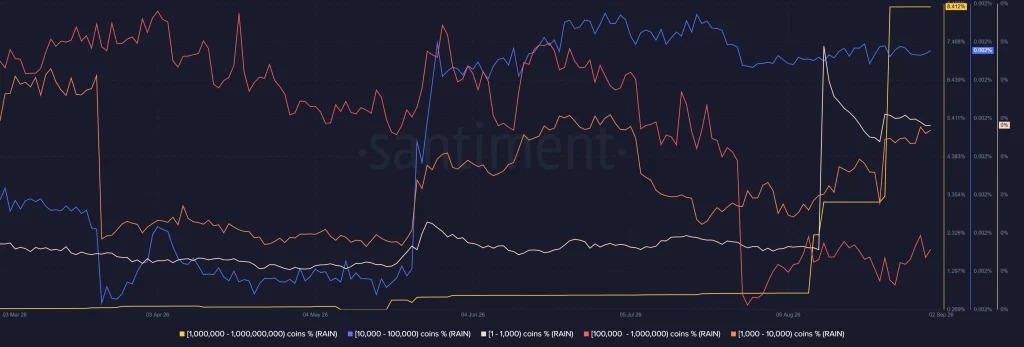
On-chain distribution data shows that the group of addresses holding between 1 million and 1 billion RAIN coins significantly increased their holdings in August, while this group saw little overall change in the months prior to 2026. This indicates that large holders have recently intensified their efforts to accumulate more coins.
In contrast, the number of addresses holding between 100,000 and 1 million RAIN has been continuously declining since the high point in the first quarter of 2026; addresses holding between 10,000 and 100,000 also saw a slight reduction in their holdings, although their level of holdings is still higher than at the beginning of the year.
There is a greater degree of differentiation among smaller-scale addresses. The group holding between 1,000 and 10,000 RAIN units increased their holdings in August, but the smallest group of addresses holding between 1 and 1,000 units has been reducing their holdings since mid-August. Overall, the selling pressure from retail investors is being absorbed by those with larger holdings.
Prices are approaching the previous high range.
As of press time, the price of RAIN is around 0.0171 US dollars, with the trend approaching the upper edge of an upward wedge pattern. Market attention is focused on the 0.0194 US dollar level, which corresponds to a previous high point.
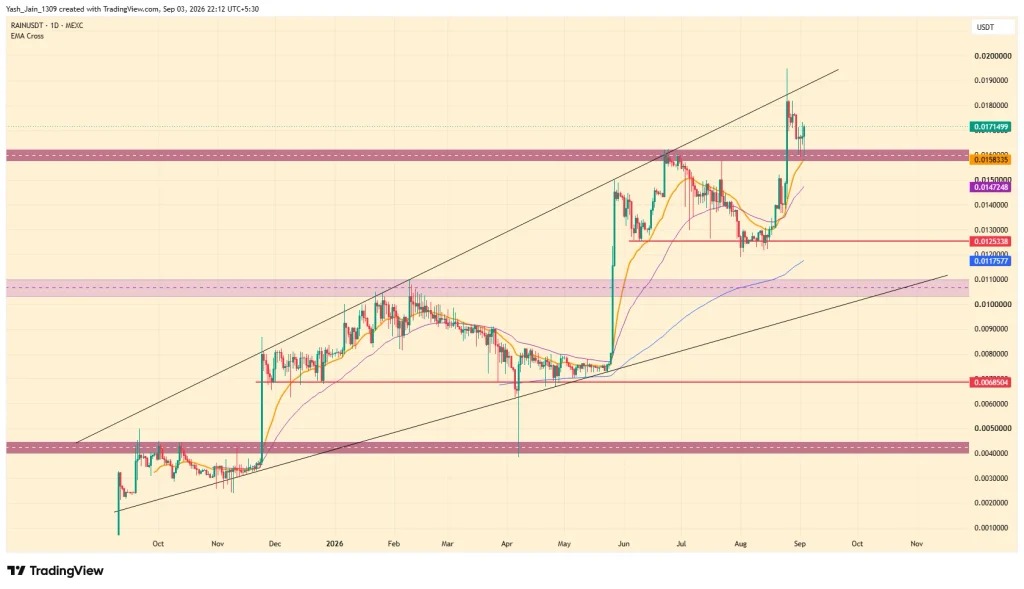
If the buying pressure continues to increase, RAIN may test higher levels; however, if the selling pressure from the group with smaller holdings persists, the pace of price breaks may slow down. At this stage, the product updates of Rain, the increased activity of addresses, and the significant increases in holdings by large investors (whales) are all collectively affecting the performance of the token.