

U.S. stocks opened higher on Thursday, with the S&P 500 index, the Dow Jones Industrial Average, and the Nasdaq Composite Index all rising simultaneously. The direct factors that drove the market rebound were the decline in U.S. Treasury yields and relatively modest signals released by Federal Reserve Governor Jerome Powell regarding this month's interest rate meeting. However, with oil prices continuing to rise, coupled with the historically weak seasonal performance in September, market sentiment remains cautious.
The Dow Jones index rose by about 395 points in the early session, an increase of 0.7%; the S&P 500 index rose by about 0.5%, and the Nasdaq index rose by about 0.6%. The previous day, all three major stock indices had just ended a three-day consecutive decline.
Waller's statement led to a decline in yields
The main support for the market on that day came from changes in interest rate expectations. Waller stated that if subsequent inflation data continues to show a cooling of price pressures, he supports keeping interest rates unchanged at the interest rate meeting on September 15th to 16th. At the same time, he also did not rule out the possibility of further interest rate hikes if inflation strengthens again.
This statement alleviated market concerns about short-term interest rate hikes, and as a result, U.S. Treasury yields declined. The yield on 10-year U.S. Treasuries fell to around 4.75%, while the yield on 2-year Treasuries dropped to around 4.32%. Lower yields are generally beneficial for the performance of tech stocks and other high-valued growth stocks.
Weak historical performance in September
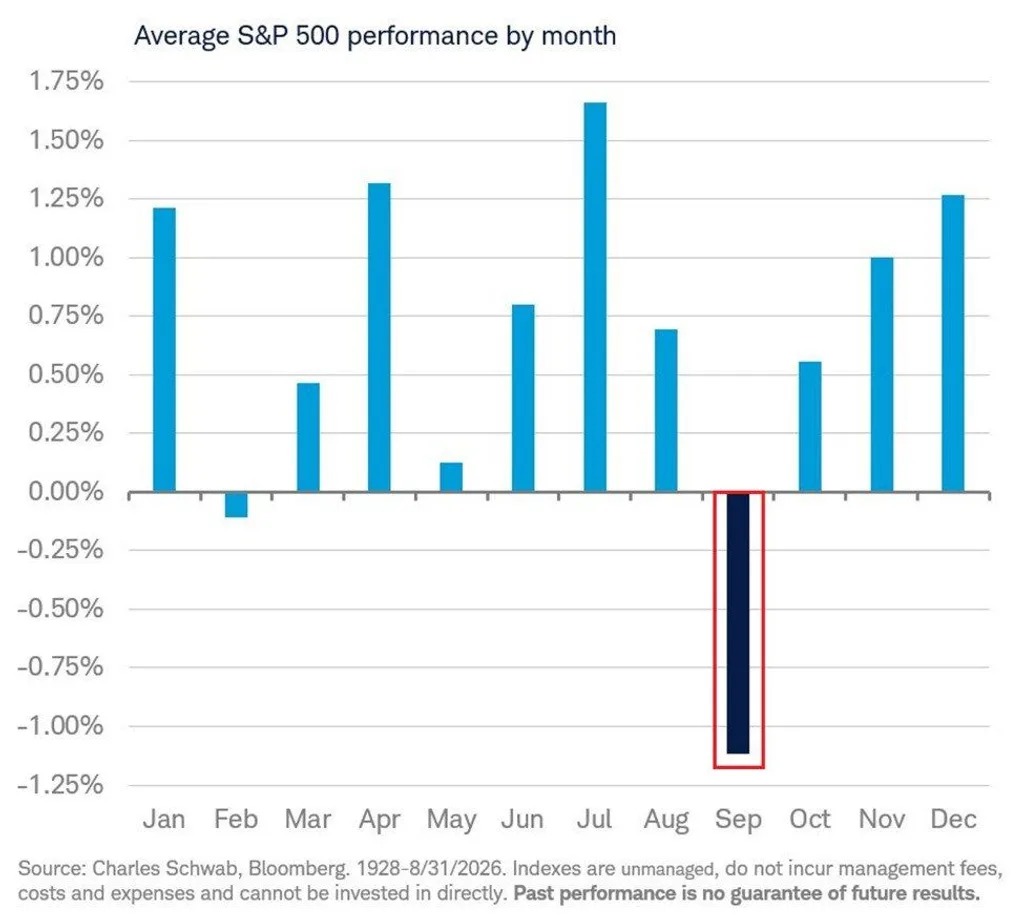
In addition to policy factors, seasonal risks have once again come into focus in the market. The Kobeissi Letter cites data from since 1928, which shows that the S&P 500 index has recorded declines in about 55% of September months, making it one of the few months in history where negative returns occur more frequently than positive returns.
Relevant statistics also show that the S&P 500 index had an average return of about -1.1% in September. The average drawdown was around 4.7%, and the second half of the month tends to be weaker than the first half. Although historical data does not necessarily indicate that the same will happen again this September, this seasonal pattern is affecting market expectations amid uncertainties regarding inflation, employment, oil prices, and interest rates.
AI Concept stocks diverge, oil prices and non-farm payroll data become the next focus
In terms of individual stocks, there continues to be a clear differentiation within the technology sector. NVIDIA rose by about 2% after the company announced its acquisition of the AI platform Hugging Face for approximately $13 billion. Snowflake soared by around 25% due to optimistic revenue expectations, whereas Broadcom fell by more than 5% following the release of its latest earnings guidance. This also indicates that AI remains one of the main themes in the market, but investors have become more selective regarding their growth expectations for different companies.
At the same time, rising energy prices continue to put pressure on the market. Brent crude oil broke through $96 per barrel on Thursday, and tensions between the United States and Iran have intensified market concerns about supplies from the Middle East. Rising oil prices could push inflation up again, thereby increasing the difficulty for the Federal Reserve to make policy decisions.
U.S. economic data released on the same day showed mixed results. In the second quarter, the annualized growth of non-farm business productivity in the United States was 1.4%, while unit labor costs increased by 1.2%. Additionally, the trade deficit in July expanded from $71.2 billion (after adjustment) to $88.6 billion, reflecting a decline in exports and an increase in imports.
Next, the market will turn its attention to the August non-farm payroll report to be released on Friday. Employment, inflation, and oil prices will continue to jointly determine whether this rebound can continue at the beginning of September.