

Foreign media analysis suggests that the reason why stablecoin issuers pay close attention to U.S. Treasury yields is that most of the reserve funds behind USDT and USDC are typically allocated in high-liquidity assets such as short-term U.S. Treasuries. For such companies, changes in interest rates directly affect the income that can be generated from each dollar of reserves.
Short-term U.S. Treasury bonds determine reserve returns
US dollar stablecoins typically promise to be convertible back into US dollars at a ratio close to 1:1. To support this mechanism, issuers need to hold cash and highly liquid assets. Short-term US Treasury bonds have become an important part of the reserve portfolio due to their high liquidity, low credit risk, and the ability to provide interest income.
The article cites an example that if a stablecoin issuer holds $100 billion in interest-bearing reserves with an average yield of 5%, the annual interest income would be about $5 billion; if the yield drops to 4%, the income would fall to $4 billion; and if it further drops to 3%, it would be around $3 billion.
Coin-holding users usually do not take this portion of the earnings.
The article points out that holders of stablecoins generally do not directly receive the returns on these U.S. Treasury bonds. What users hold is a form of “on-chain dollar” whose price is maintained as stable as possible near $1, while the interest generated by the reserve assets mainly goes to the issuer.
This is also one of the important sources of income for stablecoin businesses. The larger the circulation scale of stablecoins, the more reserve assets can typically be allocated, which theoretically can lead to higher interest income. However, if short-term interest rates decline, the earnings per unit of reserves will shrink accordingly.
Circle and Tether are both affected by interest rates.
The article states that the financial disclosures of Circle better reflect this pattern. As the trading volume of USDC increases, the manageable reserve assets of Circle also increase accordingly, thereby boosting interest income. However, if the yield on short-term U.S. Treasury bonds declines, the income generated from each dollar of reserves will also decrease.
The basic logic faced by Tether is the same. USDT has already become the world's largest stablecoin, and therefore Tether has acquired a vast reserve pool, a significant portion of which is allocated to U.S. Treasury bonds and other short-term assets. According to the example in the text, if an issuer holds $150 billion in interest-bearing reserves and the average yield drops from 4% to 3%, the annual interest income will decrease by about $1.5 billion, assuming that the asset size and structure remain unchanged.
Interest rate cuts will compress the profits of issuers.
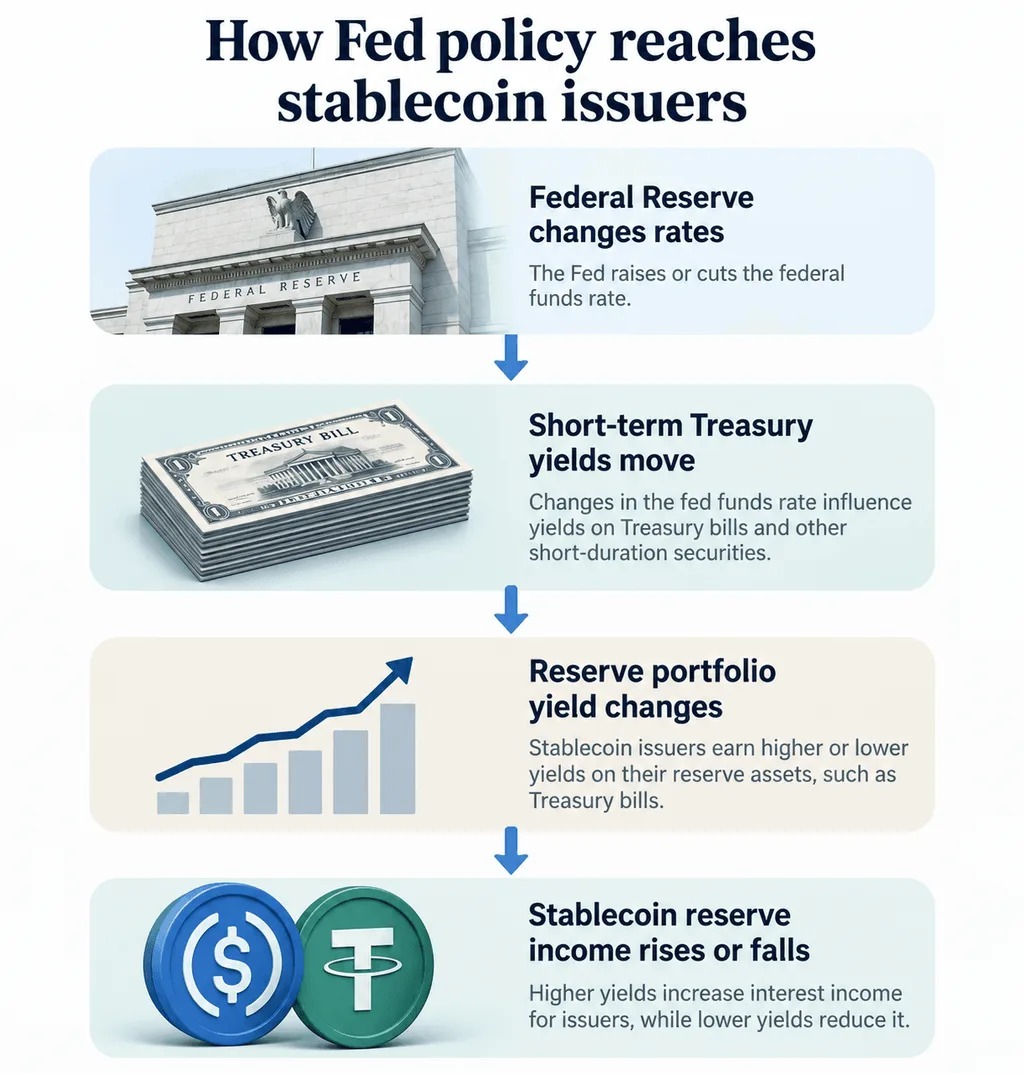
The article argues that when the Federal Reserve cuts interest rates, it typically lowers the yield on short-term government bonds, which can weaken the profitability of stablecoin reserve portfolios, unless other factors offset this impact. Possible responses from issuers include increasing the circulation of stablecoins, developing payment products, reducing costs, expanding into international markets, or establishing more sources of revenue.
The article also points out that the competition among stablecoins is not just about technology; it also involves distribution capacity, circulation scale, and reserve volume. For those observing this industry, looking solely at the token circulation volume is not sufficient. It is also important to pay attention to the supply of stablecoins, the average yield on reserves, as well as the interest rates of short-term U.S. government bonds.