






Bloom Energy will be included in the S&P 500 on September 21, replacing Molson Coors. After the announcement, the stock price of this AI power infrastructure company continued to rise after the market closed, once again making the holdings disclosed by the Pelosi family a focus of the market.
Disclosure time precedes index adjustment.
According to a announcement by S&P Dow Jones Indices on September 4, Bloom Energy will be included in the S&P 500 index. The report mentioned that transactions related to the Pelosi family were disclosed on August 21, about two weeks prior to the release of the index adjustment news.
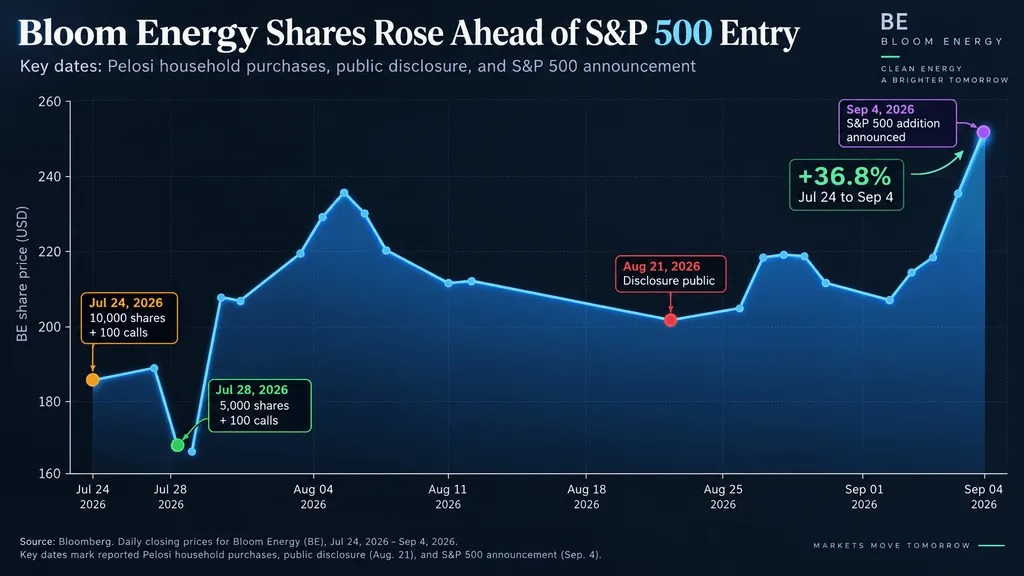
According to the current rules of the U.S. House of Representatives, members of Congress' family members can usually report their securities transactions within 30 days of becoming aware of them, or within 45 days after the transaction is completed. This means that such holdings are technically considered public information, and are not discovered by the outside world only after index adjustments.
Stock prices have risen significantly this year.
On July 24, it closed at $184.89, and by September 4, it rose to $252.87, representing a gain of about 37% in that period. After the announcement that it was included in the S&P 500 index, the stock price increased by another approximately 5.3%.
The report also mentioned that the relevant filings included options positions, so the overall exposure could be higher than that of ordinary stock holdings. However, since the documents did not disclose the option premiums, it is not possible for outsiders to accurately calculate the actual profits based on this information.
AI Electricity demand is an earlier catalyst factor
The article points out that Bloom Energy has previously been regarded by the market as one of the more notable AI infrastructure concept stocks in 2026. Its on-site fuel cell systems are increasingly being used for power supply in data centers, especially suitable for projects that cannot wait for long-term grid connection.
In June this year, Bloom Energy and Brookfield expanded the AI power financing framework from $5 billion to $25 billion. The company also reached a cooperation with Oracle to support up to 2.8 gigawatts of fuel cell production capacity for AI infrastructure.
By late August, the cumulative increase for Bloom Energy for the year had reached approximately 135%. Reports indicate that before the index adjustment was announced, several Wall Street media outlets had already publicly listed it as a hot candidate for inclusion in the S&P 500, as its market value and profitability met or approached the criteria for inclusion.
Congressional trading disputes are raised again
This incident once again raises the long-standing controversy over individual stock trading by U.S. Congress members. In July, the U.S. House of Representatives passed a bill aimed at restricting members of Congress, their spouses, and dependents from purchasing individual stocks in the future, but the prospects for this bill in the Senate remain uncertain.
From the current information, the upward trend of Bloom Energy this time is not solely driven by the news of its inclusion in the S&P 500. AI Rising power demand in data centers, corporate financing expansion, and market expectations that have matured ahead of time are all catalytic factors that appeared earlier.