






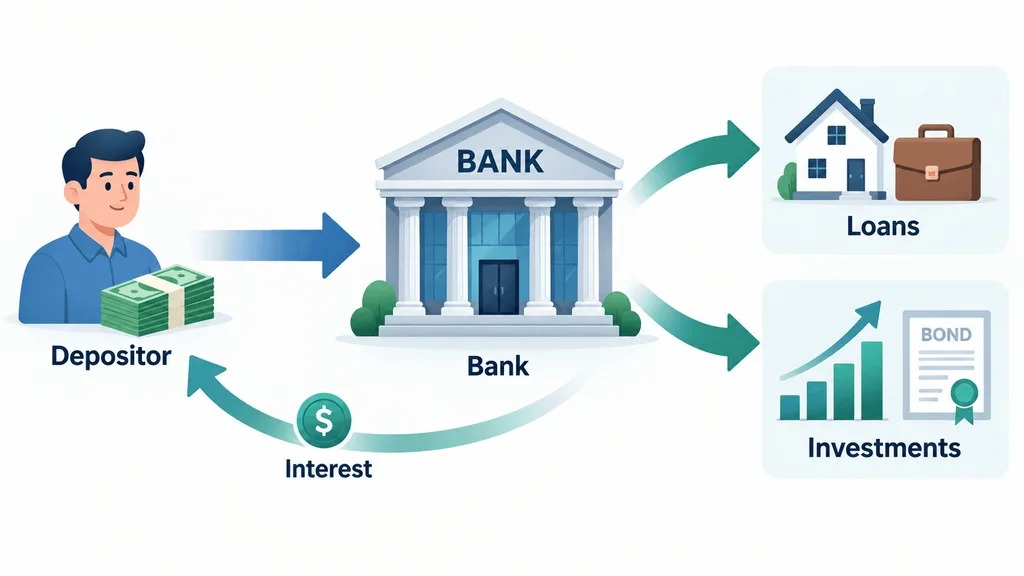
Foreign media commentary suggests that what ordinary depositors consider to be current or savings deposits are not just account balances for banks; they represent a core source of funds that support lending, investment, and daily liquidity. This is also why banks are more actively competing for deposits during periods of rising interest rates. The article also mentions that digital financial tools such as interest-bearing stablecoins are entering this competition.
Deposits determine a bank's financing costs.
Before issuing mortgages, corporate loans, or allocating securities, banks first need to have stable funds. Deposits are usually one of the most common and relatively inexpensive sources of funds. For banks, the interest margin between the returns on their assets and the cost of funds on their liabilities is directly related to their profitability.
If customers keep their funds in low-interest accounts for a long time, banks can incur even lower funding costs. On the contrary, if banks have to retain the same amount of funds at higher interest rates, their profit margins will be squeezed. The article cites the Federal Reserve's view that banks can quickly attract deposits by offering rates higher than the market rate, but this will significantly increase financing costs and also make it easier to attract customers who are sensitive to interest rates and may move their funds at any time.
3.63% interest rate leads to capital relocation
When money market funds, short-term U.S. Treasuries, or high-yield savings accounts offer higher returns, depositors will reconsider where to place their funds. The article mentions that as of early September 2026, the effective federal funds rate in the United States was around 3.63%, and the yields on short-term money market instruments were also in a similar range.
This means that if the interest rates on bank accounts are significantly low, customers are more likely to move their money to other products or competitors. For banks, the issue is not just whether to raise interest rates or not, but whether the alternative funds will be more expensive after losing this deposit.
The article further extends this logic to stablecoins. Whoever controls a large-scale cash pool can generate income by allocating interest-bearing assets. Banking groups have recently warned that interest-bearing stablecoins could draw funds away from traditional accounts and increase banks' financing costs. However, the crypto industry does not fully agree with the actual scale of this threat, and these disagreements have become part of the discussions regarding stablecoins and bank deposits.
Deposition outflows will increase liquidity pressures.
The article points out that the importance of deposits is not only reflected in profits but also in liquidity. Banks need to be prepared to handle withdrawals at any time, yet a large portion of their assets on the balance sheet consist of loans and securities, which may not be able to be liquidated without loss in a short period of time.
Therefore, stable deposits can provide banks with a more reliable source of funds. The Federal Reserve has also mentioned that the outflow of deposits significantly increases liquidity risks, while stable deposits help banks to continue operating during periods of stress. Past bank runs have shown that once the speed at which customers transfer their funds exceeds the banks' ability to replenish them, the pressure can quickly intensify.
- Wholesale financing at a higher cost
- Selling assets in exchange for cash
- Lending contraction or capital replenishment
The article concludes that banks' advancement of their own stablecoins and tokenized deposits is also related to this reality. For banks, deposits are not just numbers in accounts; they are the fundamental raw materials for the entire business operations. As the speed of fund transfers accelerates, those who can retain this capital will be better equipped to maintain lending, payments, and liquidity management.