







peaq will go live on the mainnet. Economics One day after that, the native token $PEAQ will be introduced into Solana. The new model directly links machine activation to continuous operation with $PEAQ; during this binding period, the related tokens will cease to circulate. The project team refers to this model as bringing "machine assets" into the Solana ecosystem.
Machine activation binding $ PEAQ
The goal of peaq is to make robots, vehicles, and various devices become participants in the on-chain economy. Through peaqOS, these machines can obtain identities, cross-chain wallets, and credit ratings, and based on this, they can purchase services, sell their outputs, or prove their activities.
Under the new model, every machine activated through peaqOS must be bound to $PEAQ during its active period. Machines do not have to use $PEAQ for each individual transaction; they can also settle using $SOL or stablecoins. However, $PEAQ is used as an economic commitment to participate in the network.
According to the project disclosure, the first phase will commence this week, with the first batch of approximately 1 million machines entering the activation process. The remaining machines will be gradually connected over the next few weeks, ultimately covering a network of about 3.3 million machines.
Handling fees and re-allocation of additional issuance
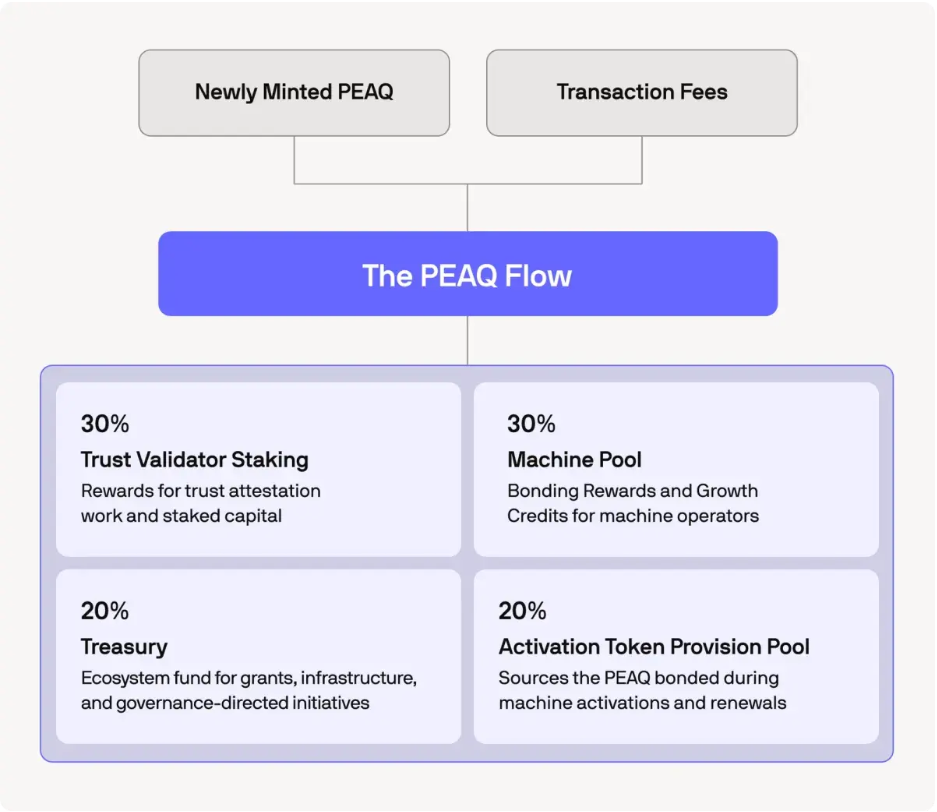
Economics 2.0 will allocate the newly issued $ PEAQ and network transaction fees to four directions:
- Trust Validator The collateral pool has obtained 30%.
- Machine Pool has obtained 30%
- Treasury has obtained 20%
- Activation Token Provision Pool has obtained 20%
The new system also introduces Growth Credits. The project states that such quotas can only be used to activate more machines. Another mechanism, named Bonding Rewards, replaces directly sellable liquidity rewards with renewal discounts in order to reduce potential selling pressure.
When the machine disconnects from the network, the supply of tokens bound to it also changes. According to the current design, after a 14-day grace period and a 14-day transition period, 50% of the remaining bound positions will be permanently destroyed, while the other 50% will be transferred to the treasury.
peaq also launched Machine Explorer at the same time, which is used for real-time tracking of machine activation, binding, economic flow, and destruction data. At the time of the report's release, more than 240,000 machines had been activated.
The machine has completed the payment using USDT.
This integration is not limited to token transactions only. The machines running peaqOS have already paid service fees on Solana through robotic.sh. This platform is a market for machine service consumption scenarios targeting peaq, and the related transactions are completed using $USDT supported by Tether Wallet Development Kit.
peaq also demonstrates cooperation cases with the LG robot simulation environment and the CLOiSim. Equipped with a peaqOS identity and a Tether WDK wallet, it can complete food delivery services without the need for manual approval for each order, and can collect $USDT on the blockchain.
According to the project introduction, next, peaqOS will expand the complete feature stack in stages on Solana. Subsequently, there are also plans to launch Machine Financing products, allowing hardware developers to deploy and raise funds, and enabling Solana users to gain ownership and trading access to machine assets.