





Jaguar Land Rover is preparing to cut around 4,000 jobs over the next two years in order to reduce costs and improve profitability. This adjustment will account for nearly 10% of its global workforce of 43,000 employees, with the first phase mainly involving voluntary departures, focusing on management and white-collar positions.
Reorganization aims at cost reduction.
The company stated that the goal of this reorganization is to save approximately 1.7 billion pounds and to reduce the annual break-even point to around 300,000 units. Management noted that the automotive industry is facing multiple pressures, including accelerated technological changes, intensified competition, and geopolitical disruptions.
Weaker financial performance as of the fiscal year ending March 2026
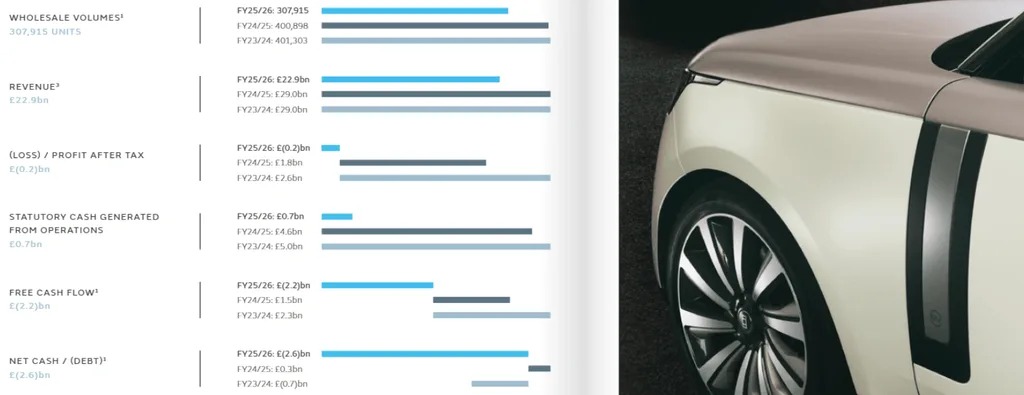
For the fiscal year ending March 2026, Jaguar Land Rover's revenue decreased by 20.9% year-on-year to £22.9 billion. Pre-tax profit and profit before special items fell to £14 million, compared to £2.5 billion in the same period of the previous year.
The company stated that US tariffs, a weakening Chinese market, and production disruptions caused by cyberattacks in 2025 are all major factors contributing to the decline in performance.
Signs of recovery appeared in the fourth fiscal quarter.
Despite facing pressure throughout the year, Jaguar Land Rover has shown signs of recovery at the end of the fiscal year. In the fourth fiscal quarter, revenue amounted to 6.9 billion pounds, and pre-tax profit and profit before special items rebounded to 458 million pounds, compared to a loss of 310 million pounds in the previous quarter.
While carrying out layoffs and cost cuts, Jaguar Land Rover still plans to invest between 15 and 18 billion pounds over the next five years in electrification, digital technology, advanced manufacturing, and customer experience. The company also intends to launch five new products within the next 12 months.
European automakers are under simultaneous pressure
The European automotive industry has recently been facing similar pressures. Automakers are cutting costs on one hand, while increasing investment in electric vehicles on the other, and at the same time, they also have to deal with the price and market share challenges posed by Chinese competitors. Volkswagen has also recently approved a new round of layoffs involving about 50,000 employees.