





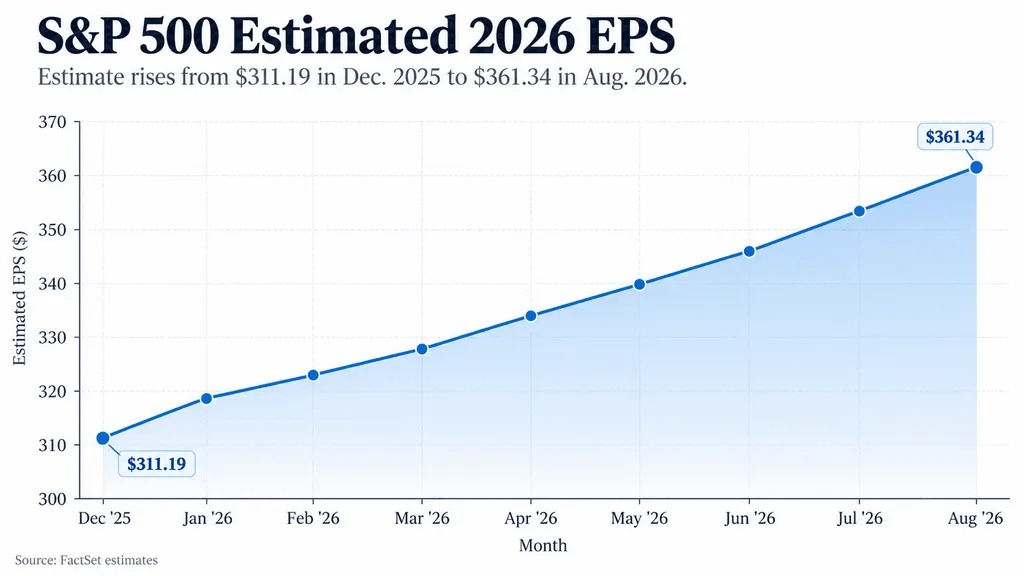
As the financial reporting season enters its latter stages, the impact of AI on corporate profits is beginning to be more clearly reflected in the performance of U.S. stocks. Wall Street currently expects that the earnings of the S&P 500 components will grow by about 32% in 2026 compared to the previous year. FactSet data shows that among the companies that have disclosed their results, 86% have earnings per share that exceed analysts' expectations, which is significantly higher than the historical average.
Rose to 86% above expectations
This round of profit improvement has provided stronger fundamental support for the rise in U.S. stocks, which was previously mainly driven by the concept of AI. The market's focus is no longer just on valuation expansion, but on whether companies have truly transformed their large-scale investments into revenue and profits.
- Among the companies that have disclosed their figures, 86% have earnings per share that exceed expectations.
- The average level over the past five years has been 78%.
- The average level over the past decade has been 76%.
Alphabet and Amazon enhance overall performance
Large technology companies have made a particularly prominent contribution to this round of performance growth. Alphabet recorded $98 billion in revenue during the second quarter, while Amazon achieved $53.4 billion in non-operating pre-tax income, mainly due to its investments in Anthropic. FactSet believes that these two companies are an important source of the significant earnings exceeding expectations in the S&P 500 this time around.
This also shows that the AI craze is affecting corporate profits through two channels. On one hand, cloud services, chips, and the sales of AI products continue to grow; on the other hand, the valuation of AI related unlisted assets held by companies has increased, which is also beginning to be reflected in their book earnings.
However, the improvement in profitability does not entirely depend on one-time investment returns. According to Reuters analysis, even excluding the earnings from the main AI investments, the earnings of the S&P 500 still grew by about 33%, representing the strongest underlying growth rate since 2021. The technology sector stood out particularly, with earnings increasing by 74%, and the energy sector also performed well.
Wall Street continues to raise its index targets
After earnings performance exceeded expectations, several Wall Street institutions began to raise their assessments of U.S. stocks. Barclays has raised its target for the S&P 500 by the end of the year from 7,800 points to 7,950 points, and increased its earnings per share forecast for 2026 from $337 to $365. The reasons include resilient economic activity, strong corporate earnings, and the continuation of AI investment.
Reuters reports that several other large banks also expect the S&P 500 to rise to or exceed 8,000 points. For the market, the focus going forward is not just on the scale of investment in AI, but whether these high capital expenditures can continue to generate sustainable returns. Revenue growth, profit margins, cash flow, and return on invested capital will still be key indicators to measure the effectiveness of this round of AI investments.