




In September 2026, the privacy coin sector became the only crypto segment still hitting new highs. Its market cap surged from $7.1 billion to $33.6 billion—a gain of 213%—while Bitcoin fell 36% over the same period. Zcash is up 2,496% year-to-date. Monero's on-chain transaction volume is climbing against the trend. Aleo has put privacy transactions into hardware wallets. And Firo's Spark protocol survived a critical security exploit.
What structural shift is happening in the privacy sector? Why have these four projects emerged as dark horses? Let's break them down one by one.
Table: Key Data for the Privacy Coin Sector
| Coin | Data Metric | Value |
|---|---|---|
| Privacy Coin | Total Market Cap | $33.6 billion |
| Privacy Coin | Year-to-Date Gain | 213% |
| Privacy Coin | Past 30 Days | ~$13 billion |
| Zcash | Year-to-Date Gain | 2,496% |
| Zcash | Market Cap Rank | No. 7 |
| Zcash | Share of Sector | 62% |
| Privacy Coin | Concentration | $20 billion concentrated in ZEC |
Note: The above data is compiled by CoinMeta from publicly available market sources. For the most current figures, please refer to official sources.
Zcash (ZEC): The Institutional Gateway to Compliant Privacy
Positioning
Compliant privacy as an institutional entry point
Strengths
Zcash completed a critical upgrade in 2026. The Ironwood network upgrade, activated in late July at block height 3,428,143, introduced a new privacy pool and the Turnstile migration mechanism. Grayscale explicitly positioned Zcash as a core beneficiary of "financial privacy in the AI era."
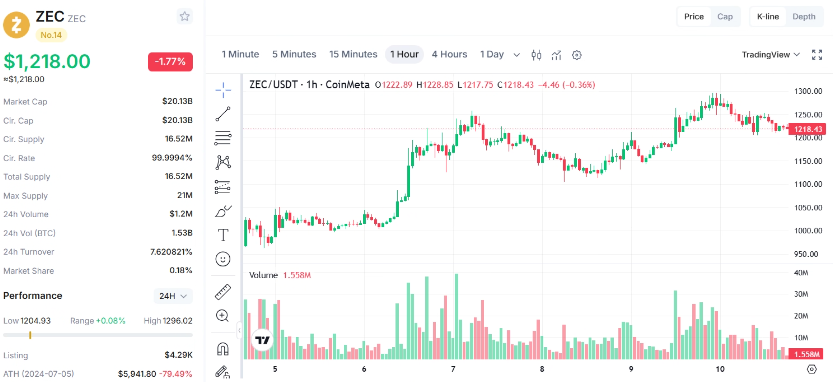
Zcash (ZEC) – Latest Price
Price data confirms this narrative: ZEC surged from around $16 at its 2024 low to over $1,000 by early September—a gain exceeding 6,300%. Its market cap briefly approached $21.6 billion, with a 30-day gain of 154% and a year-to-date gain of 2,413%. Over 30% of ZEC's supply has now entered shielded transactions, with shielded transactions accounting for the majority of network activity.
ZEC latest price at time of publication$1218.
Our take: Zcash's moat is not cryptography itself—it's compliance. Ironwood solves the trust infrastructure problem, which is precisely what institutional capital cares about most before entering.
Monero (XMR): The Real Test of Irreplaceability
Positioning
A real-world test of irreplaceability
Strengths
Despite over 70 exchanges delisting XMR in 2025, on-chain transaction volume remains higher than pre-2022 levels. Nearly half of newly emerging darknet markets accept XMR exclusively. On the technical front, Monero launched the second testnet for FCMP++ and CARROT on May 6. Full-chain membership proofs expand the anonymity set from 16 decoys to approximately 100 million unspent outputs—fundamentally neutralizing mainstream tracking tools like Chainalysis.
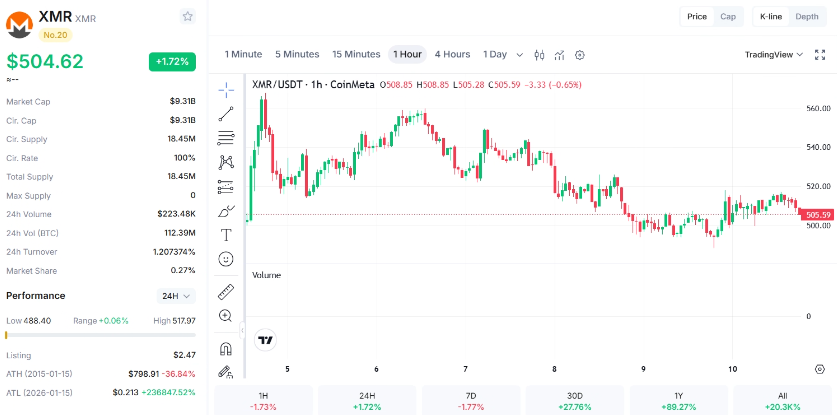
Monero (XMR) – Latest Quote
On price, XMR held between $511 and $541 in early September, with a market cap of approximately $9.6 billion to $10.2 billion, briefly surpassing Chainlink to enter the top 12 by market cap. Over the past month, it rebounded from a low of $350 to $570—a gain exceeding 60%.
XMR latest quote at time of publication$504.62.
Our take: Monero's value is not about its growth curve—it's about proving that mandatory privacy is irreplaceable in specific demand scenarios. This is a technical watermark other privacy coins have yet to reach.
Aleo (ALEO): Programmable Privacy Goes Institutional
Positioning
Institutional deployment of programmable privacy
Strengths
In 2026, Aleo accomplished something no privacy chain had done before: bringing fully shielded zero-knowledge transactions into real financial use cases. The USAD stablecoin, developed in partnership with Paxos Labs, has been deployed on mainnet. It uses zero-knowledge proofs to achieve end-to-end encryption of transaction amounts and counterparties, while supporting two selective disclosure mechanisms: account view keys and transaction view keys.
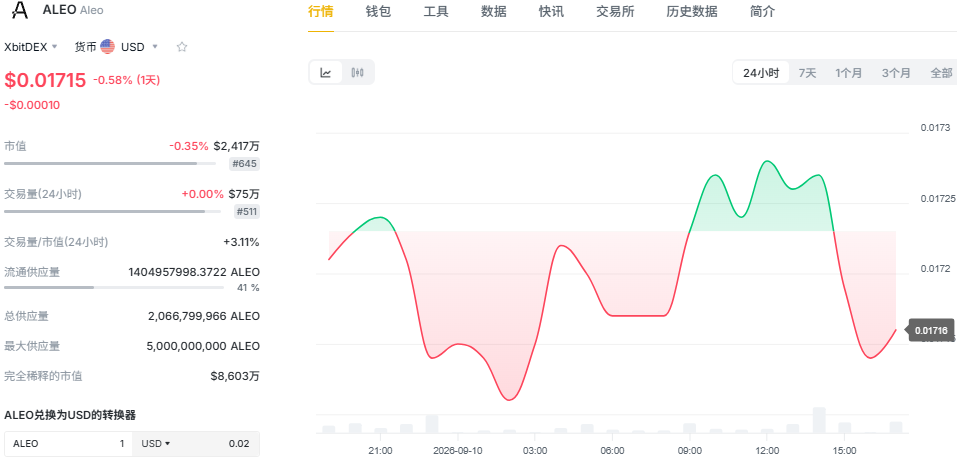
Aleo (ALEO) – Latest Quote
ALEO's token performance diverges sharply from its protocol progress. In early September, ALEO traded at approximately $0.017, with a circulating market cap of just $23.4 million and a circulating supply of about 1.4 billion tokens.
Aleo latest quote at time of publication$0.01715.
Our take: Aleo's differentiation lies in the actual delivery of "programmable privacy," not its token price. However, the severe disconnect between token market cap and protocol value is a risk investors must clearly recognize.
Firo (FIRO): A Protocol-Level Breakthrough in Privacy Assetization
Positioning
Protocol-level breakthrough in privacy assetization
Strengths
Firo's Lelantus Spark protocol underwent a stress test in 2026. A multi-input spending vulnerability discovered in August was quickly patched. On September 4, the team completed a mandatory hard fork at block 1,371,000, upgrading to v0.14.18.0. The upgrade introduced Chaum V2 proofs and a new transaction format, restoring full Spark functionality.
On price, FIRO traded around $0.95 to $1.00 in early September, with a circulating market cap of approximately $18 million to $19 million and a circulating supply of about 19 million tokens. It posted a 24-hour gain of 31.4%.
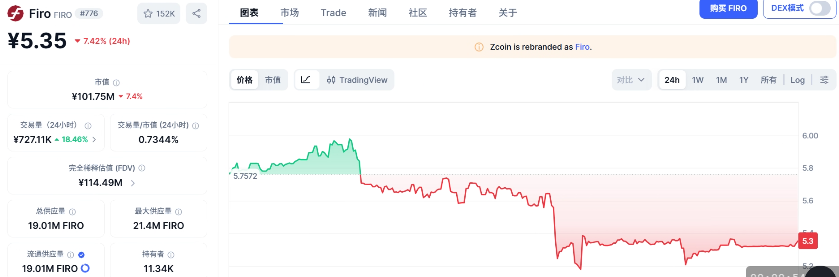
Firo (FIRO) – Latest Quote
Firo latest quote at time of publication$5.35.
Our speculation: Firo's value is significantly undervalued by the market. If Spark Assets are adopted by stablecoin issuers or RWA projects, Firo could transform from a "privacy coin" into a "settlement layer for privacy assets"—a market potentially several times larger. But with a current market cap under $20 million, liquidity is extremely thin. Any positive protocol development could be amplified by market sentiment—and vice versa.
September Privacy Coin Outlook
How is the privacy coin sector developing in September? Let's look at the data.
Glassnode's sector report published on September 7 noted that since Bitcoin's peak in October 2025, the privacy coin sector has gained 213% cumulatively. It is the only category tracked by Glassnode still above its cycle high. Over the same period, Bitcoin fell 36%, and the median of the top 200 assets dropped 58%.
The total market cap of privacy coins jumped from $7.1 billion a year ago to $33.6 billion. Approximately $13 billion flowed in over the past 30 days—accounting for more than half of the one-year increase.
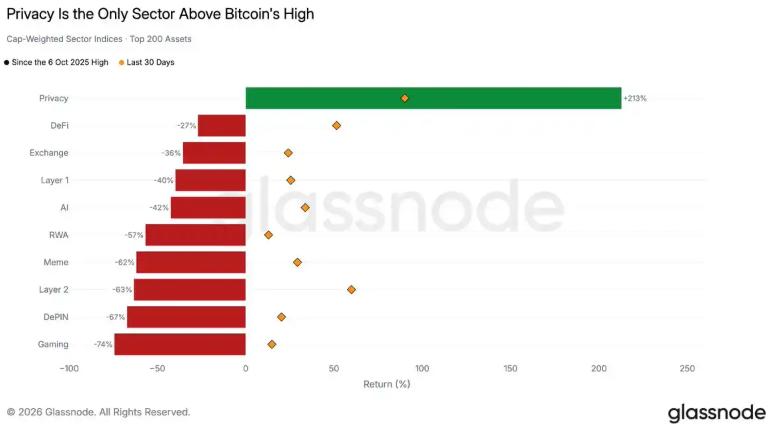
Privacy Coin Sector Up 213% Cumulative
Concentration of capital flows also warrants attention.
Zcash dominates the sector with a 62% market cap share. Excluding ZEC, a market-cap-weighted privacy coin portfolio still gained 85%, indicating the sector's strength is not an isolated move by a single asset. Monero maintained its trading center above $500 in early September, rebounding over 30% from its August low of around $380.
On the derivatives side, ZEC open interest rose to $2.91 billion on September 10, with $11.52 million in short liquidations within 24 hours. A short squeeze and spot buying formed a short-term resonance.
The core signal from this data is not "how much it gained," but that capital is voting for the privacy sector's institutionalization path. September's price action proves that privacy is upgrading into an asset class.
FAQ
Q1: Is the privacy coin sector still worth watching in 2026?
Yes. Glassnode data shows the privacy coin sector has gained 213% cumulatively since Bitcoin's October 2025 peak. It is the only crypto asset category still above its cycle high, with a total market cap of $33.6 billion and nearly half of that added in the past 30 days. However, Zcash accounts for 62% of the sector's market cap—concentration risk warrants caution.
Q2: How have fund inflows performed since the Zcash ETF launched?
Inflows have been positive. Grayscale's Zcash ETF began trading on August 25, 2026. As of September 4, it had attracted $34.4 million in net inflows. ZEC's price climbed above $1,000, and its hash rate rose from about 25 GS/s in late August to over 30 GS/s. Sustained institutional inflows indicate the compliance path is being validated.
Q3: Has Monero declined after being delisted by many exchanges?
No, it has not declined. By mid-2026, Monero had been delisted from 73 centralized exchanges, yet on-chain transaction volume climbed 30%. Transaction volumes from 2024 to 2025 surpassed 2020–2022 levels. Users shifted to decentralized channels rather than abandoning the coin. Demand for mandatory privacy in specific use cases remains solid.
Conclusion
The privacy coin sector completed a critical identity shift in September 2026. Zcash solved the supply audit problem with the Ironwood upgrade. Aleo pushed privacy transactions into hardware wallets. Firo's Spark protocol redefined privacy assets after patching its vulnerability. And Monero proved real demand for mandatory privacy through on-chain data.
The privacy sector is up 213% year-to-date with a $33.6 billion market cap—but concentration risk is equally real.
Privacy is shifting from a fringe narrative to part of institutional-grade infrastructure. The next question is: when the price narrative fades, who still has real use cases?
Disclaimer: This content is based on publicly available market data and is for informational and educational purposes only. It does not constitute investment advice. Readers are advised to strictly comply with applicable laws and regulations. For the latest updates, follow CoinMeta.