






As the Middle East crude oil market enters a new week, the focus of trading is no longer just on short-term fluctuations in oil prices. A key oil pipeline in Saudi Arabia, used to bypass the Strait of Hormuz, has been shut down following a drone attack, raising concerns about a further tightening of global supply.
The key bypass channel is temporarily shut down.
According to Reuters, citing traders and industry sources, Saudi Arabia has closed the East-West oil pipeline. This pipeline connects the eastern oil-producing regions with the Red Sea port of Yanbu, allowing crude oil to be exported directly without passing through the Strait of Hormuz.
During the period of ongoing regional conflicts, the importance of this pipeline has significantly increased. Reports indicate that the pipeline previously transported around 4 to 5 million barrels per day, accounting for nearly 4% of the global crude oil supply. If operations are halted for several days and cannot be resumed, Saudi exports could be substantially affected.
Yanbu inventory may only last for a few days.
The market had once hoped for an improvement in Gulf shipping, believing that exports would gradually normalize after the resumption of traffic through the Strait of Hormuz. However, with disruptions also occurring in Saudi Arabia's alternative routes, the pressure on the supply system has once again increased.
Reuters cites industry estimates that if the oil pipelines remain shut down, the extended inventory will only be sufficient to support exports for about 5 to 7 days. This means that the export systems on both the east and west sides of Saudi Arabia are facing higher risks, and the buffer space in the crude oil market is shrinking.
Supply contraction outpaces the decline in demand.
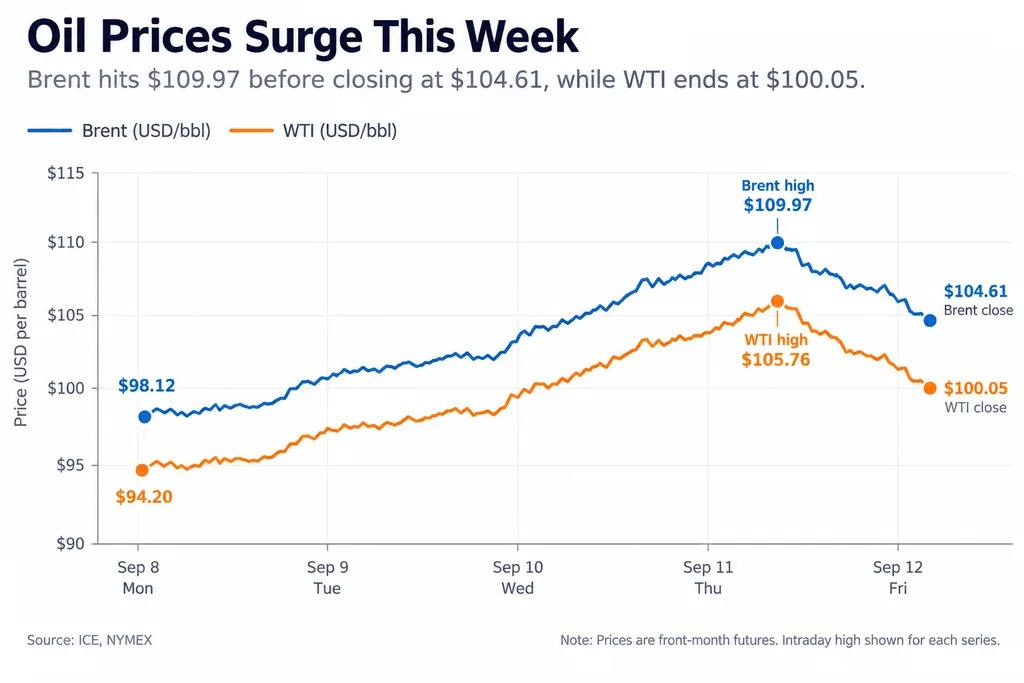
In terms of prices, Brent crude closed at $104.61 per barrel last Friday, while WTI closed at $100.05 per barrel. Despite a slight decline on that day, both benchmark oil prices still saw a cumulative increase of over 8% for the week.
The International Energy Agency (IEA) predicts that global crude oil demand will decrease by 2.5 million barrels per day in 2026, a larger decline than previously anticipated, due to high oil prices and supply disruptions suppressing consumption. However, the decline on the supply side is even faster. The agency estimates that global crude oil production this year could fall by about 5.7 million barrels per day, and Saudi Arabia's production has also significantly decreased from previous levels.
Both supply and demand have weakened, but the contraction in supply is more significant. This is also an important reason why Brent oil prices remain above $100 per barrel.
Diesel prices bring more direct pressure
The market's focus is not just on crude oil itself. Reports mention that diesel prices in the United States have risen above $6 per gallon. The U.S. Energy Information Administration expects that distillate inventories will remain below the five-year average for an extended period, possibly continuing until the end of 2026 and most of 2027.
Diesel prices will be directly reflected in the costs of truck transportation, agriculture, manufacturing, and shipping. Therefore, for the market, the current issue is not just whether the Strait of Hormuz can be reopened to traffic, but also whether there will be a longer-term restriction on the Middle East's crude oil export system.