






McDonald's stock price continues to hover at low levels. On the most recent trading day, the stock closed at $252.53, below the 20-day, 50-day, and 200-day moving averages, indicating that the medium to long-term trend remains weak. Meanwhile, the company's dividend yield has risen to around 3%, reaching a high not seen in over six years.
The daily trend remains weak.
From a technical perspective, the weakness on the daily chart is quite evident. The 20-day moving average is at $261.42, the 50-day moving average is at $267.65, and the 200-day moving average is at $286.16. Since the current stock price is below all these levels, it indicates that the selling pressure has not yet significantly eased.
There has also been no clear improvement in the momentum indicators. The daily RSI value is 31.2, which is close to the oversold range, but it has not yet fallen below 30. The MACD bar chart shows -1.21, still within the negative range, indicating that the downward momentum has not completely subsided.
A slight stabilization appears in the short term.
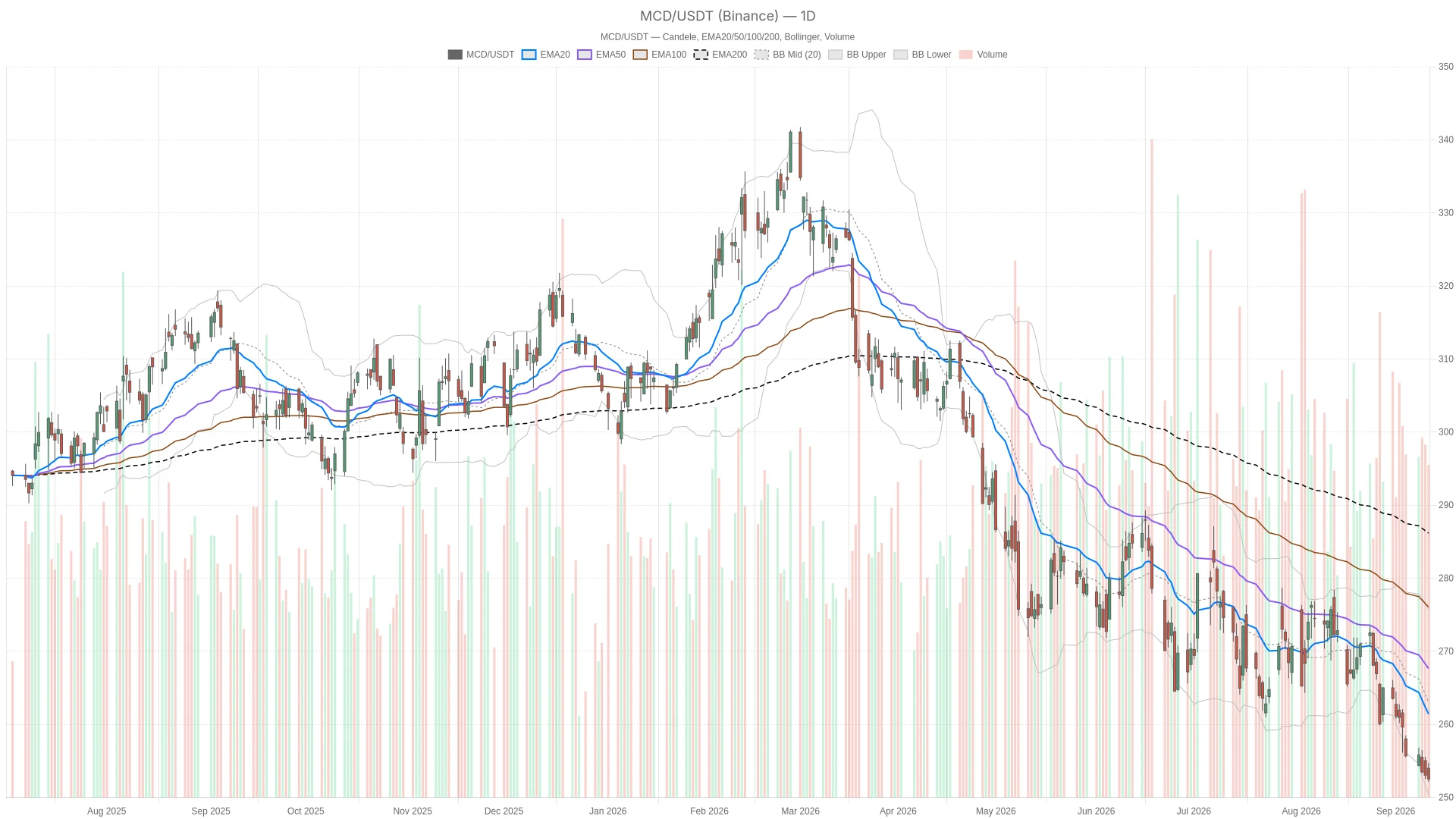
The Bollinger Bands also reflect a weak pattern. The middle band is at $263.07, and the lower band is at $250.35. The stock price is moving close to the lower band, indicating that the market is still testing for even lower support levels. Intraday fluctuations have also increased; the ATR indicator shows a value of 3.78, indicating that daily fluctuations of several dollars are now quite common.
Although there are slight signs of stabilization in the short-term trend, it is not yet sufficient to change the overall judgment. On the 1-hour chart, the MACD bar chart has turned slightly positive to 0.12, indicating that the short-term selling pressure has eased somewhat. However, the 20-hour, 50-hour, and 200-hour moving averages are still all above the current price, so the bearish pattern has not reversed.
Same-store sales drag down morale
On the fundamental side, market concerns continue. McDonald's same-store sales in the United States only increased by 0.8% in the second quarter, below market expectations. Some analysts believe that the company is under pressure at the operational level and is also facing competition from rivals such as Chipotle and Restaurant Brands.
External cost factors are also affecting market expectations. Reports mention that diesel prices and broader inflationary pressures may continue to squeeze the profit margins of consumer-facing companies, including McDonald's.
However, as the stock price fell, McDonald's dividend yield rose to around 3%, reaching its highest level in over six years. This change has also prompted the market to begin discussing whether the stock's current attractiveness lies in its increased valuation or whether it is still in a phase of weakening fundamentals.