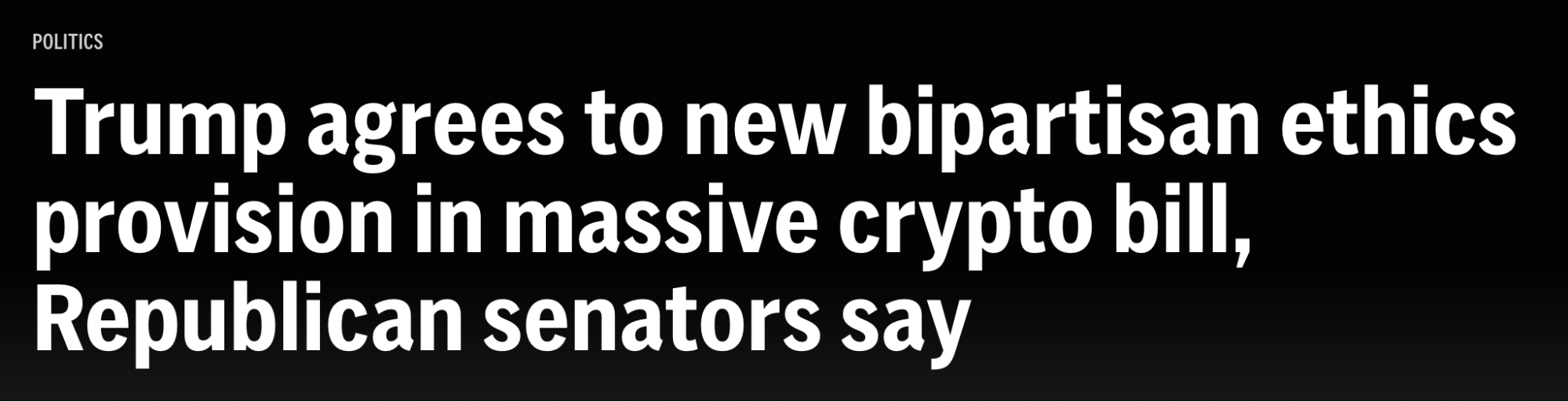






The final version of the U.S. "Digital Asset Markets Clearing Act" was announced on Sunday. The latest version incorporates several amendments previously proposed by Democrats, and market attention has shifted to the procedural vote that is about to take place in the Senate. With Trump agreeing to join some of the ethical constraints, the prospects for advancing this bill have clearly improved.
Final version includes provisions on ethics and stablecoins
New regulations require certain public officials to dispose of their related holdings or place their assets in qualified blind trusts. This arrangement draws on the Government Ethics Act of 1978. The penalty for violations is 20% of the transaction amount, or $500,000, whichever is higher. The relevant rules will be implemented within 360 days after the bill takes effect, or may take effect sooner within 60 days after the issuance of detailed rules under Section 10102.
In the section regarding stablecoins, the bill includes a separate set of restrictions. If the U.S. Secretary of the Treasury determines that funds are flowing on a large scale out of community banks and into stablecoins on the blockchain, the Treasury Department may impose restrictions on stablecoin incentive programs for up to 18 months.
Expanded scope of developer exemptions
The changes to the "Blockchain Regulation Certainty Act," which is adjusted in conjunction with the bill, are relatively minor, but they have a direct impact on developers and infrastructure participants. The new text retains the protection that exempts developers from registration for remittance services, and at the same time extends this protection to miners and verifiers as well.
This change means that some participants who only provide network operation, verification, or code development services have gained clearer boundaries under the federal regulatory framework.
Decentralized certification standards are more specific.
Bill A lists certain "coordinated control" criteria to determine whether a network can be exempted from being classified as a security. The text outlines five key conditions, including whether the code is open-source, whether the network operates without permission and remains neutral, whether the tokens or voting rights are decentralized, whether the system has the capability to operate autonomously, and whether the token value mechanism is independently established.
Among other things, the bill also defines a "distributed ledger controller," which refers to an individual or entity that has the ability to change the network functions or consensus rules. If a project is controlled by a single operator who manages the sole sorter or controls the main set of validators, it may be more difficult to meet this standard.
- The threshold for token or voting rights concentration is 49%.
- If a single entity is able to unilaterally alter the network, the risks will increase.
- Sorter and verifier control rights become a focus of scrutiny
Some applications are facing greater scrutiny.
The report mentions that Hyperliquid may become a typical subject of observation in large-scale on-chain applications. The reason is that its set of validators is relatively small, and the foundation has a strong influence; there have also been instances in the past of manual intervention in the network's operation. According to the text, the validators of Hyperliquid Foundation account for about 47% of all staked HYPE. Although this is still below the 49% threshold, if the team's allocated shares are taken into account, the compliance judgment may become more complex.
At the same time, Trump has recently publicly stated his desire to introduce Hyperliquid into the American market. This means that if the bill continues to progress, relevant platforms may need to more proactively adjust their structures to meet the requirements of the new framework.
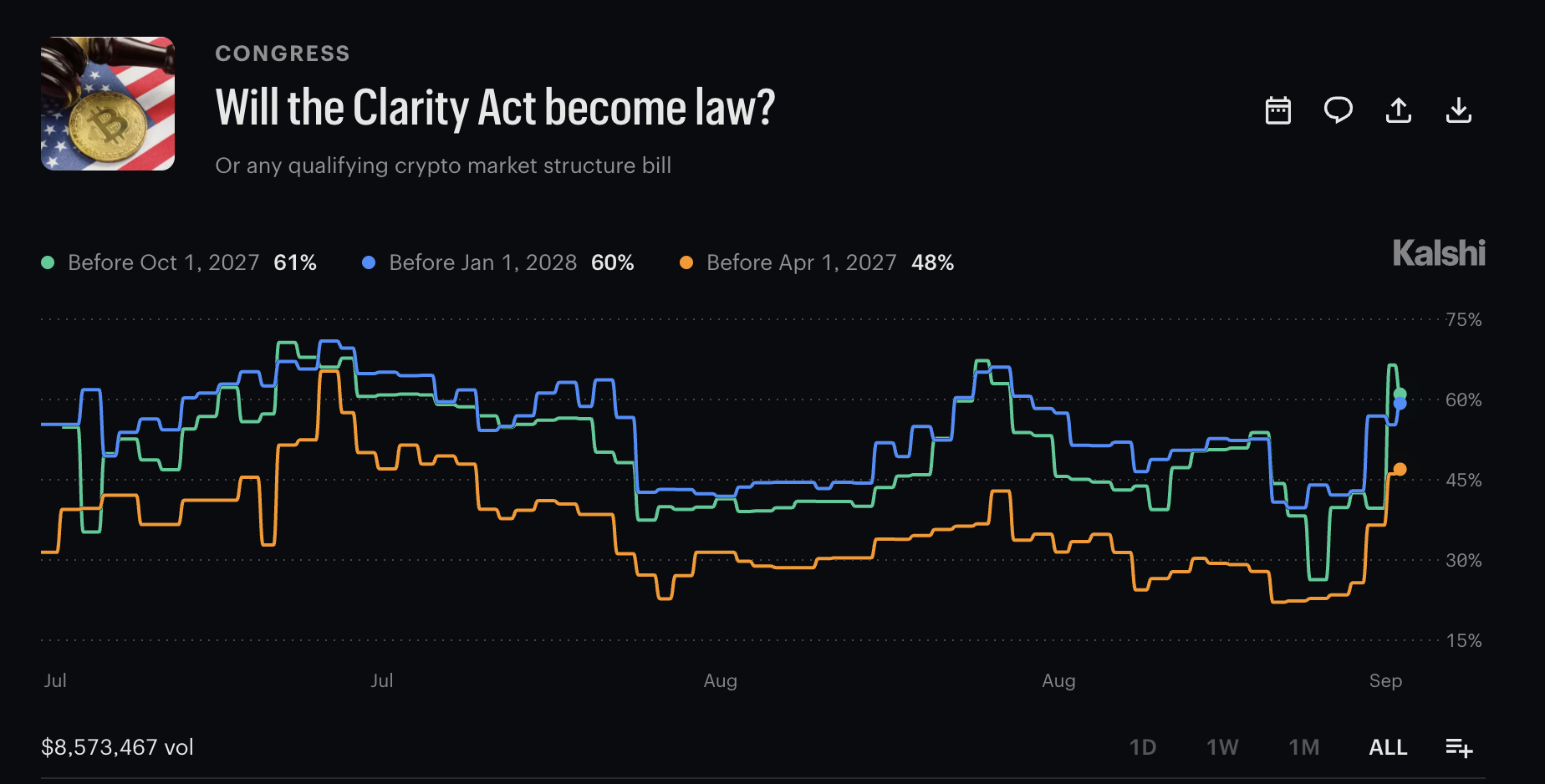
Additional information:The report also mentioned that Trump's financial disclosure for 2025 showed that his income from cryptocurrencies exceeded $1.4 billion, a considerable portion of which came from World Liberty Financial, USD1 stablecoins, and TRUMP tokens. This is also an important background for the Democrats to push for the inclusion of ethical clauses.