






Foreign media reports that Standard Chartered Bank has shifted its focus from Bitcoin and Ethereum to Arbitrum tokens ARB, and has provided a long-term forecast. The bank believes that as the large-scale unlocking phase approaches its end, the tokenized assets market expands, and on-chain revenues improve, the fundamentals of ARB are changing.
Target price set at $10 in 2030
The report mentions that analysts at Standard Chartered used models to estimate that ARB could rise from its current level of about $0.14 to $10 by the end of 2030. Based on this calculation, the increase would be approximately 7000%.
This line of thought suggests that the performance corresponding to this prediction will be significantly stronger than its judgment on the price increases of BTC and ETH within the same period. However, this conclusion is derived from institutional model extrapolations and represents a forward-looking perspective, not an established fact.
The phase of high pressure has entered a slowdown stage.
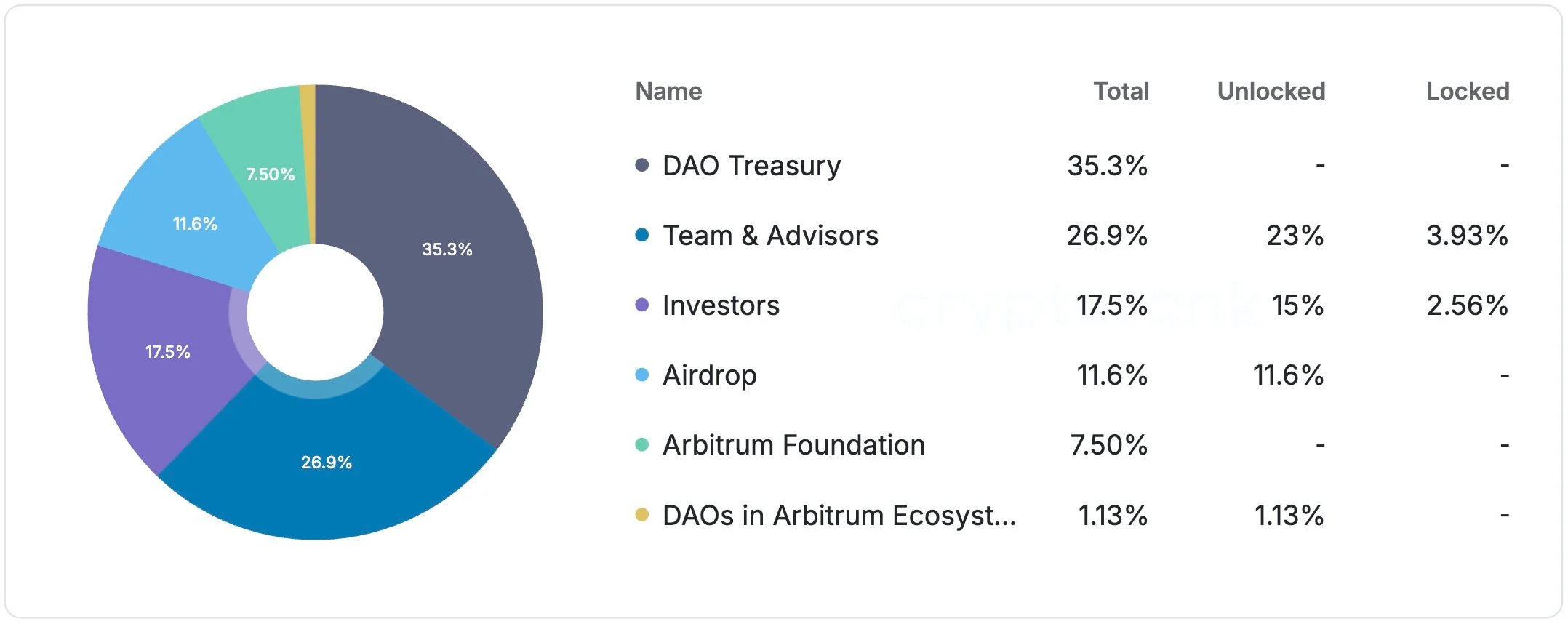
Over the past two years, one of the important reasons for the continuous pressure on the price of ARB has been token inflation. Reports show that the circulation of ARB has increased to 5.8 billion tokens, accounting for 58.45% of the total issuance. Currently, the market is still digesting the selling pressure brought about by linear unlocking; approximately 14.4 million ARB tokens enter the market each day, which, at the price mentioned in the text, is worth about 2 million US dollars.
- The current circulating supply is approximately 5.8 billion ARB.
- Accounts for approximately 58.45% of the total issuance.
- Approximately 14.4 million coins are unlocked linearly each day.
However, Standard Chartered believes that the most destructive phase of concentrated unlocking has passed, and the subsequent unlocking curve is expected to become more gradual. This means that the pressure of new supply on prices may be less intense than in the previous two years.
Robinhood Chain Drives Revenue Growth
The report lists the integration of Robinhood Chain and Arbitrum as a key catalyst. Standard Chartered believes that this collaboration has changed the revenue structure of Arbitrum. By September 2026, the monthly revenue of Arbitrum is said to have risen to 5 million US dollars, an increase of about 5 times from before; its sub-chain's daily transaction fees once exceeded 8 million US dollars at their peak.
Standard Chartered also expects that by 2028, the global tokenized assets market could reach $4 trillion. If this trend materializes, Arbitrum may continue to receive funding and demand from the asset tokenization business.
Value capture remains the main question.
Despite setting an optimistic target price, Standard Chartered also pointed out that ARB currently lacks a direct value capture path, and the token itself has not yet formed a clear mechanism for generating revenue. This means that increases in on-chain activity and protocol revenue may not necessarily be proportionally reflected in the token price.
In addition, competition and regulation remain two major risks. In terms of competition, Base supported by Coinbase is competing for similar ecosystem traffic; regarding regulation, the pressures related to CLARITY Act from the U.S. Securities and Exchange Commission (SEC) may also affect the valuation expectations of this sector.
Additional information:The report also mentioned that after the release of this forecast, ARB rose by 8.5% on that day, reaching 0.14350 US dollars during trading. Although there were profit-taking activities later on, the price still remained above 0.13800 US dollars.