






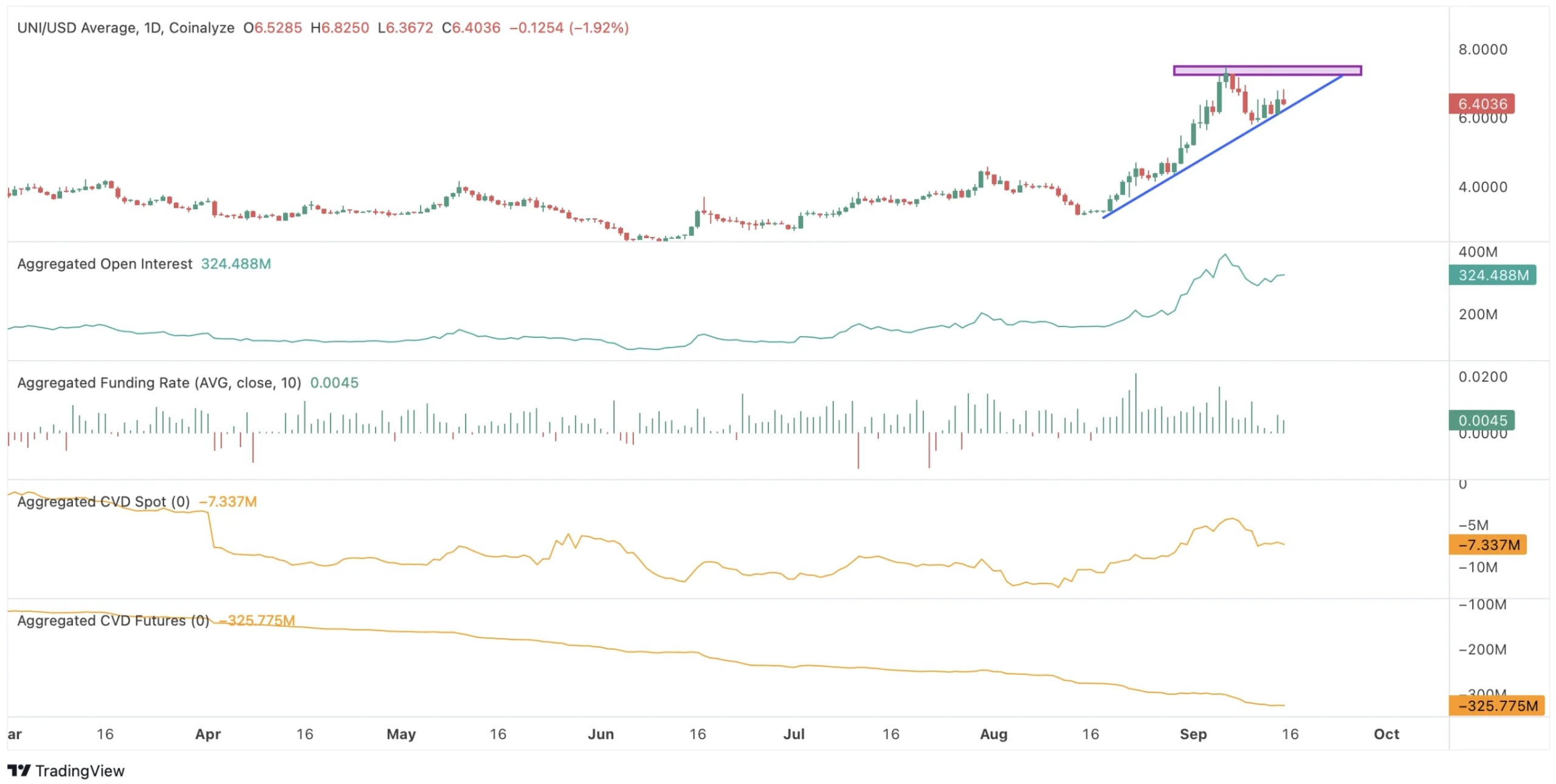
UNI has maintained a recovery trend since mid-August, with the price once rising to around $6.8 before falling back to around $6.4. It is currently still above the upward trend line, and the short-term structure has not weakened yet, but the resistance area above remains key in determining the subsequent direction.
$7.5 to $7.8 per dollar is a critical range.
The market's focus is on the range of $7.5 to $7.8. This level has seen selling pressure multiple times before. If UNI can hold this range at the daily time frame, there could be further room for a rebound; however, if it fails to break through for a long time, the price is likely to remain within the consolidation range.
Unclosed contracts rise to $324 million
Derivative data shows that the total amount of open contracts for UNI has risen to approximately $324 million, indicating that market participation is still increasing. At the same time, the funding rate is around 0.0045%, suggesting that bulls have a slight advantage, but the figure is not high, and there are no signs of obvious crowded trading yet.
This also means that the current rebound is not entirely driven by high leverage; the market is still waiting for clearer signals of capital follow-through.
Spot and futures CVD remain negative.
What is more noteworthy is the quality of the buying orders. The data shows that for UNI, the spot volume is approximately negative 7.3 million US dollars, and for the futures, it is approximately negative 325.8 million US dollars. This reflects that the active buying orders are still weak, and the recent rebound has not been supported by sufficient demand from the spot market.
If the price continues to approach $7.5 to $7.8, and the spot CVD does not improve accordingly, the continuity after a breakout may be insufficient, and the probability of a decline again near the resistance level will also increase. Looking below, $6 to $6.2 remains a support area that needs attention in the short term.