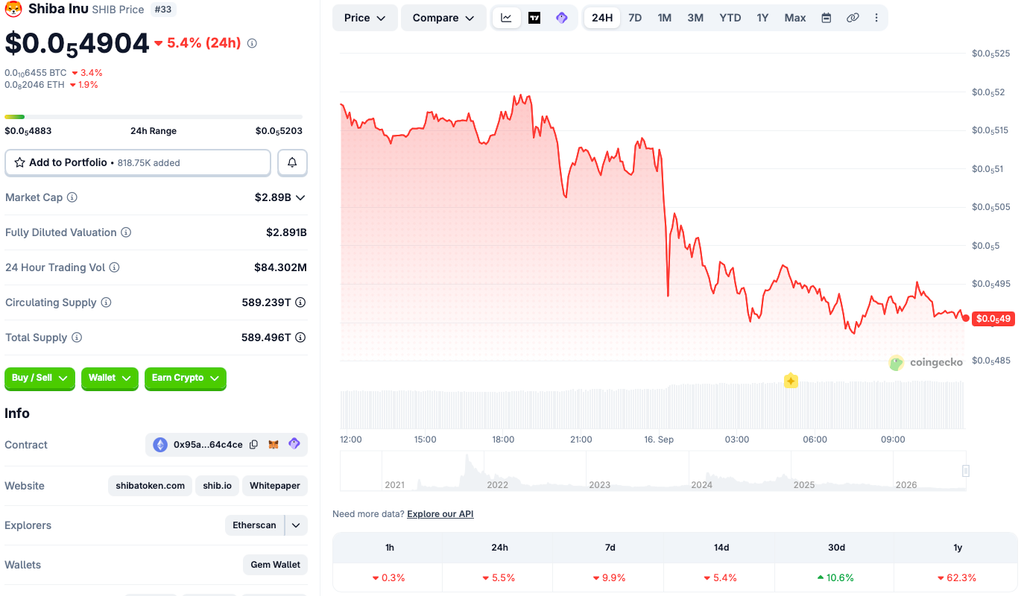







Shiba Inu has recently followed the overall weakness of the crypto market, with its price once again falling below the $0.000005 mark. Data shows that SHIB has declined by 5.5% in the past 24 hours and nearly 10% in the past 7 days. However, if we look at a period of nearly a month, its price has still risen by more than 10% in total.
The short-term decline is related to market sentiment.

The report suggests that this round of decline is first and foremost related to a cooling of market risk appetite. As a currency with significant volatility, SHIB tends to experience capital withdrawals more easily during periods of market stress. When risk assets as a whole weaken, funds often flow out of high-volatility assets first.
Judging from its recent performance, the decline of SHIB is basically in line with the broader adjustment in the crypto market, and it is not driven by news related to a single project. For such assets, changes in market sentiment often reflect in prices more quickly than fundamental factors.
Interest rate hike expectations bring additional pressure
The report also mentioned that expectations for a rate hike before the Federal Reserve's next FOMC meeting are rising, which is putting pressure on high-risk crypto assets, including SHIB. If interest rates continue to rise, investors typically reduce their allocation to high-volatility assets.
It is also mentioned in the text that the employment data for August, as well as the hawkish stance at the Jackson Hole Conference, are both seen as factors supporting expectations for higher interest rates. Against this backdrop, the downward pressure on the meme currency tends to be more pronounced.
- Past 24 hours: Down 5.5%
- Past 7 days: Down nearly 10%
- Past 14 days: Down 5.4%
The subsequent trend still depends on the broader market.
The report mentions that if the crypto market strengthens again by the end of 2026, SHIB could follow suit and rebound. The article cites a prediction by Bernstein that Bitcoin is expected to once again exceed $100,000. If this scenario occurs, the overall risk appetite in the market may rise, and SHIB could also benefit from it.
However, at this current stage, the short-term performance of SHIB still depends more on the overall market trend than on individual project catalysts.