

CoinMeta News: On September 17, Beijing time, the Federal Reserve raised rates by 25 basis points to 3.75%–4.00%. Bitcoin rose less than 1%, so why did Zcash surge 23% against the trend, with its price approaching $1,369? When traditional macro logic suggests rate hikes are bearish for non-yielding assets, why did privacy coins stage an independent rally? Is Zcash (ZEC) experiencing short-term sentiment or the beginning of a structural revaluation? As of press time, ZEC is quoted at $1,380.85, up 16.36% in 24 hours, with a market cap of $23.362 billion.
Table: Zcash Latest Key Data
| Data Item | Value |
|---|---|
| Price | $1,360–$1,380 |
| Market Cap | $21.4 billion, Rank 9 |
| Circulating Supply | 16.87 million ZEC |
| 24h Trading Volume | $2.5 billion |
| Shielded Transaction Share | 90% |
| Shielded Pool Size | 4.85 million ZEC |
| Hyperliquid Open Interest | $840 million, Ranked 4th on the platform |
| Grayscale ZCSH ETF AUM | Holds over 550,000 ZEC |
| SEC Investigation Status | Formally closed in January 2026 |
| Quantum Protection Roadmap | Full quantum protection targeted for 2027 |
Note: The above content is compiled by CoinMeta from publicly available market information. If there are any discrepancies, please refer to the actual data.
How Did the Crypto Market React to the Fed's 25bps Rate Hike?
After the Fed's rate hike landed on September 17, Zcash (ZEC) led the market with a 23.28% gain, briefly touching $1,385 intraday, a new all-time high. It was followed by Dash (DASH), up 17.21%. From a sector perspective, PayFi performed strongest overall, up 5.03% in 24 hours; Layer2 rose 4.91% (Lisk up 31.79%); Layer1 rose 3.71% (NEAR up 14.64%).
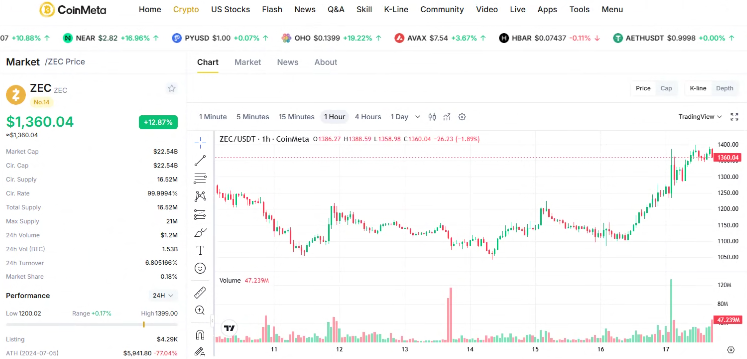
ZEC ranks 9th in the crypto market
In contrast, mainstream assets like Bitcoin and Ethereum saw modest gains. BTC rose 1.28% to break above $76,000, while ETH rose 1.63% to fluctuate around $2,400. This divergence shows that after the rate hike, funds did not flow into large-cap blue chips, but instead concentrated in the privacy sector and small- to mid-cap high-beta sectors.
Three Pillars Behind Zcash's Counter-Trend Rally
After the Fed's 25bps rate hike, why did ZEC outperform Bitcoin against the trend? Our in-depth analysis reveals that genuine demand for privacy, institutional access, and leverage expansion are jointly supporting this independent rally.
Genuine Demand in the Privacy Sector
Zcash's rally is not purely sentiment-driven. Its on-chain data provides a verifiable fundamental anchor.
On-chain data shows that as of July 2026, about 90% of Zcash transactions used the shielded feature, with approximately 4.2 million ZEC locked in the shielded pool, accounting for about 25% of circulating supply. In other words, more than one out of every four circulating ZEC is genuinely used by users for privacy transactions.
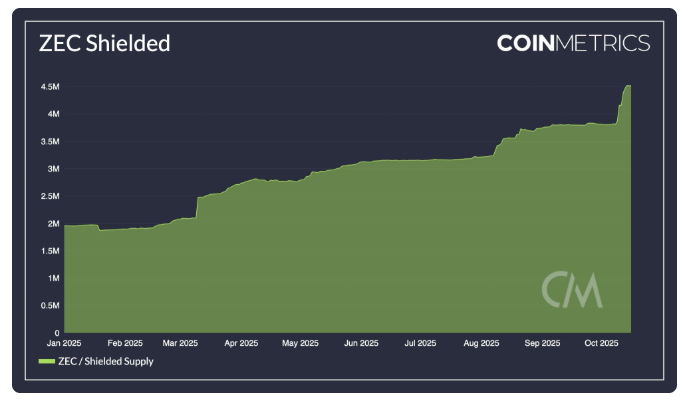
ZEC shielded pool
Bitcoin's ledger is like a public bulletin board that anyone can inspect; Zcash is like installing an "optional curtain" for transactions, letting users choose to be public or to conceal. In our view, this real usage is what distinguishes it from concept-driven tokens and is the fundamental anchor for this Zcash independent rally.
Institutional Access Opens
Zcash has cleared the regulatory hurdle.
In January 2026, the SEC concluded its long-term review of the Zcash Foundation without taking enforcement action, removing the biggest cloud hanging over ZEC. In August, Grayscale converted the Zcash Trust into an ETF product, ZCSH, listed on NYSE Arca. Just two weeks after listing, its assets under management surpassed $500 million, with cumulative inflows exceeding $70 million.
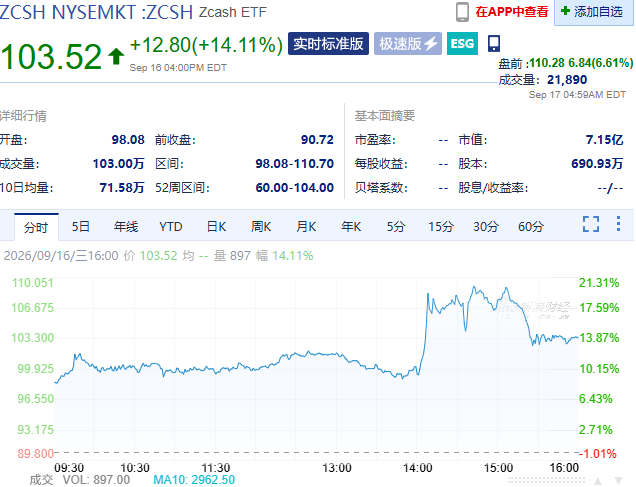
ZCSH latest price
Zcash has also received backing from top institutions. Paradigm co-founder Matt Huang publicly disclosed that the company holds ZEC. This shows us that Zcash, once a niche tool, has now become an option in institutional asset allocation. This is the fundamental reason institutional capital dares to enter.
The Double-Edged Sword of Leverage Expansion
The leverage wave in derivatives has added fuel to ZEC's rally. According to CoinMeta data, when ZEC's price broke above $1,000 in early September, perpetual futures open interest surged to a record high of about $2.4 billion, and a single move triggered over $34 million in forced short liquidations. The funding rate also flipped from negative to positive, holding around 0.0042%, indicating that longs are willing to pay to maintain bullish positions.
In our view, leverage is a double-edged sword.
ZEC perpetual open interest at its peak accounted for about 14% of circulating market cap. Once the price pulls back, the chain reaction comes quickly. As of September 17, ZEC open interest on Hyperliquid surged again to $840 million, up 60% in 24 hours, ranking fourth on the platform. Whether the rally can hold depends on whether spot buying can absorb the retreat of leveraged funds.
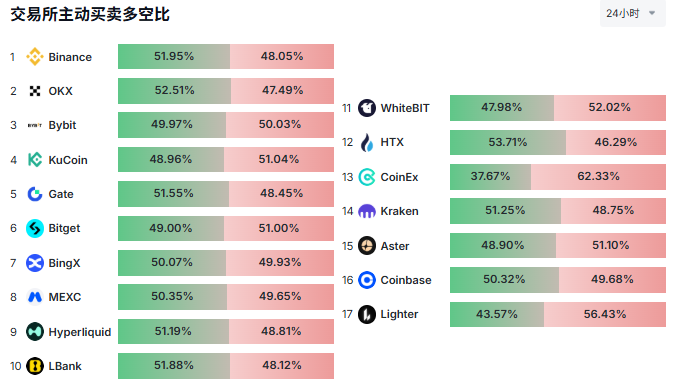
ZEC exchange long-short ratio
How Far Can Zcash Go?
Against the backdrop of the Fed's 25bps rate hike and Zcash's 23% counter-trend rally outperforming Bitcoin, how far can it go? In our view, this can be divided into short-term and long-term scenarios.
Short-Term Forecast
We recommend watching two hard on-chain metrics: the share of shielded transactions and how much ZEC is locked in the shielded pool.
As of September 2026, about 4.89 million ZEC is locked in the shielded pool, accounting for nearly 29% of circulating supply. A year ago, that ratio was only about 23%. The shielded transaction share has also stabilized at a high level of 90%, showing that privacy is not just a story. People are actually using it. As long as these two metrics continue to rise, Zcash's independent rally has solid support. Conversely, if usage stalls while leverage keeps expanding, pullback pressure will increase significantly.
Long-Term Forecast
Looking further ahead, we believe Zcash and Bitcoin are not substitutes for each other, but each serves a different purpose.
Bitcoin solves "digital scarcity," while Zcash fills in "transaction privacy." We note a calculation in a Grayscale report worth attention: Zcash currently accounts for only about 0.6% of the "monetary crypto asset" sector. If privacy demand pushes this share to 5%, ZEC's market cap theoretically has room for several-fold growth. Of course, this is a scenario projection, not a price promise.
FAQ
Q1: Will Zcash's price definitely rise after spot ETF approval?
Not necessarily. ETF approval provides a compliant entry channel, but price is affected by multiple factors including the scale of fund inflows, the macro environment, and profit-taking pressure. Grayscale's ZCSH surpassed $500 million in assets two weeks after listing, but actual demand still depends on whether shielded transactions can continue to grow.
Q2: Can the independent rally of privacy coins continue in a Fed rate hike environment?
It may not continue. In this ZEC rally, derivatives open interest nearly doubled to $1.8 billion. High leverage amplifies gains while also accumulating pullback risk. The sustainability of the rally depends on the ratio of spot demand to leveraged speculation.
Q3: Does Zcash face delisting risk at the regulatory level?
There is regional risk, but it is generally manageable. Dubai has banned exchanges from using privacy tokens, and EU AMLR Article 79 will prohibit licensed venues from providing anonymized asset services starting July 2027.
Conclusion
In our view, after the Fed's 25bps rate hike, Zcash's 23% counter-trend rally outperforming Bitcoin is the result of genuine privacy demand, institutional access, and leverage resonance. How far it can go depends on on-chain verifiable metrics such as the shielded transaction share and shielded pool size. In an era of digital finance where AI surveillance capabilities are increasingly powerful, whether privacy can return as a "core attribute of money" will ultimately determine Zcash's value ceiling. And this question can only be answered by real usage data.
Disclaimer: Readers are advised to strictly comply with the laws and regulations of their location. This content is based on publicly available market information and is for informational and educational purposes only. It does not constitute investment advice. For the latest updates, follow CoinMeta.