

In 2026, gold entered its strongest bull market cycle in two decades. In the first quarter of 2026, tokenized gold spot trading volume reached $90.7 billion, surpassing the full-year 2025 total of $84.6 billion. Meanwhile, the USD stablecoin market saw its total supply contract by over $14.6 billion from its peak due to new regulations prohibiting outflows. This article will break down PAXG's peg mechanism, real risk performance, and the essential differences between gold-backed and USD stablecoins.
Table: Overview of Latest Key PAXG Data
| Data Dimension | Specific Value |
|---|---|
| Current Price | ~$4,339 |
| Circulating Supply | ~434,000 PAXG |
| Market Cap | ~$1.88 Billion |
| 24h Spot Trading Volume | ~$149 Million |
| 30-day Spot Trading Volume | ~$205 Million |
| Total Gold Reserves | 184,251.761 Troy Ounces |
| Tokenized Gold Market Share | 41.8% |
| All-Time High | $5,622.80 |
Note: The above content is compiled and summarized by CoinMeta based on public market data. Please refer to actual data if there are any discrepancies.
What is PAXG?
PAXG is a tokenized gold product issued by Paxos Trust Company. It is regulated and backed by physical gold. Each PAXG token corresponds to one fine troy ounce of London Good Delivery gold bars. These bars are stored in LBMA-approved vaults in London and are held in segregated custody specifically for the benefit of PAXG holders.
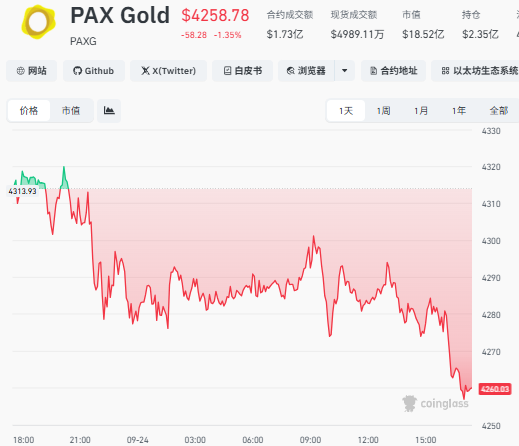
Image: Latest PAXG Quote
In August 2026, Paxos also launched a real-time gold bar allocation system, reducing the processing time for binding tokens to specific physical gold bars from roughly two hours to an average of 1.24 milliseconds.
What is the Difference Between PAXG and USDT?
In our view, the most fundamental difference lies in what they peg to: PAXG is pegged to the spot price of gold, while USDT is pegged to 1 US dollar. This means PAXG's price fluctuates with the gold price, whereas USDT aims to always trade close to $1.
| Comparison Dimension | PAXG (Pax Gold) | USDT (Tether) |
|---|---|---|
| Issuer | Paxos Trust Company | Tether Limited |
| Regulatory Framework | Holds a US OCC national trust bank charter | Offshore registration; historically lacked comprehensive audits |
| Pegged Asset | Physical Gold | USD and equivalent reserve assets |
| Audit Frequency | Monthly attestations by KPMG | Completed first annual comprehensive audit in 2026 |
| Direct Redemption Threshold | 430 PAXG | $100,000 minimum |
| Market Cap | ~$1.88 Billion | ~$183.4 Billion |
| Average Monthly Spot Trading Volume | ~$5.72 Billion | Daily on-chain transfer volume in the hundreds of billions |
| Price Behavior | Fluctuates with spot gold prices | Aims to always peg to $1 |
| Role in DeFi | Can be used as collateral | Base currency for major trading pairs |
From the table above, we can see that PAXG's physical gold backing and monthly attestations provide transparency that USDT struggles to match, at the cost of poor liquidity and high redemption thresholds.
Is PAXG Stable?
As of September 2026, PAXG's circulating supply is approximately 434,000 tokens, with a market cap of about $1.88 billion. Let's look at PAXG's actual performance during extreme market conditions.
The 2026 "Warsh Shock" provided a real stress test for PAXG. During an extreme market event where gold plunged over 11% in a single day and silver plunged 31.4%, both PAXG and XAUT tracked the spot price decline almost instantly, with no significant depeg, oracle failure, or cascading forced liquidations. RedStone's report characterized this performance as tokenized gold passing its first major DeFi stress test.
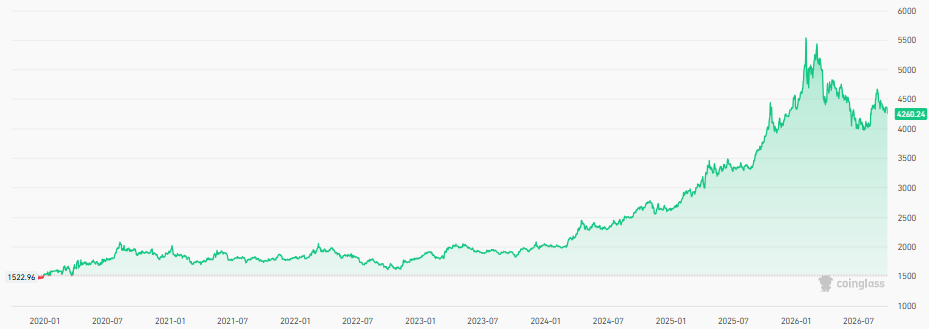 Image: PAXG Overall Price Performance
However, there is a structural risk in PAXG that we believe cannot be ignored, directly related to its issuer, Paxos.
In 2023, the New York State Department of Financial Services ordered Paxos to stop minting BUSD due to unresolved issues in Paxos's supervision of its relationship with Binance. With this precedent in place, we believe this is a variable that PAXG holders need to continuously monitor.
Another data point is also worth noting: PAXG and XAUT together control about 97% of the tokenized gold market. This highly concentrated structure means that if either party encounters problems, the entire niche sector will be affected. In our view, PAXG has proven its technical resilience in stress tests, but its risks lie not on-chain, but in off-chain regulatory decisions and industry concentration.
Is Gold-Backed Really More Reliable Than Stablecoins?
Is gold-backed really more reliable than stablecoins? To answer this, we need to break it down from several core dimensions.
Different Peg Logic
USD stablecoins maintain their price through the issuer's promise to redeem 1 US dollar, but direct redemption is usually only available to large institutional users. PAXG's peg is based on auditable physical gold, and holders can query the serial number of their allocated gold bars through the Paxos platform at any time. In our view, the anchor of trust is completely different.
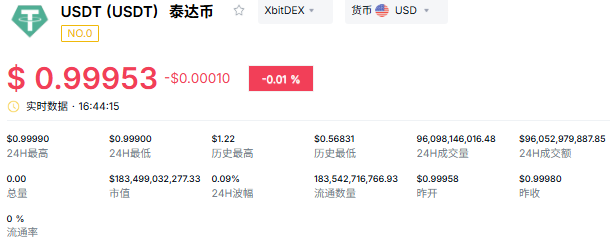
Image: Latest USDT-Related Data
Different Transparency and Verifiability
PAXG has monthly attestations from KPMG and annual physical audits from Bureau Veritas, making the cost of fraud extremely high. In contrast, in March 2023, USDC's price briefly dropped to $0.87 because $3.3 billion of its reserves were held at the failed Silicon Valley Bank. This kind of trust chain rupture risk is relatively controllable for PAXG. We believe that PAXG's audit frequency and physical verification mechanism indeed give holders a stronger sense of security.
Stark Liquidity Gap
This is PAXG's most obvious weakness. Over the past 15 months, PAXG's average monthly spot trading volume was approximately $5.72 billion; in contrast, the entire USD stablecoin market's daily net transfer volume is in the hundreds of billions of dollars. In Q1 2026, only $63 million worth of XAUT and PAXG were used as collateral on Aave v3 and Morpho, accounting for less than 1.5% of the $4.2 billion market cap. In our view, insufficient liquidity means that large capital inflows and outflows may face significant slippage costs, which is an obstacle PAXG will struggle to overcome in the short term.
Different Types of Regulatory Risk
USD stablecoins face the trust problem of "whether reserves are sufficient," while PAXG faces the policy problem of "whether regulators will allow it to continue operating." We believe that while the latter has a lower probability of occurring, its impact is more fatal once triggered.
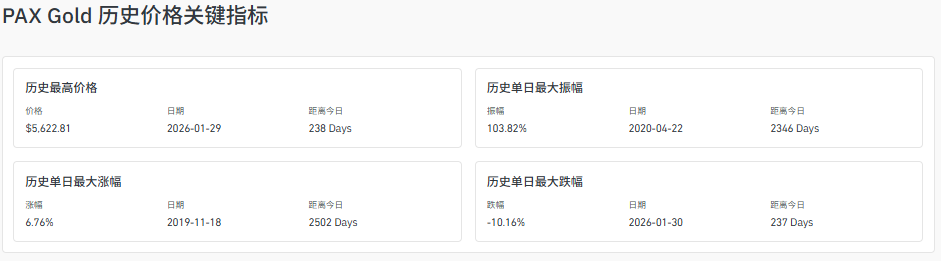
Image: PAXG Historical Price Indicators
Therefore, in our view, gold-backed and USD stablecoins solve different problems, and it is not accurate to simply say which is more reliable. If what you need is a store of value resistant to depegging, PAXG's physical backing and audit transparency are indeed superior to fiat stablecoins. But if you need a high-frequency trading medium or DeFi collateral, PAXG's current liquidity and ecosystem depth are far inferior to USDT and USDC.
FAQ
Q1: Will PAXG tokens definitely follow the gold price up?
Not necessarily. PAXG is pegged to the spot gold price, and when the gold price falls, PAXG falls in sync. During the 2026 "Warsh Shock," gold plunged over 11% in a single day, and PAXG tracked the spot price decline almost instantly without depegging, but holders also suffered proportional paper losses.
Q2: Is PAXG more suitable as a safe-haven asset than USDT?
It cannot be generalized. PAXG's physical gold backing and monthly KPMG attestations make it more transparent at the "trust level," but USDT can handle hundreds of billions of dollars in daily transfers, with liquidity far exceeding PAXG's average monthly spot trading volume of $5.7 billion.
Q3: Is PAXG's gold redemption threshold high?
Yes, it is high. According to the PAX Gold terms, redeeming a full London Good Delivery gold bar directly from Paxos requires holding 430 PAXG, which at current prices is approximately $1.9 million. Holders below this threshold can only sell tokens on the secondary market or use partner retailers for small-amount exchanges.
Conclusion: Reliability Depends on Your Needs
Is PAXG stable? In our view, in terms of peg accuracy, it is stable, faithfully tracking the gold price during stress tests without depegging. Is gold-backed more reliable than stablecoins? In terms of resisting trust crises and transparency, physical gold backing does have structural advantages, but in terms of liquidity, DeFi adoption, and regulatory flexibility, it is far inferior to USD stablecoins.
Our advice to ordinary investors is: choose tools based on your own needs, rather than expecting a single asset to excel in all dimensions.
Disclaimer: Readers are strictly advised to comply with local laws and regulations. This article is compiled based on public market data for reference and educational purposes only, and does not constitute investment advice. Follow CoinMeta for the latest updates.