Tesla has just obtained a patent named “Electric Fan Car”. This system uses four electric duct fans installed in the rear diffuser to press the vehicle towards the road surface at any speed. The vehicle model depicted in the patent drawings is Model S, which Tesla ceased production of in April.
Four fans in the rear diffuser
The United States Patent and Trademark Office granted US patent number 12,746,987 today. Tesla filed for this patent in January 2024, but it can be traced back to a provisional application dated January 17, 2023. The patent lists 8 inventors, all of whom, except for one, are located in the Los Angeles area, which is where Tesla's design studio in Hawthorne is situated.
The idea is quite simple. There is an air inlet in the middle of the underside of the car, between the rear wheels. Air is drawn into a duct that extends upwards to a wide outlet in the rear diffuser. Four axial flow fans are installed side by side at this outlet, separated by three vertical partitions. As the fans rotate, they draw the air from beneath the car and expel it from the rear of the vehicle.
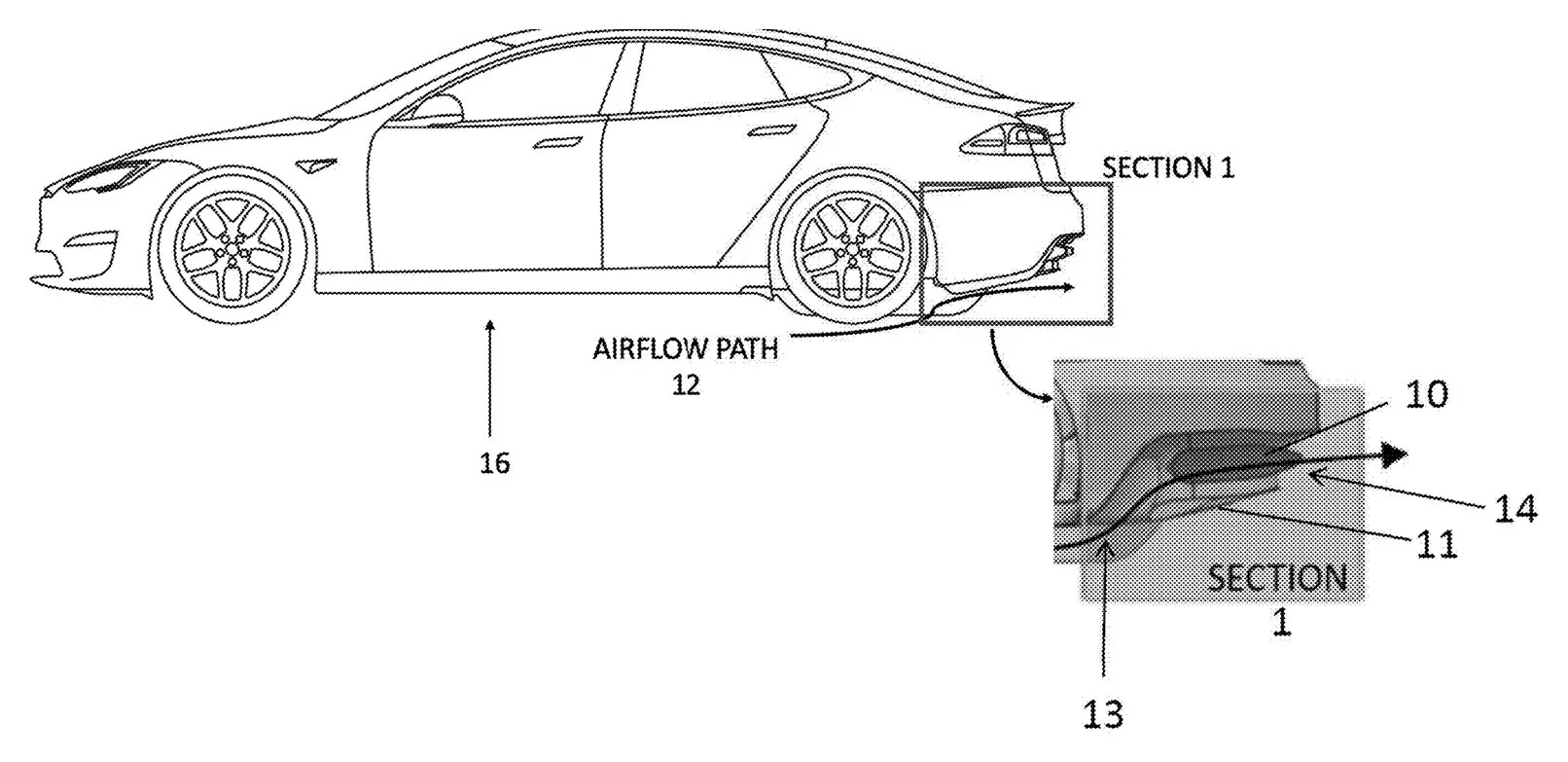
Tesla claims that this creates a "suction area" under the car, which is essentially a vacuum. There is also an inclined plate at the rear of the car that serves as a secondary diffuser.
Tesla's selling point is that it has nothing to do with speed. The document states that passive diffusers can limit downforce at low speeds and "often cause excessive load at high speeds." Tesla claims that these fans "can generate downforce that is independent of the vehicle's speed," which helps with braking stability and cornering speed.
There is also a clever detail. In the second version, two smaller lateral air inlets were added behind the main air inlet. Tesla believes that the central air inlet tends to pull the air behind the car forward, rather than drawing it in from beneath the car. This backflow does not increase downpressure, and Tesla claims that the fans would ultimately be “wasting power” on this portion of air.
The power comes from the same set of high-voltage batteries that drive the wheels, so the fan does not require a separate motor or battery, and it is integrated into the vehicle's control system. The driver can manually activate it by pressing a button, or it can be automatically activated by the vehicle at certain speeds.
Painted on a Tesla that is no longer in production.
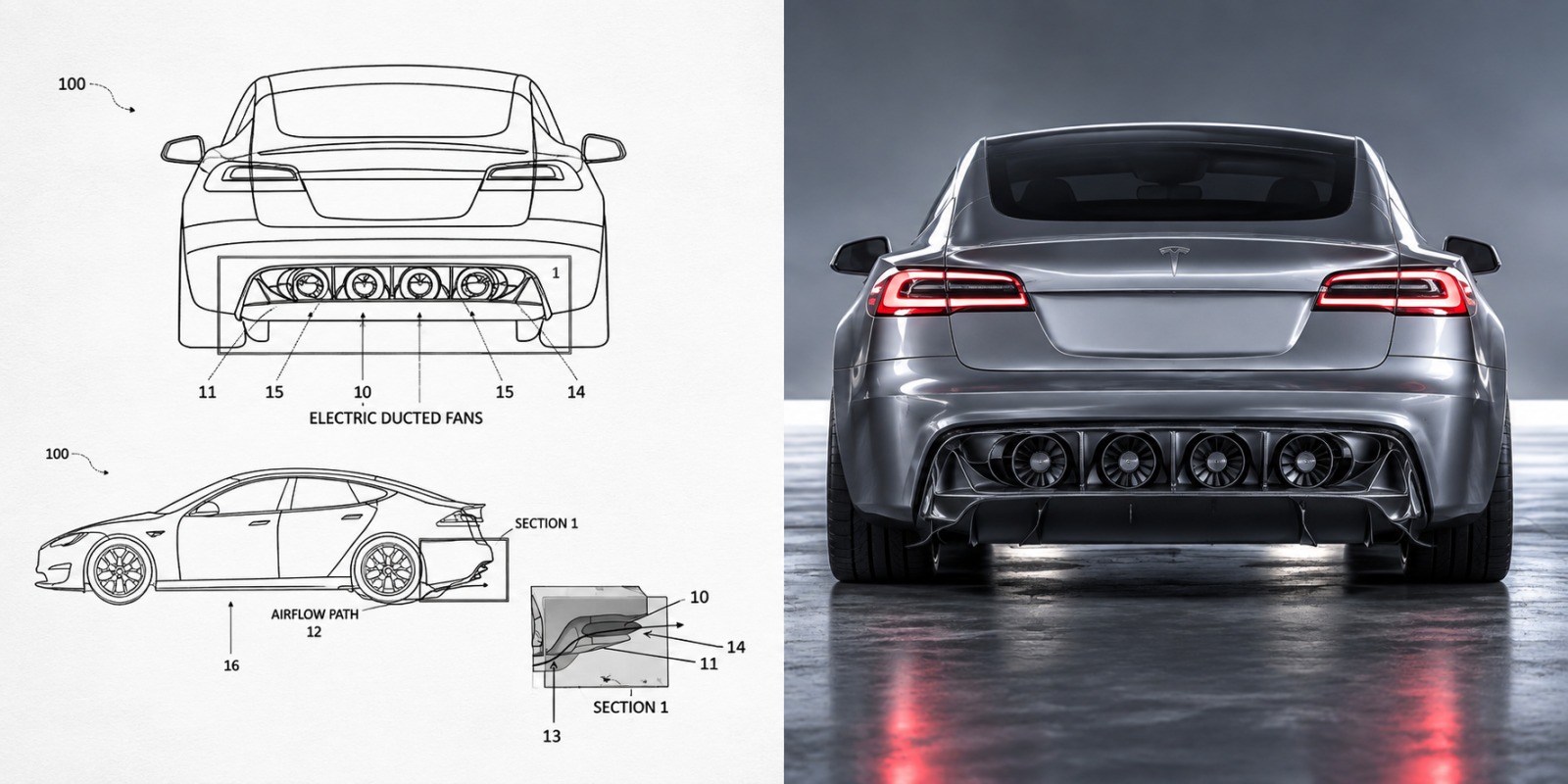
It's easy to recognize Model S in these drawings. The hatchback roof line, taillights, lip-shaped spoilers, and door handles are all there.
At the beginning of 2023, when Tesla submitted a temporary application, such a move made sense. Model S Plaid was still Tesla's performance flagship at that time, and a track version with fan assistance would have been an interesting model. However, Tesla ended the production of Model S and Model X in April, and the production line that had been in operation for 14 years will now shift to Optimus. Therefore, this path is no longer feasible.
That leaves only Roadster left – Tesla’s current sole performance car in its pipeline. Last week, we reported on another Tesla patent: a set of hidden active rear wings that can provide up to 700 kilograms of downforce. The drawings showed a car that looks just like the new Roadster. In August 2025, Tesla also obtained another patent for a fan-based car design, which uses undercarriage fans and deployable side skirts. Together, the fans and active rear wings form a complete aerodynamic package for racing tracks, and Roadster is currently the only car that can be equipped with this system.
Fan cars are not something new.
None of these are new. Chaparral competed in 1970 with a 2J racing car that used two fans powered by independent snowmobile engines. BT46B, driven by Niki Lauda, won the 1978 Swedish Grand Prix but was immediately withdrawn afterward. Gordon Murray, on the other hand, installed a 400-millimeter fan at the rear of his T.50 road car.
In the field of electric vehicles, McMurtry has been doing this for many years. Its Sp irling broke the Goodwood Hill Climb record in June 2022, about 7 months before Tesla submitted its temporary application. It is capable of generating a downward force of 2,000 kilograms even when at rest and can even be driven in reverse. McMurtry began delivering the Sp irling PURE earlier this year, which is priced at $1.36 million. Its fan is also powered by the main battery.
The main difference with Tesla is that its design does not require sealing the vehicle to the ground with side skirts. The document states that these fans can operate “without the need for additional components under the vehicle” and are integrated into a diffuser that looks normal.
Views of Electrek
This is a decent patent, but electric fan vehicles have already existed for some time; they are on the market, and McMurtry has long been significantly ahead. Placing the fan inside the diffuser instead of using side skirts is one packaging option. Without side skirts, it's hard to see how Tesla could come close to the 2,000-kilogram downward pressure achieved by Sp é irling.
The drawings of Model S are more illustrative than the patent claims. It is evident that Tesla was indeed working on a track-oriented Model S in 2023. That model is no longer around, so now the focus has to shift to Roadster. Together with this patent, last year's patent for side skirt fans, and last week's patent for a 700-kilogram rear wing, Tesla has accumulated a real set of tools for track aerodynamics. This is much more practical than relying on SpaceX propellers to achieve vehicle suspension.
Will we see fans on October 15th, or will we only see propellers?
Whether or not your next electric vehicle is equipped with a fan at the rear, powering it with home solar energy can bring the fuel costs down close to zero. Last year, electricity prices rose by nearly 10%, and it is expected to continue to rise. Switching to solar energy is one of the best ways to counter these increasing costs. Moreover, through leasing and power purchase agreement schemes, you can start with no down payment and begin saving money immediately. If you want to find the most cost-effective option, you can check EnergySage. This is a free service, and hundreds of pre-approved installers are competing for your business, so you can save 20% to 30% compared to searching on your own. There will be no sales calls before you choose an installer. Click here to get a free quote.
FTC: We use automated affiliate links that involve an income component. For more information.