


ARR and income may sound like they can be interchanged, but they actually measure very different things.
For SaaS companies, as well as an increasing number of AI companies, annual recurring revenue (ARR) is a forward-looking business indicator used to estimate the annual value of subscriptions or contracts. In contrast, revenue refers to the amount actually recognized by the company during a specific accounting period.
This difference is important because rapidly growing private companies tend to emphasize the ARR or annualized revenue growth rate before investors see the audited annual financial reports.
Stripe defines ARR as a component of recurring revenue measured on an annual basis, which typically includes subscriptions and other predictable contractual revenues.
What is ARR?
ARR measures the annualized value of recurring business.
For a simple SaaS company, the calculation method may be quite straightforward:
ARR = Monthly recurring income × 12
If a company has $100 million in recurring subscription revenue per month, then its ARR will be $1.2 billion.
ARR typically does not include one-time implementation fees, consulting projects, or other non-recurring revenues. The purpose is to demonstrate to what extent the company's predictable subscription base has expanded.
This is also why ARR is particularly useful for the business of SaaS, as customers usually pay on a monthly or annual basis to continue using the software.
As corporate clients sign longer-term contracts for models, API, and office products, AI companies are also increasingly using similar metrics.
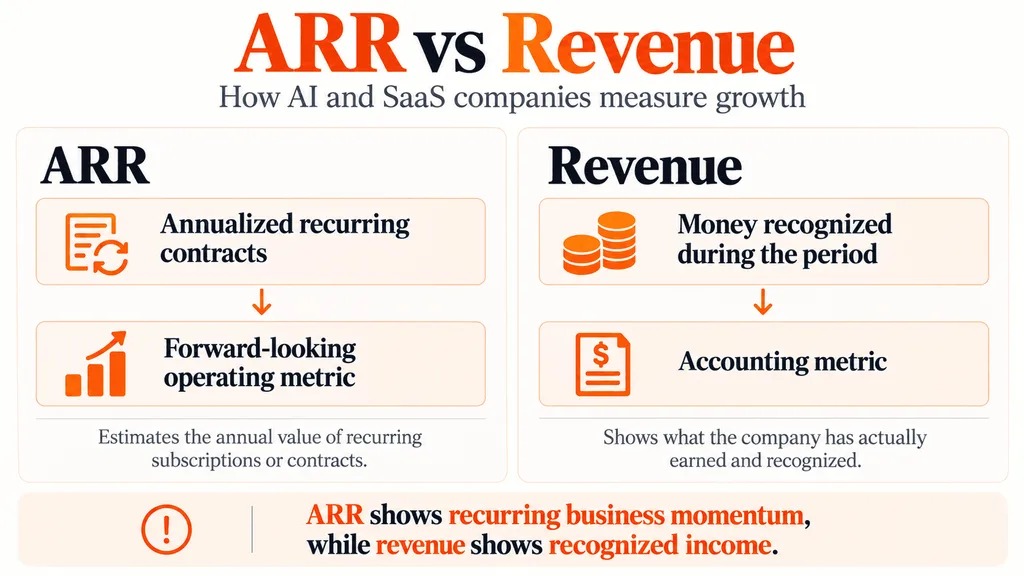
Revenue is in accordance with accounting rules.
Income varies because it is recognized in accordance with accounting standards.
According to ASC, companies typically recognize revenue when fulfilling their obligations to customers. For SaaS subscriptions, this generally means recognizing revenue over the duration of the contract, rather than recording the full contract value at the time of signing.
Assume a customer signed a one-year software contract worth $120,000.
This contract may immediately contribute $120,000 to ARR, as it represents $120,000 in annual recurring business.
However, accounting revenue may be recognized at approximately $10,000 per month as services are delivered.
This is why during a period of rapid customer growth, the growth rate of ARR may be much faster than the reported revenue.
ARR may also refer to the revenue operation rate.
There is another complexity: sometimes companies use “ARR” to represent the annualized revenue operating rate, which is not the same as the annual recurring revenue.
The revenue operation rate takes the most recent sales data – usually for a month or a quarter – and extrapolates it for the entire year.
For example, a company that generates $5 billion in revenue in one quarter may be described as operating at an annualized revenue rate of $20 billion, even though not all of that revenue is recurring.
This distinction is particularly important in the field of AI.
For example, Anthropic recently disclosed that its annualized revenue operating rate is approximately $65 billion. This figure is intended to show the company's current growth rate, rather than how much revenue it has earned in that particular year.
Adrian Cole
Adrian Cole has been engaged in financial market reporting for over 6 years, with a focus on cryptocurrencies, stocks, and macroeconomic trends. He tracks Bitcoin, major altcoins, the U.S. stock market, interest rates, commodities, as well as data that drives market changes. Over the years, he has written hundreds of market updates and analysis articles, with an emphasis on price trends, investor sentiment, and the connections between traditional finance and digital assets.