

If you now call for a Uber, you might have to wait even longer, and it will also cost you more money.
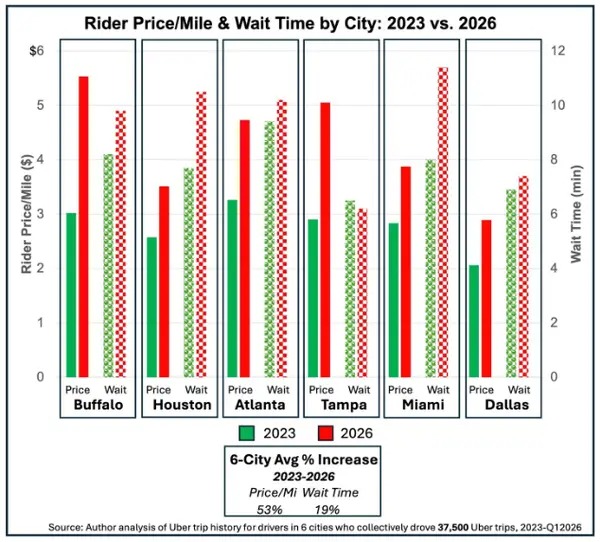
A new analysis by Lynn Sherman, a full-time executive and part-time professor at Columbia Business School (Len Sherman), shows that from the first quarter of 2023 to the same period this year, the waiting time for passengers after Uber matched drivers until the vehicle arrived increased by 19%.
The analysis also shows that during the same period, the average price per mile charged by Uber to passengers increased by 53%.
"You charge more, yet you offer less, and the service is even deteriorating," Sherman said in an interview with Business Insider. Sherman released findings regarding wait times and prices in a new report on Wednesday.
Uber A spokesperson stated, "This analysis relies on several inaccuracies, which we have publicly refuted." The spokesperson refused to comment on Sherman's specific findings regarding waiting times and cost per mile.
The spokesperson also recommended to "Business Insider" a blog post published by the company in January this year. The post stated that the claim that "the only reason Uber is able to make a profit is by raising prices and taking a larger share of the fare" is "incorrect."
These data once again illustrate that over the past decade, Uber has undergone changes for passengers.
Uber used to be one of those startups that relied on burning money to acquire users, but in recent years, it has relied more on its pre-priced strategy to generate profits. Sherman previously argued that this is usually achieved by charging passengers higher fees while paying drivers less compensation.
Scherman studied 37,500 trips completed by drivers in 6 cities in the United States, with data coming from GigU. This is an app that displays drivers with their estimated earnings per minute and per mile before they accept a order. The results show that waiting times increased in 5 of the 6 cities, including Atlanta, Dallas, and Houston.
The waiting time in the sixth city – Tampa, Florida – has slightly decreased.
Scherman stated that these data do not include the time passengers spend waiting for a driver to be matched for them by Uber, as he is using data from the driver side. After a passenger initiates a ride-hailing request, Uber sends the order to nearby drivers, and the compensation offered is usually not the same for each driver.
Scherman said that this process could result in passengers having to wait a few more minutes. “By definition, this is an underestimation,” he said.
Scherman stated that by prolonging waiting times and raising prices, Uber is taking a risk of damaging customer relationships. He also mentioned that the rise of AI agents means that passengers can more easily compare prices with competitors Lyft or local alternative services.
Scherman's research also mentioned the 2026 Axios Harris Poll 100 list, which ranks large companies based on their reputation. This year, Uber ranked 72nd, down from 58th in 2025; its scores in indicators such as trust, character, and ethics have all declined.
"This is a company that has clearly lost the trust of its customers, passengers, and drivers in its behavior," Sherman said.
Another study earlier this year also showed that there were significant differences in the commercial insurance and operational fees of Uber among what appeared to be identical trips.