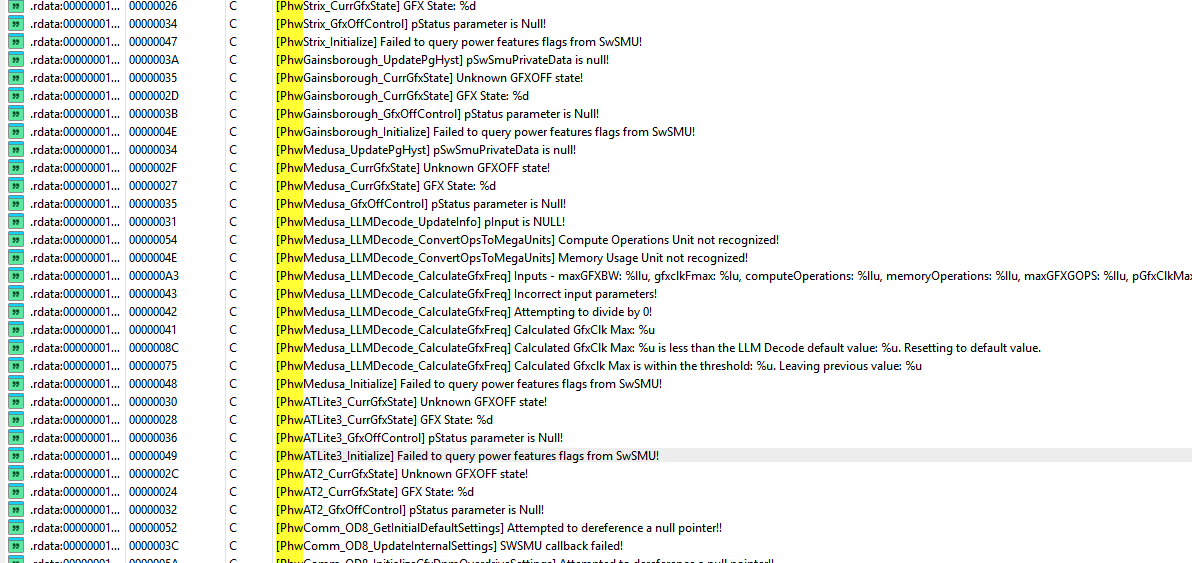
News from the IT community on October 1st: AMD released the latest Adrenalin 26.9.2 graphics card driver on September 29th local time. Within this driver's Import / Export database files, an unknown chip code “Gainsborough” was discovered.
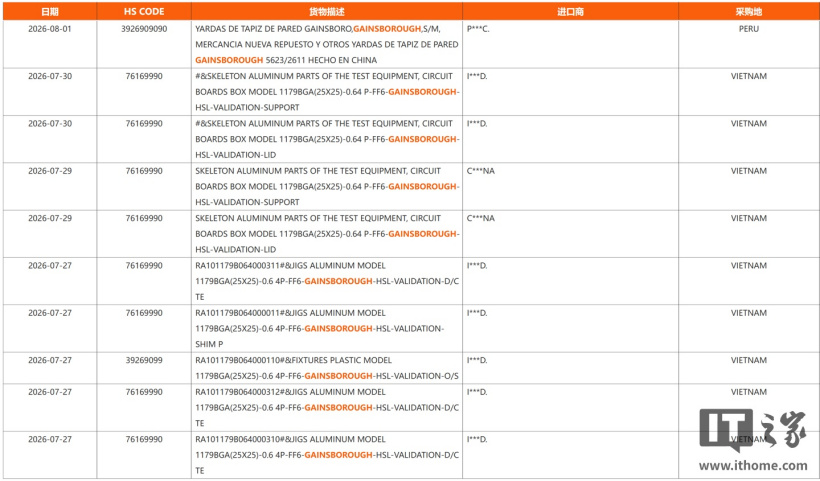
After cross-referencing with the customs import and export records of NBD Data, it was found that the testing equipment equipped with Gainsborough was shipped from Asia multiple times at the end of July. Customs records show that Gainsborough is packaged using BGA FF6 and has a total of 1179 contacts.
Blogger Moore's Law is Dead pointed out that this packaging specification is similar to the custom APU specification carried by the existing Steam Deck OLED. Therefore, he guessed that this might be the custom chip for Steam Deck 2.
The customized SoC equipped with Steam Deck OLED is codenamed “Van Gogh” and belongs to the same naming system as “Aerith”. The whistleblower Kepler_L2 indicated that Gainsborough happens to be Alice's surname.
IT Note: The standard version of the first-generation Steam Deck is customized, with the code name " Aerith ", while " Aerith Gainsborough " is the full name of "Alice Gainsborough" in "Final Fantasy 7".
Moore mentioned in the video that Gainsborough is a semi-custom APU designed by the AMD S3 team, which has previously been involved in the development of PlayStation related chips.
In terms of specifications, the leaker predicts that Gainsborough may adopt TSMC's N3P manufacturing process, which is suitable for handheld devices; CPU may consist of 4 to 8 Zen 6-core processors, and GPU may have 12 to 24 RDNA computing units.
It is also mentioned that Sony's handheld chip code " Kynis " uses the same N3P manufacturing process; whereas the PS6 home console chip " Helix " employs the N3C manufacturing process.
It is currently unclear why AMD has included a custom chip designed for Linux / SteamOS in the Windows driver. One theory in the industry is that it is "for testing purposes."
Valve has previously discussed Steam Deck on multiple occasions. On September 15, 2026, Valve designer Pierre - Loup Griffais stated in an interview with IGN that the team is still evaluating when and in what form to launch the next generation of devices. He said that what Valve expects is not a minor improvement in performance, but a generational leap that users can clearly perceive, while also needing to achieve a balance between price, performance, and battery life.
Another engineer, Jeff Lin, also confirmed in a concurrent interview that the development work for Steam Deck 2 is still ongoing, and the fluctuations in memory supply 'have not truly' affected the company's plans.
At present, neither AMD nor Valve has officially confirmed the actual purpose of the Gainsborough chip. The above specifications are all from third-party leaks, and there are still variables regarding the final product form.