

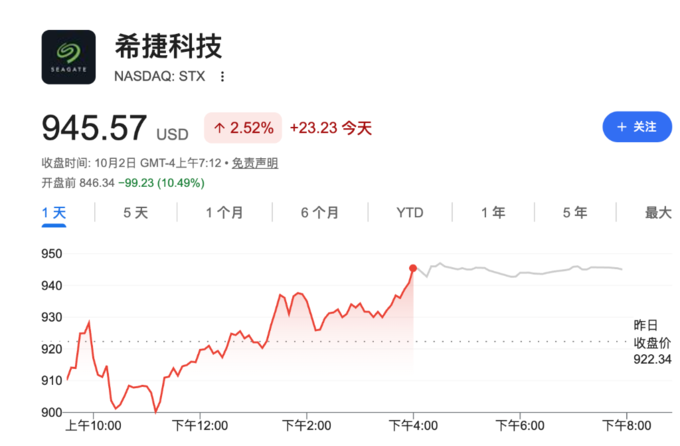
Seagate Technology's stock price fell by more than 10% before the market opening, prompting the market to re-evaluate the supply and demand dynamics in the AI data center storage market.
On October 2nd, according to Nikkei, Toshiba announced plans to invest approximately 60 billion yen in expanding its factory in the Philippines HDD, and aims to double the hard drive production capacity for the AI data center by the fiscal year 2027. For Seagate, this means that while the storage demand in AI continues to grow significantly, competitors are increasing supply substantially. As a result, the current tense situation in the HDD industry may gradually ease in the future, and Seagate faces concerns about potential pressure on its market share and bargaining power.
Previously, the HDD industry was benefiting from the surge in storage demand brought about by AI. Compared to SSD, whose cost is approximately 20 times that of HDD, high-capacity HDD remains an important choice for large-scale data storage in AI data centers. Seagate even stated in January this year that its near-line storage capacity for 2026 had been completely sold out.
Toshiba's expansion this time sends out another important signal: although the demand for AI storage is still growing, manufacturers of HDD have begun to compete for this incremental market by expanding production capacity and increasing the capacity of individual disks. As Toshiba and Western Digital both increase their efforts, the focus of the market is shifting from "how much demand AI will generate" to "whether the new supply will change the current tight balance in the HDD industry."
Toshiba spends 60 billion yen to double its HDD production capacity target
According to Nikkei, Toshiba plans to invest approximately 60 billion yen (about $380 million) to expand its factory in the Philippines. This is the company's first major investment in the HDD business in about five years.
The expansion will include the addition of new production lines and the introduction of new products, which will increase the single-disc storage capacity by up to 40%. Toshiba will also continue to advance the mass production of higher-capacity products, with the goal of achieving scaled production of 65TB-level HDD by 2030, and ultimately moving towards 100TB-level products.
Toshiba is currently one of the three major manufacturers in the global HDD market, on par with American companies Seagate Technology and Western Digital. In terms of storage capacity, Toshiba's current market share is slightly over 10%, and the company hopes to increase this proportion to 30% in the medium term.
In terms of production efficiency, Toshiba will also advance the automation of inspection processes and cleanroom operations at its factory in the Philippines. It is expected that this will reduce the additional manpower required for capacity expansion by about 40%, while also improving the yield rate.
AI Data explosion, HDD Supply and demand enter a critical phase
The increase in data volume brought about by the training and inference of the AI model, as well as the construction of data centers, is continuously driving up the demand for high-capacity near-line HDD.
IDC It is estimated that the global annual data generation volume will increase by about four times from the 2024 level, reaching 718 zettabytes (718 billion terabytes) by 2030, of which approximately 60% is expected to be stored on HDD.
Online HDD is a high-capacity storage tier that lies between high-speed online storage and low-speed offline storage, and it is becoming an important component for storing massive amounts of data in AI data centers. Since the cost of SSD is much higher than that of HDD, HDD still has a significant cost advantage in large-scale data storage scenarios.
Strong demand has already been transmitted to the supply side. Seagate stated in January this year that its near-line storage capacity for 2026 had been fully sold out, indicating that AI data centers are locking in HDD supply in advance.
Therefore, the core impact of Toshiba's capacity expansion is not to change the trend of growing storage demand for AI, but rather it may alter the supply and demand balance in the HDD industry. If the newly added capacity is gradually released, the current industry bargaining power stemming from tight supply and high capacity utilization rates may change. This is also the core logic that the market focuses on when Seagate's stock price comes under pressure.
Western Digital intensifies its efforts in synchronization; competition in the HDD sector intensifies.
As Toshiba expands its production capacity, Western Digital is also increasing its investment. The company plans to invest $1 billion in Japan by 2030 for the development of next-generation technologies, talent recruitment, and cooperation with research institutions and universities.
For Toshiba, this expansion is not only aimed at seizing the growing demand brought about by the AI data center but also an important measure to increase its own market share. The company currently holds a market share of slightly over 10% based on storage capacity, and its medium-term goal is to raise it to 30%.
At the same time, Toshiba's efforts to increase the capacity of individual disks and advance towards 65TB and even 100TB level products also mean that the competition among HDD manufacturers will increasingly focus on unit capacity, cost, and production efficiency.
For Seagate, the biggest variable at present is not whether the storage demand for AI will increase, but whether the tight supply and demand situation in the industry can continue as competitors expand their supply, and whether Seagate can maintain its market share and profitability during this growth cycle.