

Amin Nasser, the CEO of Saudi Aramco ( Amin Nasser ), stated at the London Energy Intelligence Forum ( Energy Intelligence Forum ) that global crude oil and refined products inventories are now "scarily low", and it may take up to two years to replenish them.
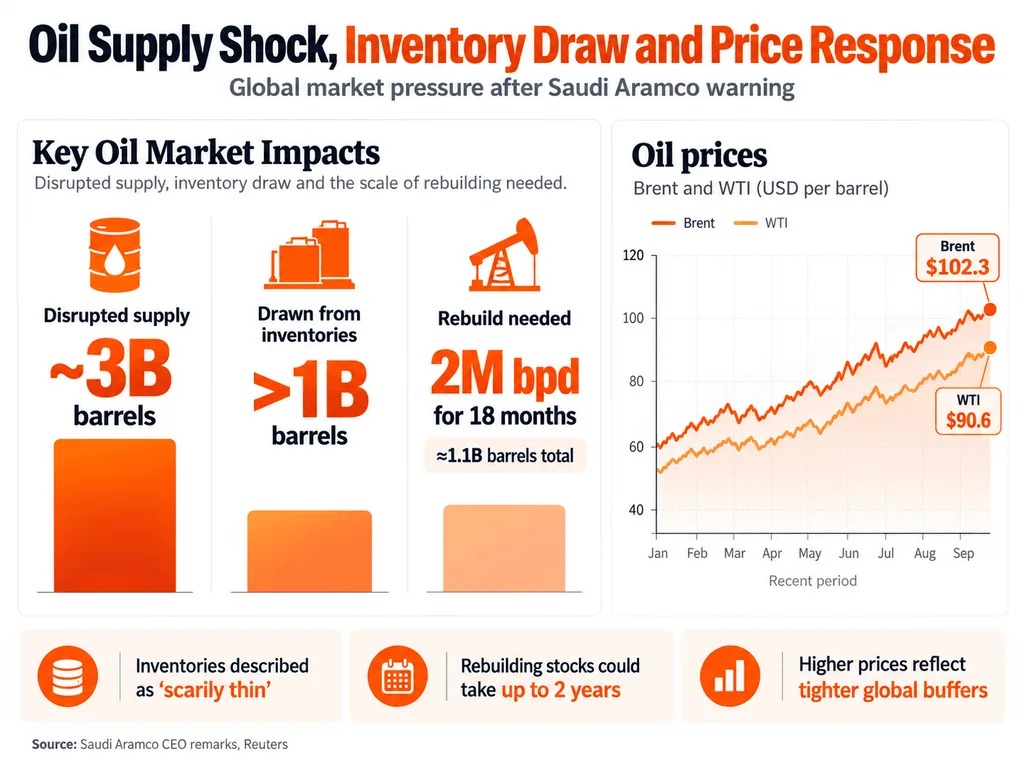
Nasser stated that since the war involving the United States, Israel, and Iran began in February, nearly 3 billion barrels of supply have been lost globally, and in order to mitigate the impact, more than 1 billion barrels have already been drawn from reserves.
He estimates that the world needs to increase supply by about 2 million barrels per day over 18 months in order to meet ongoing demand and simultaneously rebuild these inventories.
At the time of this warning, oil flows in the Middle East region had returned to about 98% of pre-war levels. This contrast is important: supply routes are being restored, but the buffer that previously protected the market from new disruptions has been significantly depleted.
6 billion barrels sounds like a lot, but in reality, it's not quite so.
Nasser stated that there are less than 6 billion barrels of commercial oil reserves remaining globally, but only a small portion of this can actually enter the market.
Reuters reported that approximately 10% of these inventories may be available for actual use, which means that the apparent total inventory amount exaggerates the quantity of crude oil that can actually be utilized in the event of the next supply disruption.
Governments around the world have begun to draw on their emergency reserves. The G7 ( G7 ) recently announced the release of 100 million barrels of crude oil and diesel, but Nasser stated that if commercial inventories remain low, such releases can only provide temporary relief.
Brent oil prices have reached $100, indicating that a buffer is still lacking.
Oil prices continue to reflect this tense situation.
On Monday, the trading price of Brent crude oil was around $102.30 per barrel, while WTI crude oil was around $90.62 per barrel, despite stronger exports from the Gulf region and the release of new reserves.
This impact has extended beyond the energy market. Brent oil prices have surpassed $100, reigniting inflationary pressures in import-dependent economies, whereas previous attacks on Saudi infrastructure had pushed markets closer to a scenario where prices could reach $120 per barrel.