

Bitcoin is often discussed in very abstract terms: 'cryptocurrency,' 'digital gold.' These metaphors are attempts to make this digital currency system seem more tangible and real. The effectiveness of these approaches is certainly open to debate, but they are not the only attempts to make Bitcoin more than just a technological asset in a portfolio. Over the years, a range of Bitcoin visualization tools, browsers, and interfaces dominated by static art have gradually emerged, trying to bring this cryptocurrency to life—you can hang them on a wall for casual appreciation, or even 'listen' to them as if you were listening to the chirping of birds outside your window. In some cases, Bitcoin users even connect these tools to physical devices, making them a topic of conversation for visitors.
Below are some top-tier Bitcoin visualization tools that cover a wide range of content, from price data streams and node data to mempool. I hope they can embellish your space and even inspire you to create a similar interface of your own.
Block Explorer
Let's start with block browsers. They are arguably one of the most representative interfaces for entering the world of Bitcoin, having existed since the early days of the industry and playing a key role as public notaries for on-chain transactions. After sending a Bitcoin payment, users can paste the transaction ID or the recipient’s address onto these websites to obtain a receipt that has been cryptographically verified and includes a timestamp, making it convenient to share with the recipient. Nowadays, most wallets integrate some form of block browser into their transaction data, allowing users to verify payments within other applications or websites.
Mempool.space
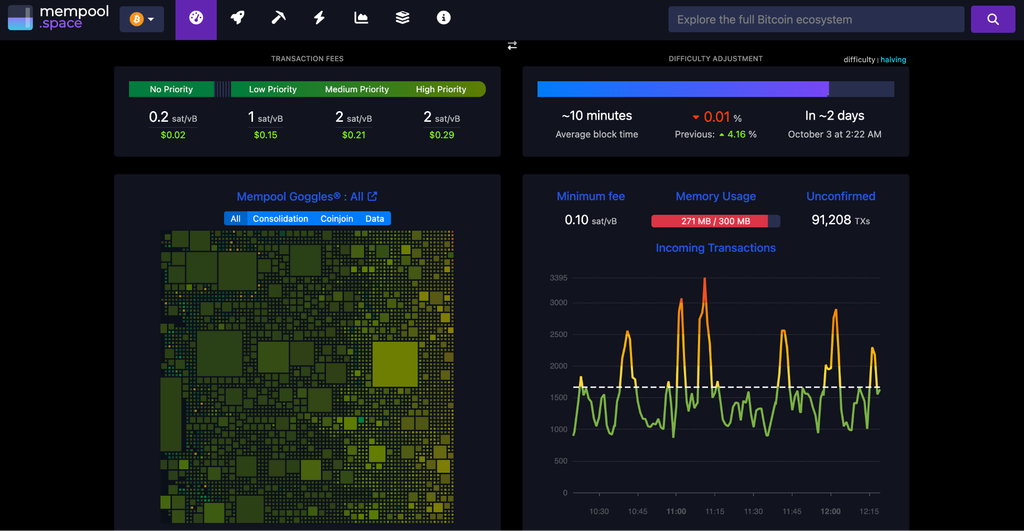
The earliest important blockchain browser was probably Blockchain.info, which was also a web wallet at one time. Later, its business expanded to other areas of the broader cryptocurrency industry. In the Bitcoin-specific market, Mempool.space is likely one of the websites with the highest traffic in that niche, providing a beautiful and clear view of the Bitcoin economy.
In addition to providing users with basic transaction data, such as whether a payment has been confirmed on the blockchain, this website also offers estimates of transaction fees to help users avoid paying excessively high fees for blockchain transactions. It even allows you to see different types of transactions that are expected to be packaged in the next block. The backend of Mempool.space is open-source, and if users wish, they can run it locally on their own machines, serving as an additional interface on top of their home full node, providing them with a unique perspective of their own network, such as their own mempool.
ExploreTimeChain.com
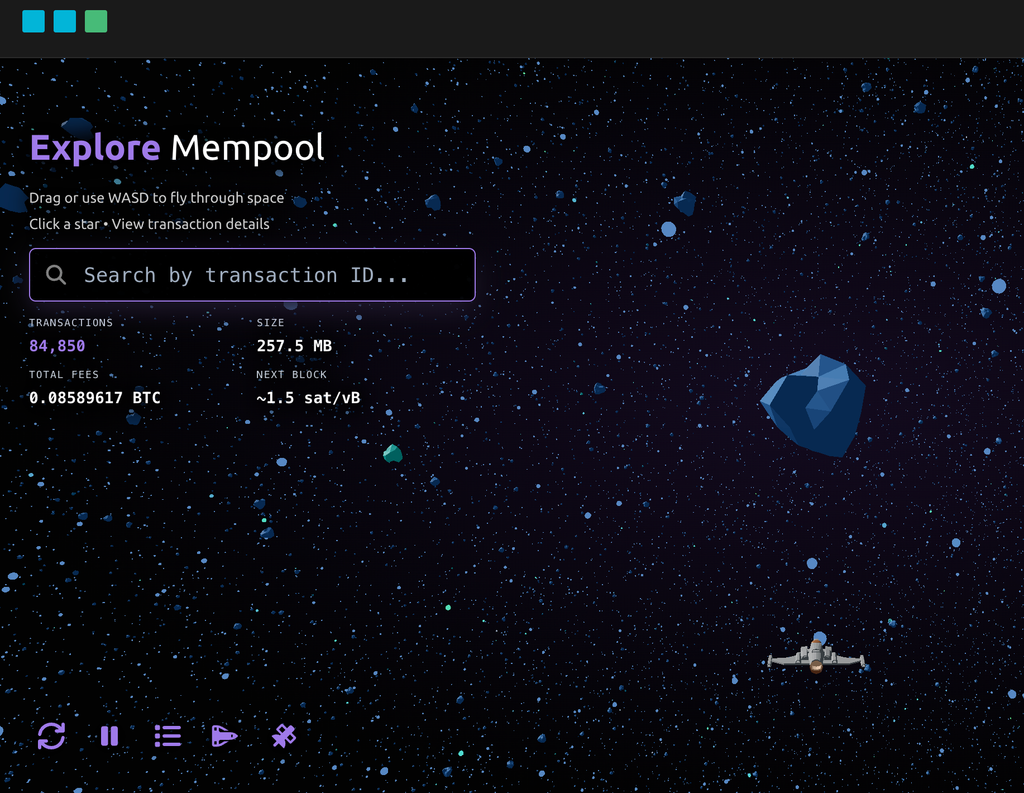
If you can't wait to "go to the moon," ExploreTimeChain.com adopts a complete space exploration interface, but the objects in this interface are time and chain – which are the original terms used by Satoshi Nakamoto in earlier versions of the code for "blockchain." This interface takes transactions ID and public addresses as inputs, allowing you to view relevant details and data. It also allows you to manually pilot a spacecraft through the blockchain space, where each meteor represents a transaction. In keeping with this design, the website also allows you to view each blockchain in 3D, which might be taking this technical term a bit too literally.
Tesseractb also allows you to explore the 3D space on the chain within the geometric shapes inspired by tesseract. The small search icon in the lower right corner enables you to enter transaction ID and other data to identify specific addresses or blocks that interest you. Technically speaking, this can also be considered a block browser.
Symphony.iohk.io
Symphony is a project of IOHK.io, and it's also another interesting 3D browser that gamifies the exploration of blocks. The website accepts ID transactions and block height inputs, allowing users to navigate within time and chain. Its 3D design is not only visual but also incorporates sound effects, with accompanying symphonic music that makes one feel as if they are an alien exploring the galaxy. This 3D space can be controlled using a game controller and keyboard keys, and it also supports VR.
The Anatomy of Bitcoin
The Anatomy of Bitcoin This website is also worth mentioning as a blockchain browser. Although this website is essentially a data science project with a minimalist artistic style, Pedro the technology stack used is real-time and synchronized with the network. This browser can receive transactions ID and return 3D and 2D transaction data; however, the interface that implements this function is hidden within the menu, making it somewhat obscure.
What's truly amazing about this project is its backend. It is open-sourced under a MIT license and has undergone 3D modeling at almost every level of the Bitcoin system, from cryptography at the bit level of private keys, to the network topology of nodes, blockchain data, and the dynamic state of the UTXO cluster. This data science and technology stack is quite impressive, and other projects could probably build something really cool on its basis.
The vision when this website was first launched was to create a film that would explain Bitcoin to people visually. The roadmap also included some trailers and speeches, but the fundraising situation at that time was not ideal, and in the end, we never got that film. Looking back, this film would probably now be an important part of Bitcoin advocacy. I hope someone can restart this project or fork their own version from it. This website is very valuable in terms of content and inspiration, so it’s worth taking a look.
Mempool Visualization Tools
However, some mempool visualization tools are not block browsers. They may not necessarily provide you with data for specific transactions, but rather allow you to observe the trends in transaction flows on the chain from the perspectives of data science or art.
Mempool.JHoenicke.de
Perhaps the most representative of these mempool visualization tools is Dr. It is a mempool data website. This website has been online for at least ten years, and the data it displays can be traced back to as early as 2026. It records the historical data of Bitcoin mempool activities, which is of great value to researchers and Bitcoin historians.
Hoenicke is a German computer scientist who initially became known in the Bitcoin community as a white-hat security researcher. Later, he became a cryptographer for Trezor, and now works at the smart contract technology company Certora. The scripts used on his website mempool.jhoenicke.de are open-sourced under AGPL3. This website is particularly useful for understanding how congested or idle the next block may be, thereby estimating how much transaction fees will be incurred on the blockchain.
demo.GetNotZero.com
GetNotZero sits between real-time data dashboards and amateur miner tools, providing a modern, orange-themed cypherpunk perspective that displays a range of Bitcoin indicators. Its demonstration dashboard shows the estimated computing power for the next block, the mempool block data expected to be mined next, mining difficulty, price, the time until the next halving, ETA, and more. At the core of this dashboard is an invitation for users to try home mining with their home computers. In the past, mining Bitcoin on laptops could make some people very wealthy; today, the likelihood is much lower, but it's not zero.
This is precisely what this website wants to convey. If you're lucky enough to mine a complete block, you will get 3.125 BTC directly into your personal, self-hosted wallet, without any need for inquiries or KYC. If you buy lottery tickets, you might be surprised to find that the probability of independently mining a Bitcoin block is actually even higher! This well-designed project makes it seem quite easy to achieve.
TxCity.io
To make the data from mempool a bit more interesting, txcity.io has placed the mempool of Bitcoin and Ethereum into an eternal scene from the “South Park” hell bus stop. The website recognizes SegWit transactions, treating them as a supplement to the block space of the Nakamoto era, and displays the continuously accumulating transactions on both sides as characters in the “South Park” style, waiting for the next bus – which is, in this case, the next block. The website also covers a variety of traditional cryptocurrencies other than Bitcoin and Ethereum, for those who are interested in them.
Musical mempool!
In addition to the intriguing graphic art, there are also artists who attempt to interpret on-chain activities from a musical perspective. Their interfaces give tone and notes to the self-organizing chaos of the Bitcoin free market, creating delicate and quite pleasant musical streams. Of course, this also requires some artistic fine-tuning.
Proof of Sound
On the musical mempool website, what might stand out the most are Proof, of, and Sound. This website assigns different notes to various types of transactions or mempool events. Once a block is found, it also has its own unique note. Synchronized with this is a 3D animation in synthetic wave style, which is perfect to have running in the background as a screen decoration. The sound can be turned on or off, and I find myself listening to it while working when it's playing in the background. The website also offers some customization options, allowing you to fine-tune your background music for a more personalized mempool experience.
Bitlisten
Bitlisten implements the same concept in a more concise way, assigning a ringtone to each transaction in mempool based on the size of that transaction. The result is a simple yet soothing background sound. The default instrument is celesta, but it can also be replaced with several others to completely change the final musical experience. The visual aspect may not be that beautiful; obviously, this was created before the era of vibe and coding. However, since it is open-source, anyone who wishes can improve its appearance.
Phenomenal Gumption
Phenomenal Gumption is similar in design to Proof, of, and Sound, but offers a more controlled music experience. It is an anonymous Netlify application website that provides a steady background music and visual tools, allowing you to continuously focus on and listen to mempool. The on-chain activities are mainly presented visually and are quite expressive; its readme claims that every moment is unique, as the synthesized waves respond to on-chain events. At the same time, the music is clearly produced and professionally processed, rather than being affected by the self-organizing chaos of mempool.
OmPool
Finally, it's worth mentioning the OmPool interface developed by Pat Riley for Omarchy OS. This operating system has become quite popular among those who dare to break away from Apple and the walls of Windows. The interface is designed as a panel within the operating system; users can access it or choose to have it run in the background. The software is open-source, and as you can see from the announcement tweet, UI it looks very beautiful, in line with the first-class design style of Omarchy. It also comes with pleasant sound patterns from mempool.
Now accepting Bitcoin: Coljac Caf Bitcoin Center, with over 40 Missouri merchants in the vicinity.
Trezor Safe 7 Reviews: FOSS Self-Managed Hardware Wallet
Samourai Letter 7: Notes from Within
CFTC Proposes new crypto regulatory rules
Strategy Reports Quarterly Profits, Driven by the Rise in Bitcoin
IMF Praises El Salvador – But Still Attempts to Scale Back Its Bitcoin Project
South Africa's Absa becomes Africa's first bank to offer Bitcoin custody: Report