

The S&P 500 index is gradually approaching 8,000 points, a level that was once considered extreme, and now it has begun to enter the mainstream discussions on Wall Street: 10,000 points.
This idea has been supported by an exceptionally strong profit cycle. The profits of S&P 500 components increased by more than 50% year-on-year in the second quarter, and profits are expected to grow by more than 30% in the third quarter. Companies related to AI remain the biggest driving force behind this accelerated growth.
This continues the strong profitability that has been evident during the recent AI craze for this index, with technology profits and infrastructure spending exceeding expectations on multiple occasions.
The 10,000-point mark for the S&P 500 is no longer a marginal prediction.
ETF Provider Roundhill has recently launched a product with the core premise that the S&P 500 will reach 10,000 points by January 2030; strategist Ed Yardeni continues to believe that reaching 10,000 points before the end of this decade is achievable.
More boldly, strategist Manish Kabra from Societe Generale believes that the index will close at around 8,000 points by the end of 2026, and suggests that under a stronger bull market scenario, 10,000 points could be achieved as early as 2027.
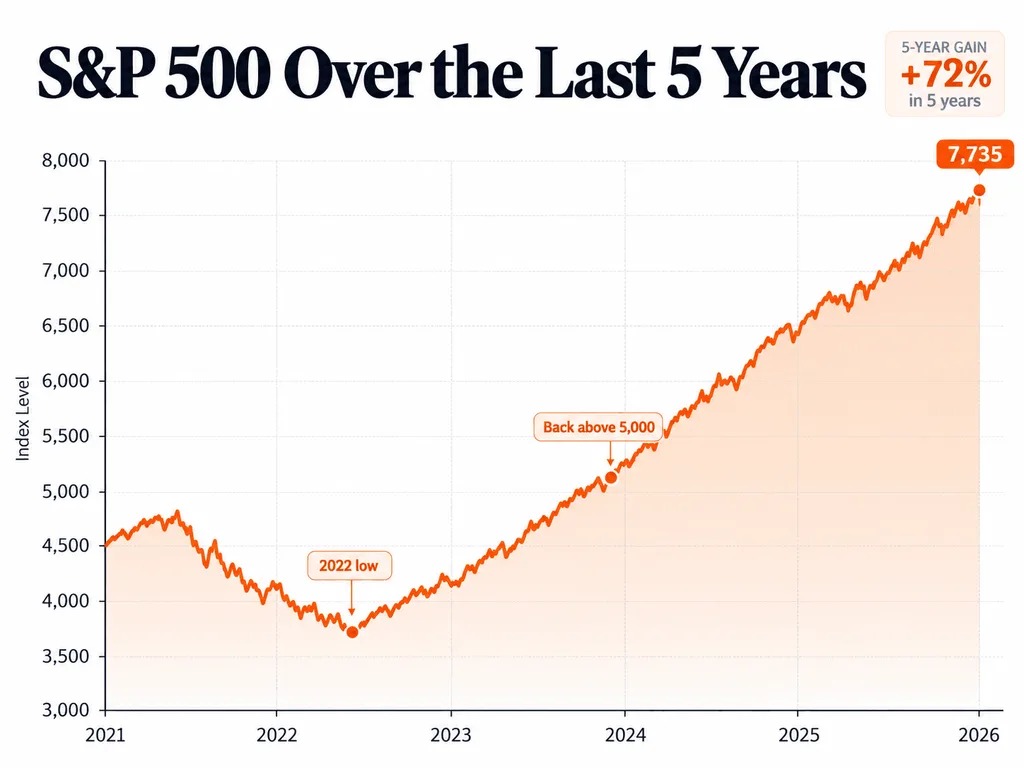
Currently, the index is trading around near its historical high of around 7,700 to 7,800 points, which means that to reach 10,000 points, it still needs to rise by about another 30%.
AI is undertaking the majority of the profit growth tasks.
Artificial intelligence remains at the core of bullish logic.
Nvidia, Microsoft, Meta, Amazon, and other tech giants are transforming massive infrastructure investments into rapidly growing revenues and profits. Nowadays, the proportion of companies related to AI in the S&P 500 is also much larger than it was a few years ago.
This level of concentration has both advantages and disadvantages. On one hand, the growth of AI has a greater impact on the overall index earnings; on the other hand, if the investment cycle slows down, the S&P 500 will also be more vulnerable to shocks as a result.
For now, the data remains strong. Analysts expect that the annual earnings of the S&P 500 will grow by about 35% in 2026, followed by a slowdown to around 15% in 2027.
The key question is whether this slowdown will remain orderly.
The yield of 5% U.S. Treasury bonds is a major balancing factor.
The main obstacle to achieving a 10,000-point scenario is the cost of borrowing.
The yield on 10-year U.S. Treasury bonds is around 5.3%, which constitutes one of the most severe interest rate environments for stocks in decades. Higher yields make bonds more attractive and also increase the discount rate used to discount future corporate profits.
However, the market has repeatedly demonstrated its ability to absorb such pressure, as the AI stock has continued to show strong profit growth, which partially offset the impact on valuations.
About the Author
Maya Bennett is a financial journalist with experience reporting on cryptocurrencies, stocks, and broader market trends. Her areas of focus include Bitcoin, major digital assets, the stock market, monetary policy, as well as economic developments that influence investor sentiment. She is adept at transforming rapidly changing market news into clear and concise reports.