
Ethereum is testing for increased capacity through 200 million gas blocks
Coinpaper
10-07 04:08
Ai Focus
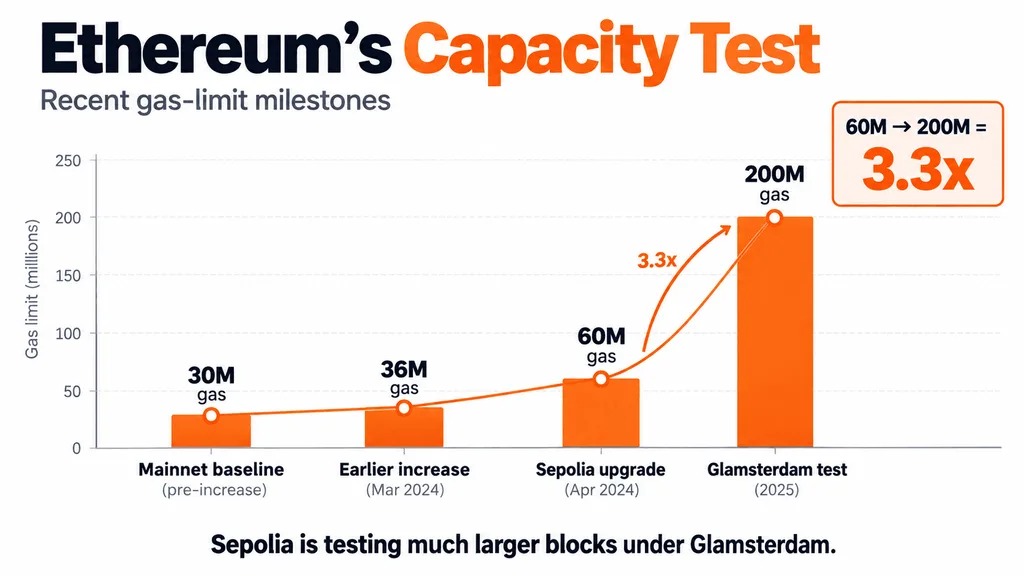
Ethereum is testing the Glamsterdam upgrade on the Sepolia test network, with a target block size of gas set at 200 million, which is more than three times the previous limit of around 60 million. Developers are using this opportunity to assess whether validators can safely handle larger blocks and to observe to what extent the capacity can be expanded without significantly increasing hardware or verification burdens.
Helpful
No.Help

Ethereum is testing one of the most significant attempts to increase its capacity. During the Glamsterdam upgrade, which is being progressed on the Sepolia test network, the target for the number of blocks has been set at a limit of 200 million gas.

This test more than tripled the previous upper limit of approximately 60 million gas for Sepolia. Developers use this to measure whether Ethereum validators can safely process significantly larger blocks.

This change does not mean that the Ethereum mainnet will immediately increase to 200 million gas. On the contrary, developers are using Sepolia to determine to what extent the capacity of Layer can be expanded further, while also avoiding placing an excessive burden on hardware or verification requirements.

Ethereum tests an over-three-fold increase in capacity

Gas represents the computational workload required to execute transactions and smart contracts on Ethereum.

A higher limit on blocks gas means that each block can accommodate more exchanges, stable coin transfers, and smart contract interactions before users start competing fiercely for available space.

Ethereum has previously been gradually increasing the upper limit of gas, but on Sepolia, it has been raised from 60 million to 200 million, representing a more radical test.

This experiment emerged as developers attempted to expand Ethereum itself while maintaining a broader Layer 2 scaling strategy for the network.
Glamsterdam Changing the Way Ethereum Processes Blocks

Glamsterdam introduced a number of architectural changes aimed at supporting higher throughput.

One of these is the block-level access list, which allows nodes to know in advance which accounts and storage locations will be used by a block before it is executed. This may make it easier to process independent transactions in parallel, rather than executing them all in sequence.

Another important feature is the separation of proposers from builders within the protocol, which is ePBS. This feature incorporates more aspects of the Ethereum block construction process directly into the protocol.

Previously, the tests of Nethermind included 2,302 performance tests, during which it processed 570.7 billion gas in just over three minutes. Developers used this to evaluate the design's performance under heavier loads.

These improvements are at the core of Ethereum's broader roadmap for scaling, especially as blockchain activities are growing in the fields of payments, DeFi, and tokenized assets.

Tip
$0
Like
0
Save
0
Views 59
WalletJYS reminds readers to view blockchain rationally, stay aware of risks, and beware of virtual token issuance and speculation. All content on this site represents market information or related viewpoints only and does not constitute any form of investment advice. If you find sensitive content, please click“Report”,and we will handle it promptly。
Submit
Comment 0
Hot
Latest
No comments yet. Be the first!
Related
Clear Channel Outdoor has obtained approval from CFIUS; the acquisition transaction with Mubadala Capital is expected to be completed around October 14th.
Clear Channel Outdoor Holdings, Inc. This indicates that the acquisition transaction by Mubadala Capital has been approved by the US Foreign Investment Committee (CFIUS). The company stated that all regulatory requirements necessary for the completion of the merger have been met, and the transaction is expected to be completed around October 14, 2026, provided that the remaining customary closing conditions are satisfied.
PR Newswire
·2026-10-08 06:50:18
4
Analysts say Anthropic will become this year's "most absurd IPO"
An independent research institution, New Constructs, stated in a report that IPO within Anthropic's plans will be the "most absurd IPO" of 2026, and believes that this artificial intelligence company poses extremely high risks despite a valuation of $2 trillion. The institution cited disclosed data and media reports stating that Anthropic had revenue of $4.6 billion and a net loss of $42 billion in 2025, questioning the feasibility of its business model.
CNBC
·2026-10-08 06:50:15
3
Verifact Markets Launches a Disputed Facts Trading Platform
Verifact Markets launched on October 6 what it claims to be the first platform for resolving controversial facts, where users can trade on whether contracts are "true" or "false," with the platform deciding the outcome after evaluating the evidence. The company states that this platform is aimed at eligible users outside of the United States and is seeking regulatory pathways to enter the U.S. market.
The Cryptonomist
·2026-10-08 06:23:22
12
Russian regulated crypto market opens up, with Sberbank and VTB among them
On September 1st, Russia's regulated crypto market opened, and the first batch of 4 crypto trading operators and 5 digital custody institutions have emerged. Both Sberbank and VTB Bank are on the registration list. The report also mentions retail purchase limits, proposals for upper limits on bank exposures, as well as the service launch schedules for Sberbank and VTB.
The Cryptonomist
·2026-10-08 06:23:19
13
Caribou Biosciences Stock price closes at $1.14
Caribou Biosciences closed at $1.14 on Tuesday, below the three-day moving average and below the lower band of the daily Bollinger Bands. The daily, hourly, and 15-minute RSI indicators are all in oversold territory. Post-market reports indicated that the company plans to evaluate strategic alternatives and will cease vispa-cel and CB-011 projects. CAR-T
The Cryptonomist
·2026-10-08 06:14:00
12
View More