

Spain has just made it clear to all property owners in Europe that the rules surrounding their assets can be rewritten overnight through decrees. Bitcoin, on the other hand, is a type of asset for which such a thing will not happen.
I am in charge of the Bitcoin Master's program at Universidad, de, las, Hesp, and rides. My research focus is on how people accumulate wealth over decades, rather than just a few weeks. In Spain, for generations, the answer to long-term family wealth has been land and property, and that remains the case to this day.
Last week, the government almost made this path impossible. I’m not writing this article to deny the importance of real estate, but because Spain has just threatened one of the few tools that ordinary families have to accumulate wealth over the long term, and they will need another tool to do so.
Two decrees, one piece of information
On September 29th, the Spanish government approved two emergency decrees regarding housing. These decrees came into effect within a few days, while the parliament was scheduled to hold hearings on Friday, October 2nd. However, the decrees were not passed, despite the voting results being very close.
The Spanish government did not pass these regulations in the form of ordinary laws. On September 29th, it approved two emergency decrees ( reales decretos-ley ). The constitution only allows the use of this tool in cases of "exceptional and urgent necessity." The decrees took effect immediately, and thereafter, the congress had 30 days to confirm or repeal them. The government split the reforms into two parts in order to vote on them separately, so as not to let one controversial measure undermine the entire set of reforms.
The first decree limits rent increases until the end of 2027. If a rent is already higher than the upper limit set by the official reference price index, it cannot be increased at all. In all other cases, both parties may agree to an adjustment; however, without a new agreement, the increase must not exceed 2%. Spain's inflation rate in September was 4.9%, which means that landlords' actual income will decrease year by year according to the law, according to data from the National Statistics Institute.
The second decree goes a step further. At the end of the minimum lease period, if neither party notifies the other, the lease will automatically renew for another five years; if the landlord is a legal entity, it will be seven years. If the landlord terminates the contract without a legal reason specified by law, they must compensate the tenant. The amount of compensation is calculated, where possible, according to the national rental reference system, and shall not be less than one month's rent for each year of residence. In practice, this means that landlords lose a significant degree of freedom to repossess their property or to rent it out again at current prices.
These rules also apply to contracts that have already been signed, taking effect from the next renewal date ( Provivienda summary ). This is also why many people consider these decrees unconstitutional. Critics argue that these decrees retrospectively rewrite private agreements signed by both parties under different rules, whereas Article 9.3 of the constitution prohibits retroactive measures that restrict individual rights.
Congress has not resolved this issue. On October 2nd, the first decree was rejected by a vote of 178 to 172, and the second decree was rejected by a vote of 184 to 166. Subsequently, Sanchez announced that general elections would be held on November 29th.
On Tuesday, the ministerial meeting once again approved these two decrees, making only technical modifications, and submitted them to the permanent delegation of Congress ( Diputaci on Permanente ), where a vote from Junts is not required. This is a scaled-down body that replaces the entire congress after its dissolution. Sánchez stated that the second decree regarding automatic renewals will only take effect after it is confirmed by this body, and not automatically upon its publication in the Official Gazette ( BOE ). A jurist consulted by a newspaper believes that this approach borders on the abuse of the law.
Investors can accept strict rules. What they cannot control is when those rules change after they have already made their investments. This last point is something that every property owner in Europe should read repeatedly.
The market responded within a few hours.
The property owners did not wait for the voting results. A Spanish television program reported that approximately 2,900 rental properties were removed from property listing websites within about four hours ( EDATV ). In Madrid, it was reported that the number of rental properties decreased by about 20% within 24 hours, from 11,815 to 9,398 ( LaBandera ). These are preliminary, unaudited statistics, but the trend is clear.
This is nothing new. We have conducted this experiment many times before, and the results are always the same.
Berlin, 2020: The city froze rents for five years. At that time, studies found that the supply of regulated apartments had decreased by about half, while unregulated rents rose. In 2021, Germany's Constitutional Court ruled that this law was invalid.
San Francisco, 1994: A study by Stanford University Diamond, McQuade, and Qian found that expanding rent controls helped existing tenants stay, but landlords reduced the number of regulated properties by about 15%, resulting in a 5% increase in rents across the city.
Catalonia, 2024: Rent caps in tense areas have slowed down price increases, but the number of rental properties in Barcelona has decreased by 22.2%, while in Madrid it has increased by 3.9% ( Fedea, cited by idealista ).
In Spain itself, from 1946 to 1985: Mandatory and nearly permanent lease extensions led to old rents remaining frozen for several decades. Landlords stopped maintaining the buildings, and the city center gradually declined until the Boyer legislation of 1985 ended this system.
The new automatic renewal decree, logically speaking, represents a return to the old Spanish model.
The real problem is not the landlord.
There is no problem with landlords in Spain. What there is is a shortage of housing. By 2025, about 240,000 new families will be formed, yet only around 92,000 units of housing will have been completed. The Bank of Spain estimates that the cumulative shortfall between 2021 and 2025 will be approximately 750,000 units of housing ( Cantabria Econ or mica ).
The same report lists obstacles such as a scarcity of buildable land, slow urban development, and rigid planning. Economists like my colleagues Daniel Fern, ndez, and ndez believe that restrictive land regulations and increasingly stringent building standards make the construction industry unprofitable even at today's prices ( Hesp é rides ).
Thus, on one hand, the state restricts what can be constructed, and on the other hand, it limits the earnings from existing properties. Supply shrinks from both ends simultaneously.
It's not the existing homeowners who pay the price. They have a choice: they can sell, wait, or prefer to leave their houses empty rather than risk having tenants who never move out. It's the tenants who suffer the consequences. With fewer houses available for rent, the rent for the remaining properties will rise, and more people will end up in informal arrangements without contracts or protections, hovering on the fringes of the grey economy.
Buying a house is not either a solution. Spaniards cannot afford to buy houses for the same reason they cannot afford to rent them: there are too few housing units, and these laws have not changed that situation at all. Some landlords will be forced to sell, but this will have almost no impact on prices. The adjustment in housing sales is much slower than that in the rental market. If the mortgage on a property exceeds the price at which it can be sold, owners simply cannot sell it. Many people will just wait, hoping for a change in government, while their apartments remain vacant. As a result, more people will find it impossible to either rent or buy a home. Renters are harmed, as are small investors, and the housing shortage remains unchanged.
An asset that cannot be rewritten by any decree
The biggest risk in real estate is not the market, but rather the possibility that the rules surrounding your assets could be changed by the government at any time, and you would be unable to move those assets elsewhere. Buildings are always fixed within a particular jurisdiction.
Bitcoin is quite the opposite in these aspects.
The rule is fixed: the supply cap is 21 million coins, and this rule has not changed in 17 years. It can be said that the establishment of all Bitcoin infrastructure is precisely to prevent such a situation from occurring. No minister can set a profit cap for it, freeze it, or extend anyone else's claims to it.
True ownership: If it is held in your own wallet, then there is no tenant who can refuse to pay, no unauthorized occupant who can move in, and no court approval is required for its sale.
Carryable: It doesn't belong to any one country. If the rules in your region become hostile, you don't have to keep your savings there.
Suitable for small savers: Buying a house requires a down payment, mortgage, notarization, and long-term commitments. Bitcoin, on the other hand, can be purchased by anyone in fixed amounts, such as a few euros at a time.
For most Spanish families, property is almost their entire wealth. This week has shown to what extent this wealth depends on politics.
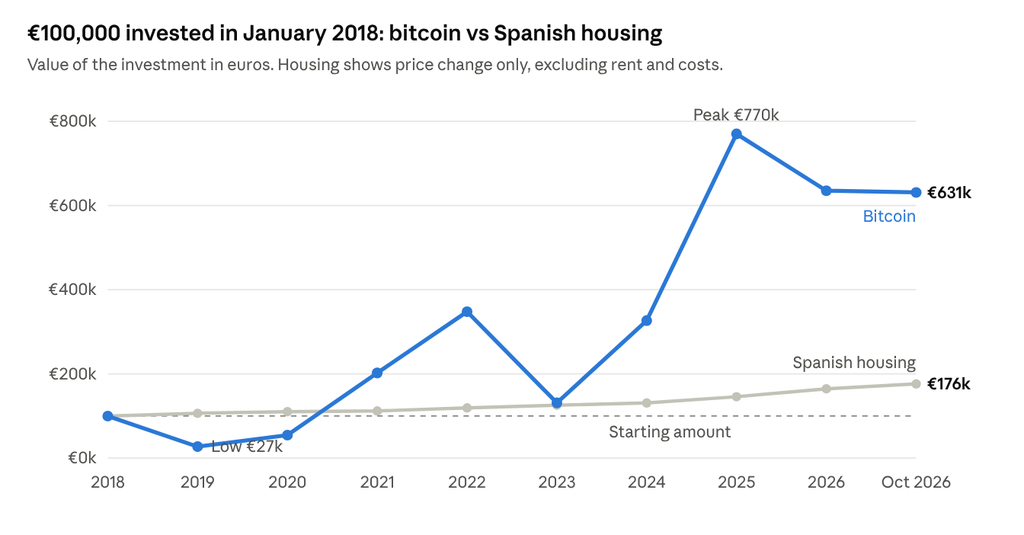
The long-term perspective also shows the rewards and costs of such a choice. If one bought Bitcoin shortly after its peak in 2017, the position would lose nearly three-quarters of its value within a year, only to later outperform Spanish housing several times over.
Past performance does not indicate future returns. Bitcoin is highly volatile, and its value could fall significantly. The housing chart only shows price changes and does not include rental income, taxes, maintenance costs, or purchase costs. This is not investment advice.
Bitcoin for the Long Haul
Families always need a place to live, so they will still purchase or rent housing. What has changed is the approach to their second property, which is now seen as an investment. For small investors, the risks have now outweighed the returns, which also eliminates one of the few ways ordinary Spaniards can accumulate wealth over their lives.
If Bitcoin is treated as something similar to real estate in the past – that is, as an asset to be held for the long term, rather than a form of gambling like lottery tickets – it could fill this gap. Its price fluctuates greatly, and it may experience significant drops in the short term. Any holder should think on a multi-year time frame, make regular purchases, rather than trying to time their investments perfectly, and certainly never invest money that they will need next year.
Real estate provides you with an asset whose rules may be rewritten. Bitcoin offers you price volatility, but the rules remain unchanged. After this week, more Spaniards will ask: which type of risk are they more willing to expose their savings to?
Regardless of what decision Congress makes, Spanish property owners have learned that the contracts they sign can be changed. This lesson will not disappear with a vote. The rental market that Spaniards are familiar with no longer exists. Long live Bitcoin.
Label
Real Estate
Spain
Ecash Ecosystem Rises to Challenge in the Defense of Decentralized Custody
Bringin Opens Euro Business Accounts for Bitcoin Companies Across 30 European Countries
The Quantum Issue : Quantum Isn ’t Coming For Your Bitcoin
OKX Gets New Funding From Circle, Standard Chartered at $25B Valuation
BlackRock Says AI Agents Could Be the Next Big Driver of Crypto Demand
Treasury Drops Crypto Surveillance Proposals
Ecash Ecosystem Rises to Challenge in the Defense of Decentralized Custody