

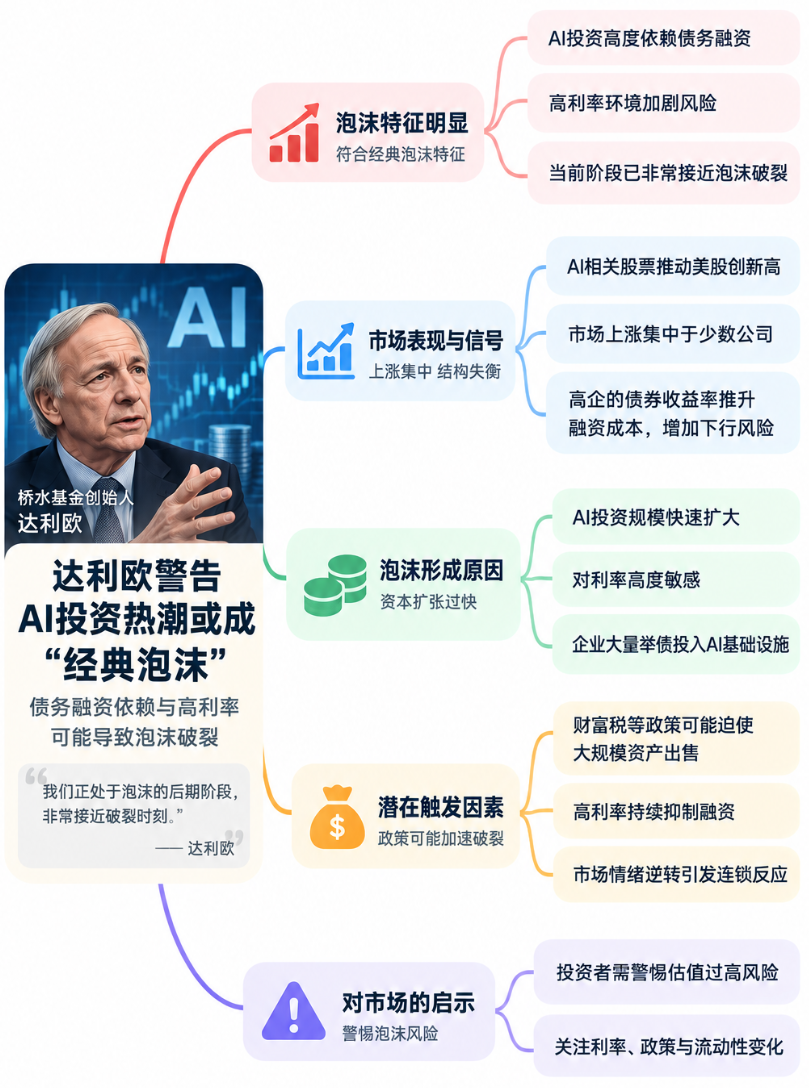
Ray Dalio, the founder of Bridgewater Fund, warns that the boom in artificial intelligence investment has created a "classic bubble." As large technology companies become increasingly reliant on debt to finance the expansion of infrastructure and global interest rates remain high, the market is approaching a stage where the bubble could burst.
On Wednesday, Dalio stated at the Forbes Global CEO conference held in Singapore that a large amount of debt is currently being used to fund AI investments. As financing costs continue to rise, this type of expansion model, which relies heavily on capital investment, will face increasing pressure.
"We're still not at that stage yet, but we're getting closer to it," he said. "I think we're already very close."
This judgment comes at a time when stocks related to AI continue to push U.S. stocks to new highs. This week, both the S&P 500 index and the Nasdaq 100 index reached record levels, with the market still betting that AI will bring sustained profit growth. However, at the same time, global government bond yields have risen to levels not seen in decades, significantly increasing the financing costs for technology companies to build data centers, purchase chips, and expand power infrastructure.
What Dalio focuses on is not whether the AI technology can continue to develop, but whether the capital investment and asset prices formed around AI can maintain the current pace in the long term.
Large technology companies are investing tens of billions of dollars in data centers, servers, chips, and energy facilities. In the early stages, the expansion of AI infrastructure mainly relied on the vast cash flows of these tech giants themselves, but as the scale of investment continues to grow, the importance of corporate bonds, project financing, and other debt instruments is increasing.
This makes the investment cycle of AI more sensitive to interest rates. In an environment with low financing costs, companies can tolerate a longer payback period for their investments; however, as bond yields continue to rise, projects that require future cash flows to justify their viability face higher barriers.
The yield on 10-year U.S. Treasury bonds remained above 5% this week, hovering around 5.3% at one point. The U.S. government's financing needs, the resilience of economic growth, and global capital competition have all contributed to pushing up long-term funding rates. AI infrastructure has once again become a new source of significant funding demand.
Dalio believes that when debt-driven investment expansion encounters rising financing costs, it usually constitutes an important turning point for the formation of a bubble cycle.
The stock market continues to set new highs, with risks concentrated in a few AI companies.
At present, this pressure has not yet been significantly reflected in the prices of large American tech stocks. AI Profit expectations continue to drive the main indices higher, and investors are still willing to pay a high valuation for related companies.
However, the market gains are increasingly concentrated among a few companies that can directly benefit from AI capital expenditures. The weight of chip, cloud computing, data centers, and large internet companies in the index is constantly increasing, making the performance of the U.S. stock market more dependent on whether the AI investment cycle can continue.
Dalio considers a combination of rapid increases in asset prices, a large amount of capital flowing into the same investment themes, and continuously expanding debt financing to be typical characteristics of a bubble.
His judgment echoes the recent concerns of some market participants regarding the investment returns of AI. As the scale of capital expenditure expands, investors are beginning to demand that tech companies prove that the additional revenue and profits generated by AI products can cover the substantial investments in data centers, computing power, and energy infrastructure.
However, at present, the profitability and balance sheets of large technology companies are still relatively strong, and there has been no significant decline in AI demand. Therefore, what Dalio describes is the gradual accumulation of potential risks, rather than believing that a bubble has already begun to burst.
"Realizing wealth" could also become a triggering factor.
In addition to interest rates, Dalio also proposed another mechanism that could burst asset bubbles, namely investors being forced to convert their book wealth into cash.
Taking high-net-worth investors as an example, he stated that a person may claim to possess $1 billion in wealth, but if they need to actually spend that wealth, they would have to sell stocks or other assets to obtain cash. Large-scale asset sales would disrupt the market cycles that rely on continuously rising prices to sustain themselves.
Dalio specifically mentioned the wealth tax and related policy discussions regarding unrealized capital gains. Such measures, if they force investors to sell assets to raise cash for taxation, could become an external shock when valuations are at extreme levels.
"Everyone says, 'I'm worth 1 billion dollars,' but you have to try spending it," said Dalio. To truly utilize that wealth, one must sell assets to obtain cash. "It's usually at times like these that bubbles burst."
Dalio has previously warned for a long time about the risks of U.S. debt and interest rates. Earlier this week, he also stated that China and Japan may reduce their demand for U.S. Treasury bonds in the future, while about one-third of U.S. debt financing relies on foreign capital. If the weakened demand for U.S. bonds further drives up long-term yields, the financing environment faced by AI companies may continue to tighten.
The current AI market has thus shown a clear differentiation: corporate capital expenditures continue to expand, and major tech stocks are constantly setting new highs, but long-term interest rates, which are used to price this investment cycle, have also risen to levels not seen in decades. Dalio believes that the real turning point that could change the market situation will occur when financing costs and cash demands begin to force investors or companies to actively reduce their risk exposure.