

Robinhood has recorded Bitcoin worth $25 million on its balance sheet, as this trading platform invests company capital into its crypto business, which encompasses trading, tokenized stocks, derivatives, and blockchain infrastructure.
Robinhood, the person in charge of encryption business, Johann Kerbrat stated that this purchase is aimed at aligning the company with the crypto community.
"We place great importance on Bitcoin and the ecosystem surrounding it," Kerbrat told crypto media. "For us, it's more about aligning our company and vision with the crypto community."
According to Kerbrat, this position of $25 million is relatively small for Robinhood and will not cause too much change considering the company's scale. The stock of Robinhood listed on NASDAQ closed down 1.85% on Tuesday, at $112, with a market value of nearly $100 billion.
“Robinhood is now a very large company, with a market value of around $100 billion,” said Kerbrat. “So 25 million dollars in Bitcoin won’t change the company’s current trajectory much.”
This Bitcoin position indicates that Robinhood has bet its own capital on a certain asset, which has become an increasingly important part of its trading business. According to operational data cited by crypto.news in September, Robinhood reported that the nominal trading volume of cryptocurrencies in August was 17.5 billion US dollars, representing a 61% increase from 10.9 billion US dollars in July.
Among them, Bitstamp contributed $10.1 billion to the August trading volume, with another $7.4 billion coming from the main application of Robinhood. By the end of August, the number of funded customers reached 28.6 million, and the platform's total assets were approximately $384 billion.
While Robinhood is purchasing Bitcoin, its derivatives business is also making progress.
The encryption products of Robinhood are expanding beyond spot trading, and the company is preparing to offer perpetual futures to eligible American users.
Plans announced earlier this month cover Bitcoin, Ethereum, Solana, XRP, Doge Coin, Cardano, Chainlink, and Hyperliquid. Bitcoin and Ethereum perpetual contracts are expected to offer up to 10x leverage, while the remaining six assets can offer up to 3x leverage.
These products are expected to operate through Robinhood Derivatives, and will utilize the infrastructure of the crypto exchange Bitstamp which was acquired by Robinhood in 2025. The transaction fee will be set at 0.01% and will remain in place until the end of 2026.
Robinhood CEO Vlad Tenev referred to this plan as the first batch of "true perps" for American customers, with no expiration date and settlements for profits and losses every 15 minutes.
While disclosing its derivatives plans, the company also mentioned another aspect of its crypto business. Robinhood indicated that the trading volume of its stock tokens has approached the upper limit set by the U.S. Securities and Exchange Commission's five-year innovation exemption for tokenized stocks.
Kerbrat indicates that Robinhood plans to add voting rights and physical redemption functions to its stock tokens, while also working towards supporting more U.S. stocks and exchange-traded funds.
Robinhood Chain Allows companies to have their own encrypted networks
Robinhood Nowadays, most on-chain strategies are implemented through Robinhood Chain. This is an Ethereum Layer 2 network built using Arbitrum technology.
On July 1st, the company launched the public Layer mainnet, simultaneously introducing tokenized stocks and decentralized perpetual contracts. Users from over 120 eligible countries can trade these tokenized stocks on supported decentralized exchanges through Robinhood Wallet.
In the early stages of its launch, activities were mainly focused on native cryptocurrency transactions. Robinhood Chain handled a transaction volume of 570 million US dollars in the first week of its operation, with corresponding liquidity of 21.68 million US dollars, of which a large portion of the activity came from meme coin transactions.
Network usage continued to grow after its launch. According to data shared by MSBIntel and verified by Token Terminal, Robinhood Chain processed 7.6 million transactions on a single day on July 11th, while during the same period, Base of Coinbase handled 9.2 million transactions.
According to Bernstein, as of the end of July, the network has processed over $12 billion in decentralized exchange trading volume and more than 150 million transactions. Robinhood Wallet provides another pathway for companies to enter this network and can be used in over 120 countries.
Kerbrat indicates that Robinhood has approximately 27 million funded accounts in the United States, with another 1 million accounts overseas.
“So this might be the first time that a L2 has been connected to such a large distribution channel,” he said.
Enterprise Bitcoin buyers remain active
When Robinhood entered the corporate Bitcoin market, its position size was much smaller than that of companies that had already built their balance sheets around Bitcoin.
Strategy reported on Monday that the company purchased an additional 334 BTC between September 28th and October 4th, amounting to approximately 28.7 million US dollars. The company paid an average of 85,838.80 US dollars per coin, thereby increasing its holdings to 848,000 BTC.
This latest transaction occurred after Strategy purchased 1,665 units of BTC on September 27th for a total amount of $142.7 million. The average price per unit during that purchase was $85,681, and at that time, their holdings increased to 847,666 units of BTC.
Strategy funded its September purchases by selling MSTR common shares. The company raised a net income of $246.2 million from 1.47 million shares, of which $142.7 million was used to purchase Bitcoin, and another $103.5 million was used to repurchase STRC preferred stocks.
After a two-week pause in purchases, the company resumed buying Bitcoin just a week ago. From September 14th to September 20th, Strategy spent $75.7 million to buy 950 units of BTC, at an average price of $79,670 per unit.
In 2026, other listed companies adopted different approaches to their holdings. Sequans Communications sold the remaining 314 BTC in September. Previously, the company had used earlier sales of Bitcoin to reduce its convertible debt, ultimately ending its Bitcoin treasury strategy.
Bitcoin price outlook still focuses on $82,000
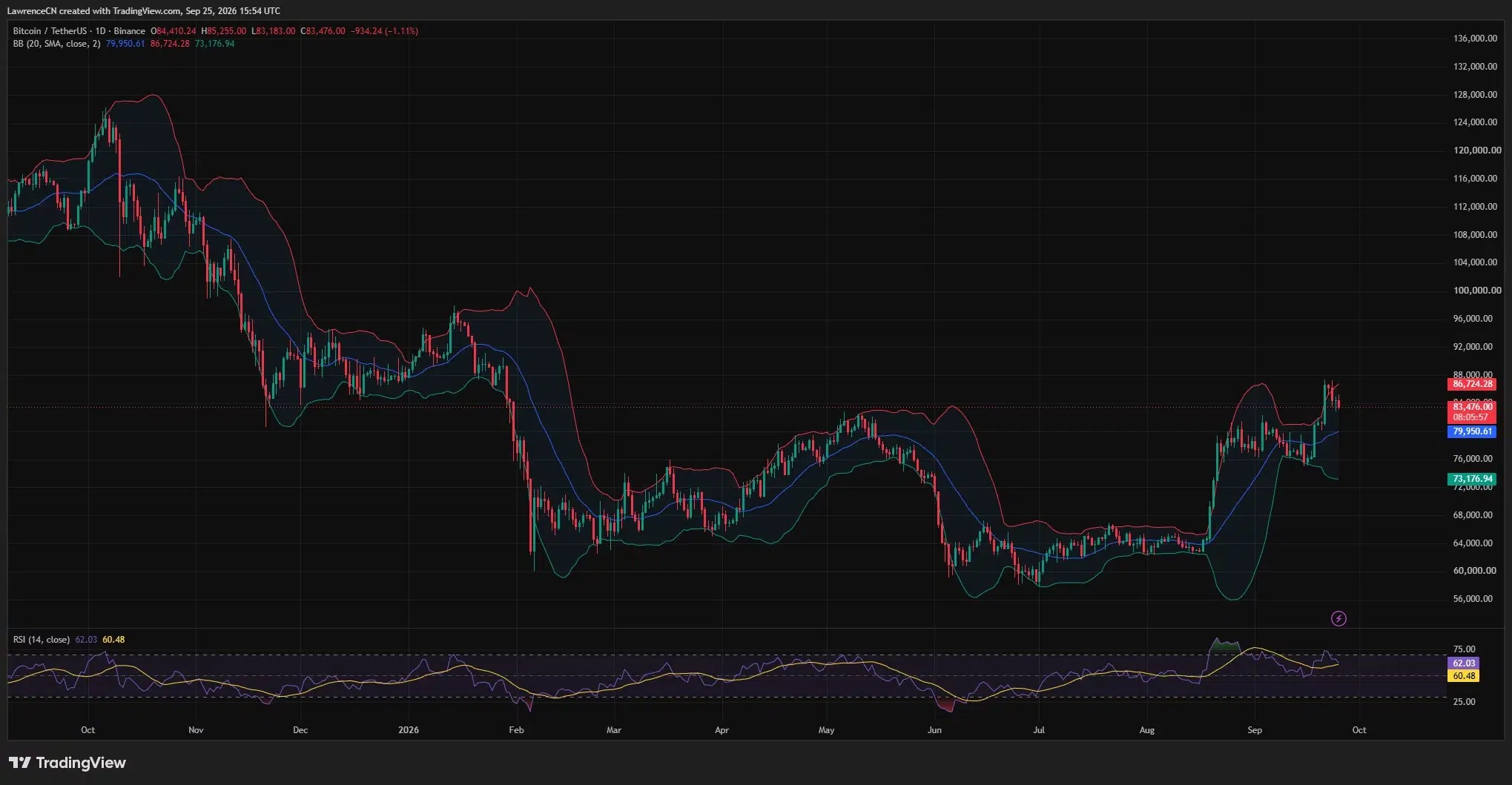
On Wednesday, Bitcoin traded around $84,000, with rising oil prices, U.S. Treasury yields, and a stronger dollar weighing on the crypto market. During the selling pressure, over $403 million in leveraged long positions were liquidated within an hour, while Brent crude oil rose above $101. Data from Santiment shows that as 24,073 BTC left the trading platform, the supply of Bitcoin exchanges dropped to 6.5%, a figure cited in an update on the crypto market.
Price trends have brought BTC close to the range that analysts have been watching since early October. Bitget Wallet, the head of research for Lacie Zhang, previously estimated that Bitcoin's possible range of fluctuations in October would be between $78,000 and $95,000, considering $82,000 as an important downward level. Zhang stated to crypto.news that before a stronger rebound can occur, Bitcoin needs to break through the key level of $87,500 first. According to the outlook for Bitcoin in October, institutional demand will need to absorb the sales from long-term holders and miners for the upward trend to be sustained.
However, the demand for ETF has since cooled down. Analysts from Bitfinex stated that as of the week of October 2nd, the net inflow of spot Bitcoin in the United States ETF decreased from $2.39 billion to $241.1 million, and Bitcoin failed to break through the $87,722 level. Analysts have set the BTC range between $84,000 and $87,722, believing that with still weak buying interest in the spot market, if it continues to fall below $81,300 and is accompanied by outflows of ETF funds, a rebound could be at risk.