

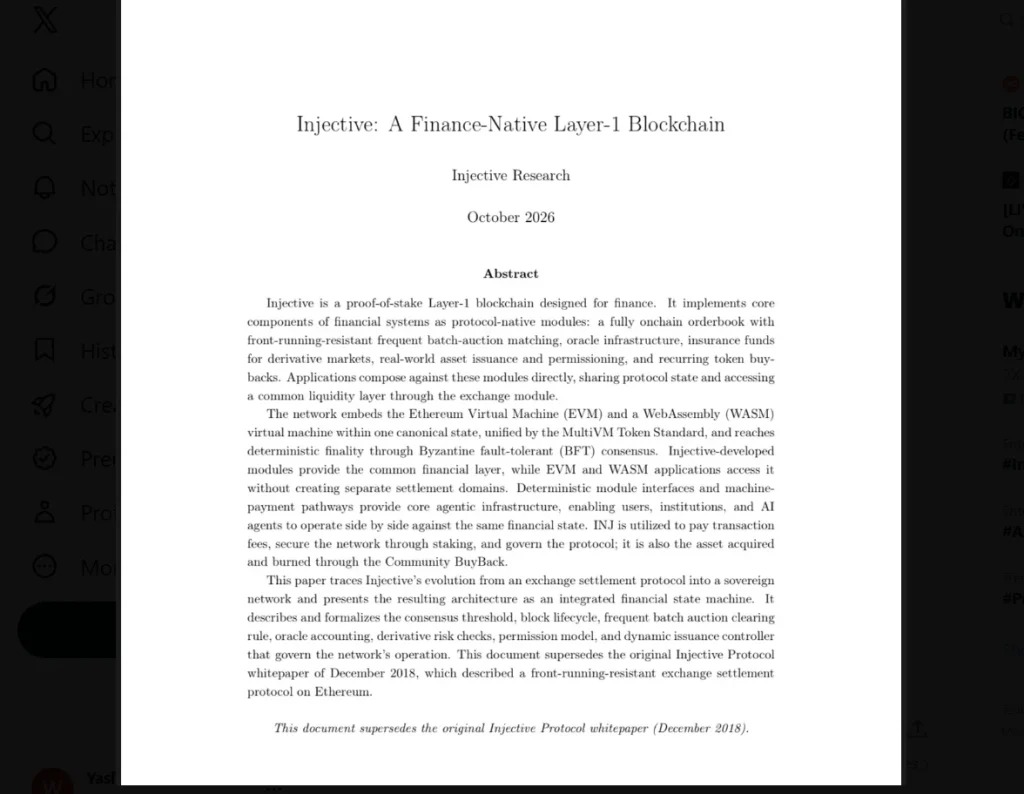
Injective has released its first comprehensive rewrite white paper since December 2018. The goals of this protocol include the issuance of RWA, on-chain transactions, derivatives, settlement, as well as AI and agent finance.
Injective uses the BFT consensus, with block times of approximately 600 milliseconds, and it possesses definitive finality.
This new Injective white paper marks the first comprehensive rewrite since December 2018. At that time, the project described itself as a transaction protocol deployed on Ethereum that was resistant to pre-mining. Eight years later, the protocol has proposed a broader positioning: a Layer blockchain built around institutional-level finance and tokenization.
The core idea is very straightforward: each level of design revolves around the issuance of real-world assets, allowing these assets to function within the market, applications, and between AI and agent.
Injective The white paper puts asset issuance first
Native RWA tokenization is at the heart of the new architecture. Assets can utilize role-based permissions to cover铸造, sending, receiving, and destruction, while also supporting programmable receive hooks and sealable namespaces.
Next is iAssets, which offers derivatives priced in stablecoins and determined by oracles, used for tracking external assets without the need for packaging or upfront capital injection. This is a rather ambitious architecture.
On-chain transactions adopt different structures.
Tokenized assets can be traded through the fully on-chain CLOB. Each block will execute a closed, frequent batch auction at a unified settlement price. This design is intended to prevent preemption and sorting-based MEV.
Settlement is completed through the BFT consensus. Exceeding two-thirds of the submission threshold ensures definitive finality, with a block time of approximately 600 milliseconds.
At the same time, the native EVM and WASM operate under the same set of standardized conditions. MultiVM Token Standard ensures that each asset in the banking module retains only one balance, and this balance is exposed to Solidity through pre-compilation.
AI agent Derivatives and the same technology stack
The architecture also includes perpetual contracts, with a time-weighted premium funding rate, margin checks, liquidation only upon reduction of positions, and an insurance fund.
In addition, there are agentic and finance. AI and agent can interact with tokenized assets through the MCP server, policy-constrained signatures, and the x402 machines that use USDC.
Finally, the revenue from on-chain protocols will flow into the regularly conducted Community BuyBack, which is used for repurchasing INJ. Therefore, this Injective white paper outlines a chain that unifies issuance, trading, derivatives, settlement, composability, and agentic finance under a single protocol.