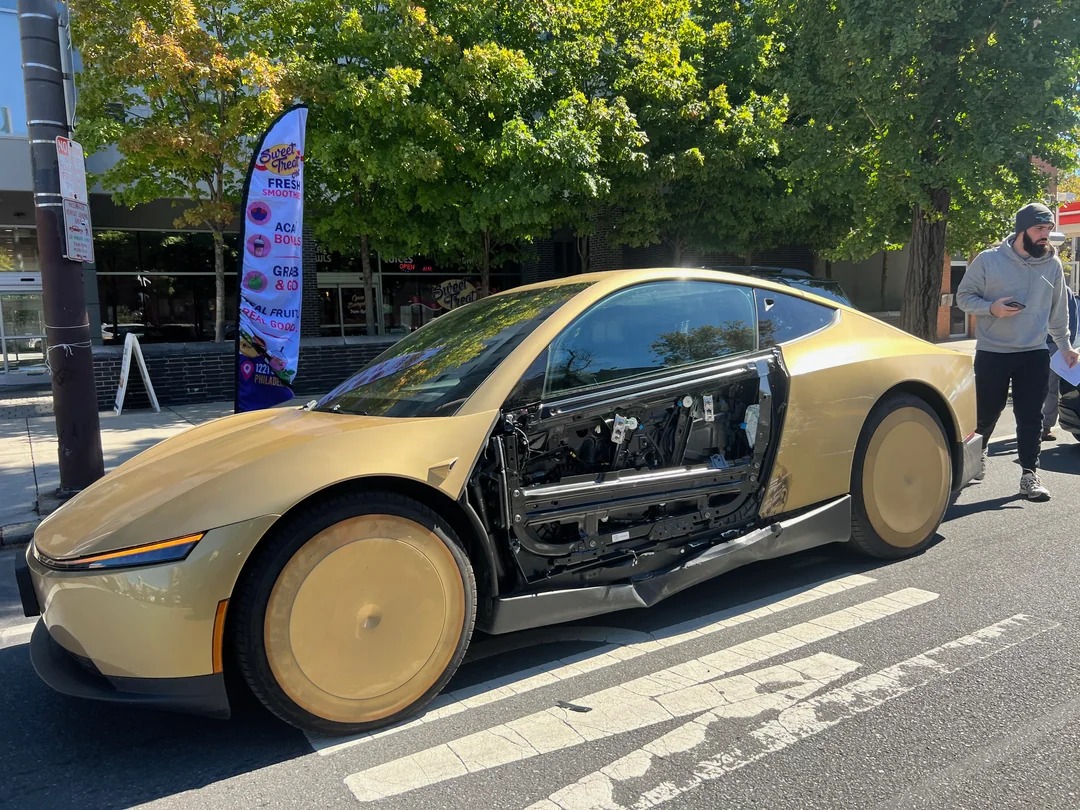
This week, a Tesla Cybercab was involved in a collision accident in Philadelphia, and after the accident, the entire outer panel of the driver's side door fell off.
It is still unclear who is responsible for the accident, nor is it known whether Tesla's software was in control of the vehicle at the time of the incident. However, Tesla does not have a license to operate autonomous vehicles in Pennsylvania, which narrows down the possibilities of the vehicle being in autonomous driving mode at that time on Broad Street.
Reddit user ryephila posted a photo showing a golden Cybercab parked about a mile south of the town hall; the left side door shell is no longer present. The poster did not witness the accident, but wrote: "It looks like a low-speed accident that tore off the left side door panel of this cybercab."
The photos largely support this claim. It is evident that the internal frame of the car door, the window lifting mechanism, and the wiring harness are all exposed. The glass remains intact, and there appears to be no bending in the underlying structure. The rest of the damage is minor: there are wrinkles on the side skirt panels beneath the car door, and there are some scratches on the rear fender plates.
The second photo shows a dark-colored sedan parked directly behind Cybercab, but it is not clear at this time whether that vehicle is involved in the incident. There are also no reports of any injuries to people.
The plastic outer panel of Cybercab is originally designed to be detachable.
Tesla does not apply paint to Cybercab. Its body panels are made of molded plastic, with the color directly mixed into the material. Last year, Tesla's engineering leader Lars Moravy and design directors Franz, von, and Holzhausen introduced this concept to Sandy Munro: a colored outer layer is connected to a plastic backplate, and the entire panel is fixed with fasteners that can be accessed from the inside.
Therefore, the peeling of the entire car door outer skin is somewhat expected given this design. If the same impact occurred on a vehicle with a steel body, it would typically result in the door denting, requiring repair and repainting. In theory, Tesla could simply install a new outer panel and send the vehicle back on the road again; however, there may be more serious damage beneath the door, which could complicate the repair process.
Tesla does not have a license to operate Robotaxi in Pennsylvania.
Pennsylvania requires that those operating "highly automated vehicles" must obtain a compliance certificate issued by the Pennsylvania Department of Transportation ( PennDOT ). This requirement applies to SAE level 3 and above autonomous vehicles, regardless of whether there is a driver in the vehicle or not. There are a total of 7 organizations on the list of certified entities ( PennDOT ), and Waymo is one of them, authorized to operate with drivers in the vehicle in Philadelphia. Tesla is not on this list.
Golden Cybercab began to appear around Philadelphia in mid-September. The Philadelphia Inquirer reported that several vehicles were spotted at a Tesla store in Devon, and Tesla refused to explain the purpose of these vehicles at the time.
In the absence of the aforementioned certificates, it is most likely that this vehicle on Broad Street was being driven manually at that time, or it was operating with Tesla's Level 2 driving assistance system, with a human driver sitting behind the steering wheel who is legally responsible. Tesla has been testing the installation of Cybertruck steering wheels on Cybercab for such purposes. It is impossible to determine whether this vehicle is equipped with a steering wheel based solely on photographs.
And this will also affect whether the accident will be recorded in the federal database. According to the "Standing General Orders" of the National Highway Traffic Safety Administration (NHTSA) of the United States, if an accident involves an autonomous driving system, it must be reported even if the result is merely property damage that exceeds a certain threshold. If the accident occurs during the operation of a Level 2 system, then a report is only required in cases of death, hospitalization of anyone involved, deployment of airbags, or collision with pedestrians or cyclists.
Top comment Beario
"The Cybercab has been appearing at the location of Devon for over a month now. There are quite a few of them parked in the parking lot there, at least 30. They indeed come equipped with cybercab steering wheels, which makes me think that Tesla is conducting fleet testing in the area. The traffic in that vicinity is relatively busy, which adds even more significance to this matter."
If this incident is ultimately reported, it will be recorded in the NHTSA database as an accident involving a driving assistance system, joining Tesla's record-breaking 207 incidents reported in a single month earlier this year (referenced by Autopilot and FSD). Like other Tesla-related entries, the details of the accident will be abbreviated.
Views of Electrek
First, I would like to express a few reservations. We don't know for sure who hit whom. If it was a human driver who deviated from the lane and hit Cybercab, then this accident has nothing to do with Tesla's software, and there is nothing in these photos that could prove otherwise.
In my opinion, the most interesting part is that outer panel. It came off cleanly, and the structure underneath seems to be intact as well. This might indicate that the design was effective: the inexpensive, paint-free plastic outer shell can be quickly replaced after a collision, without having to leave the vehicle in a body shop waiting for painting for an extended period. It could also suggest that this type of body panel is so prone to coming off that it loosens after even a minor impact and falls onto city roads. With just a few photos, we cannot draw a definite conclusion.