


Overnight, the yield on 10-year U.S. Treasury bonds reached a 24-year high this week, briefly breaking through 5.36% before closing at 5.276%. Against this backdrop, the U.S. stock market presented a divided picture: the S&P 500 index continued to hover near historical highs, but within it, valuation compression, sector differentiation, and extreme market concentration were evolving simultaneously.
The current forward price-earnings ratio of the S&P 500 index is about 19.3 times, whereas at the beginning of the year it was 22.2 times. The compression in valuation is significant, but the index itself has not tumbled significantly. The reason is that profit expectations have also strengthened, partially offsetting the impact of the narrowing valuation.
Crossmark Global Investments Chief Investment Officer Bob Doll stated: "Rising interest rates have had a huge impact on the stock market. The price-earnings ratio has dropped by three notches. This effect is very direct, but it has been overshadowed by the outstanding earnings performance."
Nationwide Investment Management Chief Market Strategist Mark Hackett said, "This is basic common sense in finance 101 – the higher the interest rate, the less valuable the stock."
Small-cap stocks are hit the hardest, with Mag providing a 70% safe haven.
Meanwhile, small-cap stocks are suffering more direct impacts. The Russell 2000 index has fallen by 9% from its historical closing high set less than two months ago, closing at 2,793.20 points on Wednesday, just a step away from officially entering a technical correction zone (a 10% decline from the high point).
Truist Advisory Services Chief Investment Officer Keith Lerner pointed out that the "primary and most important factor" behind the recent decline in small-cap stocks is the rise in long-term U.S. Treasury yields. "Rising interest rates are having an impact—only the tech sector has masked this fact."
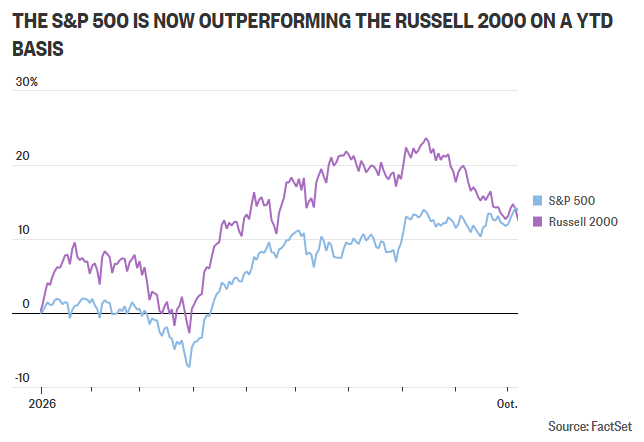
The vulnerability of small-cap stocks has its structural reasons. Lerner explains: 'Small-cap stocks are more sensitive to interest rates; they hold more debt, and the proportion of floating-rate debt is also higher than that of their large-cap counterparts.'
Interactive Brokers Chief Strategist Steve Sosnick also stated: "A second-quarter GDP growth rate of 2.2% may not necessarily ensure that all ships rise with the tide. Uneven economic growth, coupled with a significant rebound in interest rates, creates a difficult environment for small-cap stocks."
It is worth noting that even small-cap technology stocks were not spared – Invesco S&P Small-Cap Information Technology ETF ( PSCT ) has fallen by 10.4% since its peak on June 30th.
Extreme market concentration: Four companies support the entire index
The resilience of the broader market index largely comes from the contributions of a very small number of companies.
According to research data from Citadel Securities, Microsoft, NVIDIA, Apple, and Meta contributed approximately 300 points to the rise of the S&P 500 in the third quarter, which is more than three times the total increase of the index during the same period; whereas the remaining 496 companies collectively dragged down the index by 150 points.
The Scott Rubner of Citadel wrote in a client report: 'The stock market is not the economy, and it is becoming increasingly clear that the S&P 500 does not represent ordinary stocks either.'
This level of concentration has approached historical extremes for various indicators. The Dow Jones Industrial Average has fallen by 4.2% in the past month, while NASDAQ has risen by nearly 4% during the same period. This divergence between the two is a direct reflection of this differentiation.
Bonds and stocks are being priced in "different worlds"
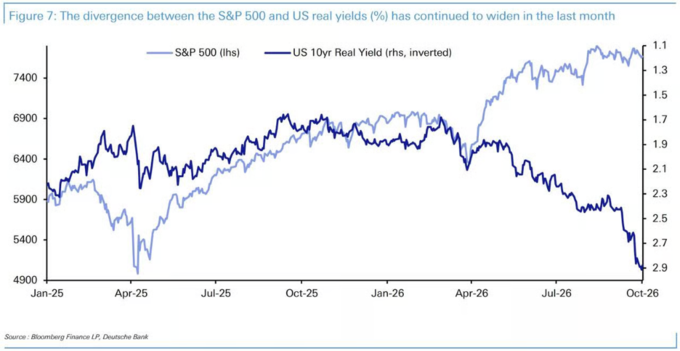
Deutsche Bank’s macro strategist Henry Allen issued a deeper warning in the latest report: the bond market and the stock market are currently pricing “fundamentally different macroeconomic environments.”
The bond market has begun to reflect higher inflation risks, greater fiscal risks, and more restrictive policy interest rate expectations, with yields rising to multi-year highs in many parts of the world. However, the stock market has largely ignored this—on Friday, the S&P 500 closed just less than 1% away from its historical high.
Allen pointed out that such a deviation is "unlikely to continue." He wrote, "We are pricing the symptoms of the new regime (such as yields at multi-decade highs and widening spreads on sovereign bonds), but not its logical consequences (such as slower growth and increased default risks) – consequences that have historically manifested themselves in the weakening of risk assets."
Deutsche Bank has identified the five most notable market misalignments at present, and the core conclusion is that if financial pressures do not subside quickly (as they did rapidly after the Silicon Valley Bank incident in March 2023), risky assets will face ongoing upward pressure.
Profit season becomes a crucial test
As the third-quarter financial reporting season kicks off next week, with heavyweight institutions on Wall Street such as JPMorgan Chase and Citigroup being among the first to disclose their results, the market's expectations for corporate earnings have been raised even higher.
Bob Doll of Crossmark predicts that higher interest rates will continue to act as a barrier to the stock market, especially for cyclical companies. He said, "If you have some cash on hand, that's not a problem, because I don't think the stock market will rise in a straight line like it did in the past few months."
Since the closing high on August 13, 18 out of 25 industry sectors in the S&P 500 have seen declines, with the equal-weight version of the S&P 500 index falling by 5%. Several sectors, including banking and real estate, have experienced declines of more than 10%.
Whether the profitability can continue to be "super outstanding" will determine the ultimate outcome of this tug-of-war between valuation and yield.