

The bond and stock markets are operating according to fundamentally different logics, and this rare misalignment is arousing deep concern on Wall Street.
DB Macro Strategist Henry Allen pointed out in the latest report that the bond market has begun to price in rising inflationary pressures, expanded fiscal risks, and a more aggressive monetary policy path, with global yields rising to multi-year highs; however, at the same time, global stock markets remain near historical highs, with the S&P 500 index closing last Friday less than 1% away from its all-time high, and the Euro Stoxx 600 index also less than 4% away from its peak. The VIX volatility index remains low, and credit spreads are far from reaching the levels seen during periods of stress in recent years.
This misalignment means that the market is pricing for the “symptoms” of the new macroeconomic regime—such as yields at their highest levels in decades and widening spreads on sovereign bonds—but it has not yet priced in the logical consequences of these symptoms, such as a slowdown in economic growth and an increase in default risks. Deutsche Bank warns that unless financial market pressures dissipate as quickly as they did after the Silicon Valley Bank incident in March 2023, risky assets will face increasing selling pressure.
Why are European stock markets indifferent to the sudden widening of the main interest rate spread?
The European sovereign bond market witnessed extremely rare trends last week. According to Bloomberg data, the yield spread between 10-year government bonds of France and Germany widened by 32 basis points in a single week, representing the largest single-week increase since Germany's reunification in 1990 as recorded by Bloomberg; during the same period, the yield spread between 10-year government bonds of Italy and Germany widened by 23 basis points.
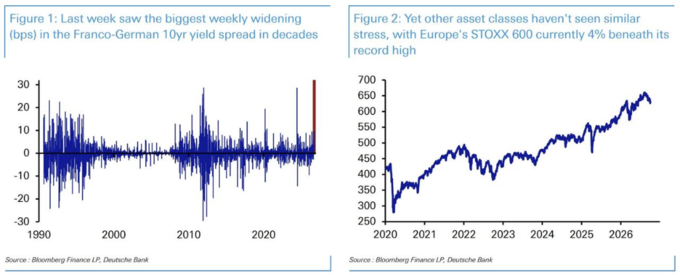
However, the reaction of European stock markets was unusually calm. The Stoxx 600 index fell by only 1.1% last week, still less than 4% from its historical high. The investment-grade credit spread in the eurozone rose to just 101 basis points by last Friday, far below the levels during the European sovereign debt crisis of 2011-2012, the impact of the pandemic in March 2020, and the interest rate hike cycle in 2022.
Deutsche Bank pointed out that during the European sovereign crisis from 2011 to 2012, the turmoil caused by the pandemic in March 2020, and the bear market triggered by interest rate hikes in 2022, each significant widening of sovereign yield spreads was accompanied by sharp adjustments in risky assets. This time, the French-German yield spread has risen to its highest level since 2012, yet the reactions of the stock market and credit markets have clearly deviated from historical patterns.
The market has overbetted on central banks becoming more dovish, but inflationary constraints cannot be ignored.
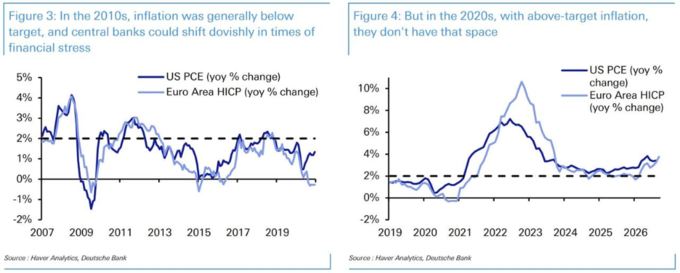
Last week's turmoil in financial markets prompted investors to quickly adjust their expectations regarding central bank policy paths, significantly reducing the likelihood of further interest rate hikes by the Federal Reserve and the European Central Bank. However, Deutsche Bank believes that there are clear flaws in this pricing logic.
Current inflation is still above the target level, which fundamentally limits the central bank's room to move towards a more accommodative policy. This is vastly different from the situation in the 2010s, when inflation was below target, allowing the Federal Reserve to take a more dovish stance at the beginning of 2016 and at the end of 2018 due to financial pressures.
A report by Deutsche Bank suggests that similar errors have occurred multiple times between 2022 and 2023: at the beginning of the Russia-Ukraine conflict, during the market turmoil caused by the UK's "mini-budget" in September to October 2022, and around the collapse of Silicon Valley Bank in March 2023. Each time, there was a temporary shift in market pricing towards a more dovish stance by central banks, but these moves were forced to reverse due to persistent inflation. Deutsche Bank also noted that central bank officials tend to overcorrect from the previous crisis. Given that many policymakers faced criticism for underestimating inflation between 2021 and 2022, the current reaction patterns are clearly more hawkish.
Oil price futures curves continue to "report errors," and the secondary inflation effect has been underestimated.
There is also a persistent deviation between the pricing logic of the oil futures market and reality. Since the outbreak of the conflict between the United States and Iran, the Brent crude oil futures curve has been in a state of deep futures premium for a long time ( backwardation ). The market has always expected that oil prices would fall significantly in the coming months – but this expectation has been proven wrong for over six months now.
As of the time of this report, the near-month contract for Brent crude oil was priced at $102 per barrel, the 6-month forward contract at $90 per barrel, and the 12-month forward contract at $83 per barrel. The market still expects oil prices to fall significantly, but the December 2026 forward contract has been hovering near historical highs.
Deutsche Bank also warns that the market has underestimated the secondary transmission effects of supply shocks. Historical experience shows that after the oil crisis in 1973, oil prices soared and remained high for many years in real terms; the inflation wave from 2021 to 2022 also clearly demonstrated that rising energy prices would gradually spread to the prices of core goods and services. In addition, according to The Wall Street Journal, President Trump is expected to resume military strikes after the mid-term elections, and the prospects for a short-term alleviation of the situation in the Strait of Hormuz are not optimistic.
The bond market and the stock market operate in two different worlds of pricing, and this misalignment is unlikely to persist in the long term.
Deutsche Bank's core judgment is that the bond market and the stock market are currently pricing for two fundamentally different macroeconomic scenarios, and this divergence is unlikely to coexist in the long term.
The bond market has fully reflected inflation risks, fiscal risks, and the prospects of tighter monetary policies, with yields rising to multi-year highs. The stock market, however, remains near its historical highs, implying that growth is still strong and that financial pressures will not spread to the real economy.
Deutsche Bank acknowledges that during periods of strong economic growth, yields and stock prices can rise in tandem. However, the market trends of last week indicate that we are no longer in a situation of mere “strong growth.” The spread between sovereign interest rates has widened significantly, the credit market is under pressure, and oil prices remain high. Investors have begun to question whether the economy can withstand further interest rate hikes.
The report also points out that there are precedents in history for a lagged reaction in the stock market. For example, at the end of 2021, even though central banks had begun to take a more hawkish stance and inflation was significantly exceeding targets, the S&P 500 and the Stoxx 600 continued to rise until they peaked in January 2022. However, Deutsche Bank's conclusion is clear: if current financial pressures persist rather than dissipate quickly, referring to historical precedents such as the European debt crisis in 2011, the impact of the pandemic in March 2020, and the interest rate hike cycle in 2022, risky assets will eventually come under pressure, even if there is a time lag in this process.