

Justin Drake's call for advance preparations in case AI might crack wallet cryptography has sparked mixed reactions, while Bitcoin has fallen below $83,000.
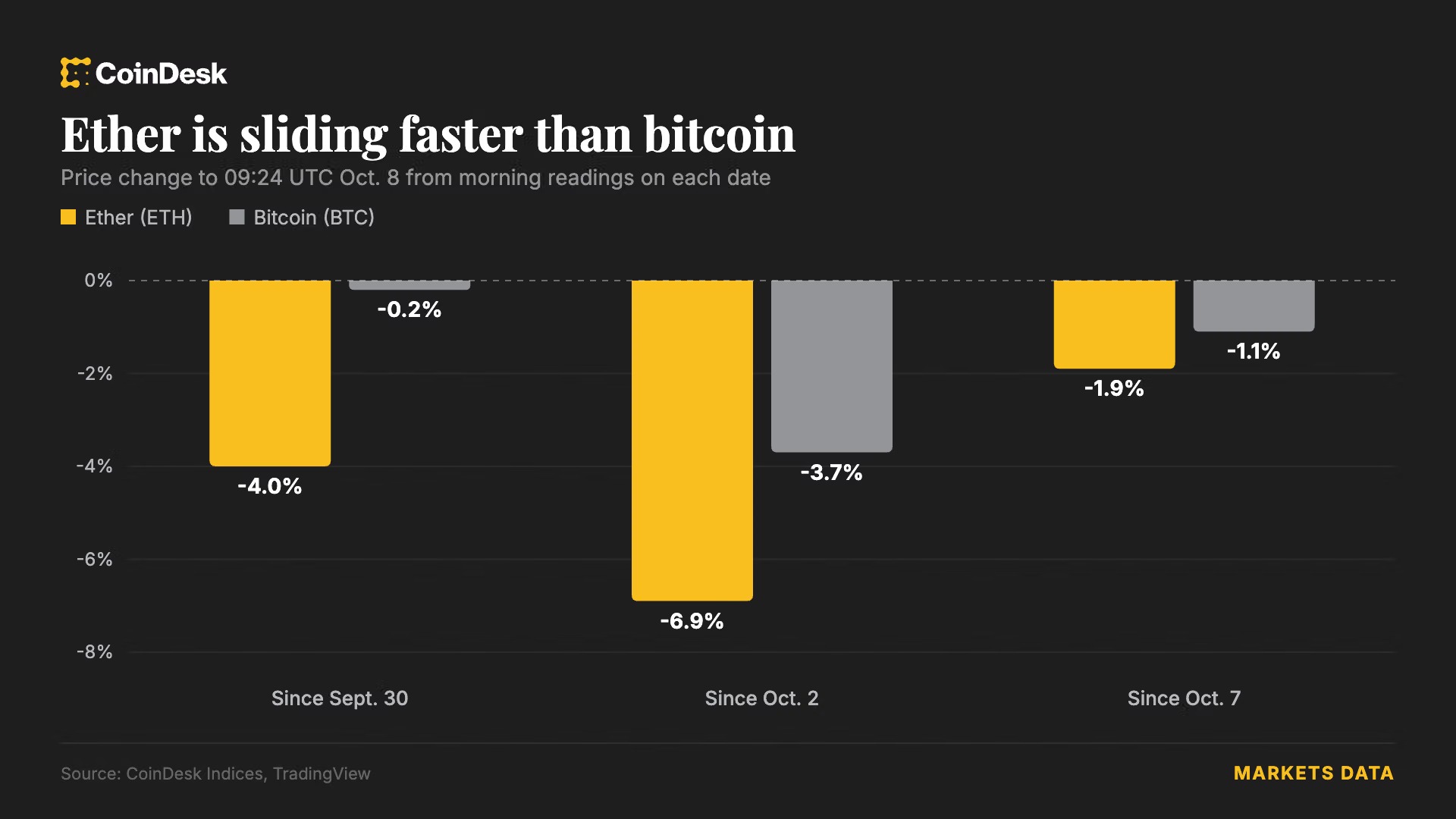
Bitcoin once fell to around $82,300, then rebounded to around $82,800, which is about 4% lower than the high of nearly $86,600 on Tuesday.
Ethereum Foundation researcher Justin Drake calls on the industry to prepare for what he refers to as “bunker mode” in case the mathematical advancements driven by AI crack wallet cryptography; Vitalik Buterin indicates that this risk indeed exists, but token holders should not act rashly.
After the Fed meeting minutes showed that most officials expected another interest rate hike before the end of the year, the yield on 30-year U.S. Treasury bonds rose to 5.71% ahead of a $22 billion auction.
Bitcoin BTC fell to $82,500.03 during the Asian session, dropping to around $82,300 at one point before rebounding to around $82,800, which is about 4% lower than its high of nearly $86,600 on Tuesday. CoinDesk The 100 index has fallen by nearly 2% in the past 24 hours.
A researcher from the Ethereum Foundation, Justin Drake, posted on X and received nearly 4 million views, calling on the industry to begin planning for what he referred to as “bunker mode”.
The idea is to gradually migrate funds to new addresses, whose public keys have never been exposed. Drake believes that the mathematical progress driven by AI gives reason to prepare for the possibility that the elliptic curve signatures used to protect Bitcoin and Ethereum wallets could be cracked in “a few months rather than years.” He mentioned the 722 mathematical achievements released by OpenAI this week as one piece of evidence.
Not everyone agrees with this urgency. Ethereum co-founder Vitalik Buterin stated that the risks brought about by the accelerated progress in mathematics due to AI should be taken seriously, but he advised token holders not to rush to transfer their funds. On the other hand, the CEO of Bitcoin technology company Jan3, Samson Mow, reassured concerned individuals that there is no need to panic, “because one Ethereum researcher is saying some foolish things.”
The pressure in the bond market has not eased either. According to data from CNBC, the yield on 30-year U.S. Treasury bonds rose by 4 basis points to 5.71%, and the yield on 10-year bonds rose to 5.32%. Previously, the market was awaiting the auction of $22 billion in 30-year Treasury bonds scheduled for later on Thursday.
The minutes of the Federal Reserve's September meeting were released on Wednesday, showing that all 19 officials supported the interest rate hike decision from last month, and most of them believed that another hike before the end of the year might be appropriate. The September Consumer Price Index will be released on October 14th, which is the last inflation data before the Federal Reserve's decision on October 28th.
Derivatives positions
The main cryptocurrencies are experiencing deleveraging, rather than an increase in short selling: The scale of open contracts for BTC, ETH, HYPE, XRP, and DOGE has declined significantly, with the maximum decline being comparable to or even greater than the drop in spot prices. This indicates that traders did not continue to increase their positions during the downturn; instead, in some cases, they chose to close their positions. This round of selling seems more like a risk reduction strategy, rather than the accumulation of new short positions.
NEAR shows strength against the trend, with capital inflows: NEAR has risen by 4% in the past 24 hours, and its not-yet-closed contracts have soared by 11% to $1.7 billion, indicating new capital has entered the market. There is no consensus on who is driving this trend. The funding rate is slightly negative, suggesting that shorts are paying a price for their positions; however, NEAR's 24-hour cumulative trading volume adjusted for not-yet-closed contracts ( CVD ) is the most positive among major currencies, indicating strong buying momentum. If the upward trend continues, shorts who bet on a decline may be forced to cover their positions.
SOL Short positions may be increasing: Despite a 2% decline in SOL, the number of open contracts for Solana still rose by 1.5%. A rise in open contracts while prices are falling usually indicates that new short positions are being established.

Selling pressure continues for a second day: In the past 24 hours, the CVD values for most major cryptocurrencies have been negative, including BTC and ETH, with only NEAR and SUI being exceptions. Sellers are still actively suppressing buying orders at market prices, just as they did yesterday.
Bitcoin volatility has rebounded from its year-low: The 30-day implied volatility index BVIV rose 5% today, turning upward from its year-low. This rebound indicates an increased demand in the market for option protection, although the index is still within its recent range. Some analysts believe that as volatility in the bond market continues to rise, the calmness in the crypto market and on Wall Street may not last long.
Option traders are shifting to a more defensive stance: The bearish/bullish skew for Bitcoin has risen to 10% over the week, and the skew for contracts with a maturity of one to two months is also slightly positive. This indicates that the market favors bearish options, which provide downside protection, representing a change from yesterday's relatively neutral readings. Ethereum shows a similar trend. Bitcoin and Ethereum bullish options still rank among the top five most active contracts in the past 24 hours according to Deribit.
Token Dynamics
Although SOL has fallen by about 1% since UTC midnight, the Solana DeFi token rebounded after a sell-off on Wednesday. The jupiter ( JUP ) aggregator token has risen by 15% in the past 24 hours, and the DEX ecosystem tokens have risen by 14%. The raydium ( RAY ) token has also risen by 14%, while the liquid staking token jito ( JTO ) has increased by 10%. Jito and jupiter had previously fallen by 6% to 8% the previous day.
The largest privacy coin by market capitalization, Zcash ( ZEC ), has fallen 6% in the past 24 hours to around $1,240; the related privacy token, midnight ( NIGHT ), has fallen 8%. Monero ( XMR ) has not seen significant changes, with a slight increase of about 0.5% since UTC.
Curve ( CRV ) has risen by 11% in the past 24 hours, while the synthetic US dollar token ethena ( ENA ) has fallen by 7%, leading to a divergent trend in the DeFi sector. Moreover, there is still a lack of clear bullish catalysts at present.
AI Tokens continue to show a downward trend, bittensor (TAO) has fallen by 6% in the past 24 hours, venice (VVV) has fallen by 7%, and the decentralized AI data network grass (GRASS) has also fallen by 7%.
1 Bitcoin ETF Investors massively withdraw, creating the largest outflow in months 21 minutes ago
2 Real-time News: Bond selling and rising oil prices intensify pressure on risky assets 51 minutes ago
2 hours ago, Standard Chartered Bank will expand its institutional encryption and RWA custody services to Singapore.
Greece prepares to impose a 10% capital gains tax on cryptocurrencies 2 hours ago
5 Samsung integrates USDC to reshape cross-border remittances for 82 million Galaxy users 2 hours ago
6 crypto investment companies Deus X Capital have closed; supporters are shifting to their own strategies 3 hours ago
7 Ripple earns fees by financing bets on leveraged stocks; this business has long been dominated by banks 5 hours ago
8 bitcoins are being used for tuition payments and working capital, not just for trading, according to lenders 5 hours ago.
9 Ethereum Glamsterdam tests showed nearly 200 million gas per block 7 hours ago
10 hours ago, as reports of an Iranian attack plan drove up oil prices, Bitcoin fell below $83,000
The Definitive Stablecoin Landscape Series : Asia Pacific
As stablecoins move into regulated finance , APAC is becoming a key proving ground . This report maps the region ’s rules , use cases , and RLUSD ’s role.
Why it matters : As stablecoins move into regulated finance , APAC is becoming a key proving ground . This report maps the region ’s rules , use cases , and RLUSD ’s role .
Live news : Risk assets under pressure as bond selloff and oil rally intensify
Ripple is earning fees financing leveraged stock bets , business long run by banks
Bitcoin loans are paying for tuition and working capital , not just trades , lenders say
Bitcoin ETF investors head for the exit , and it 's the biggest rush in months
Live news : Risk assets under pressure as bond selloff and oil rally intensify
Standard Chartered to expand institutional crypto and RWA custody to Singapore