

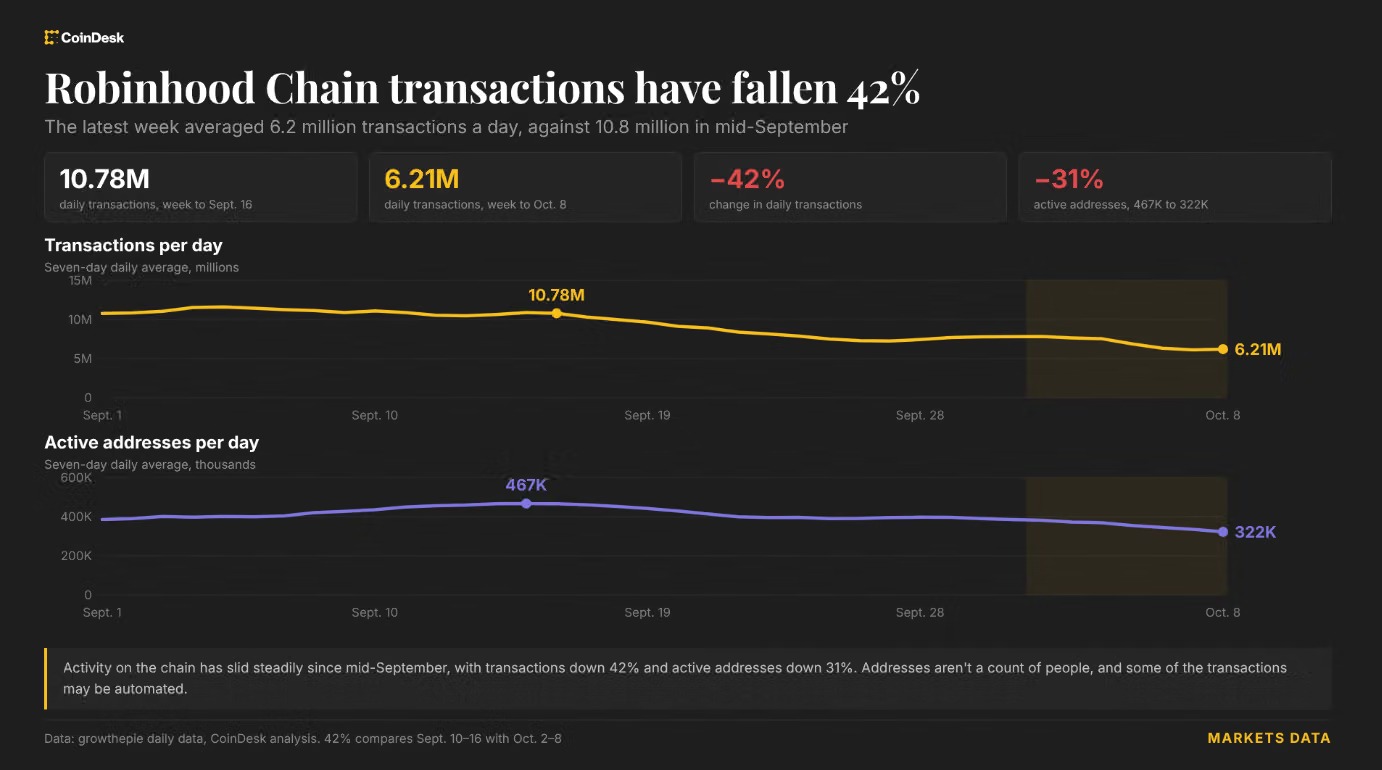
The slowdown in activities of Robinhood Chain has extended to the transactions themselves. Although Robinhood continues to process token exchange payments for users through its Robinhood Wallet application, with amounts exceeding 50 cents to cover network fees, the average daily transaction volume on this chain has decreased by 42% since mid-September.
According to the calculations based on growthepie using CoinDesk, Robinhood Chain processed an average of 6.2 million transactions per day from October 2nd to 8th, which is a 42% decrease compared to the 10.8 million transactions from September 10th to 16th. The number of active addresses per day also decreased by 31% during the same period. Even when compared to the previous week, activity saw a 20% decline.
Robinhood launched this blockchain in July, allowing users to trade tokens and engage in lending through applications connected to Ethereum, with plans to implement 24/7 trading of tokens linked to stocks and funds.
Each transaction incurs network fees, and the applications built on top of it also charge their own fees for transactions and lending. According to a report from Bernstein last month, Robinhood retains approximately nine-tenths of these network fees. Therefore, a decrease in the number of transactions means that the revenue generated by that blockchain will also decrease.
On September 19th, when CoinDesk reported a 97% plunge in fees, the number of transactions was still near a high, and the weekly trading volume was also increasing. Now, both of these indicators have turned downward.
This reduction may not seem as significant on a practical level as the original figures suggest, because a single trader can use multiple addresses, and an automated program could generate thousands of transactions.
Transactions have decreased, but the balance remains stable.
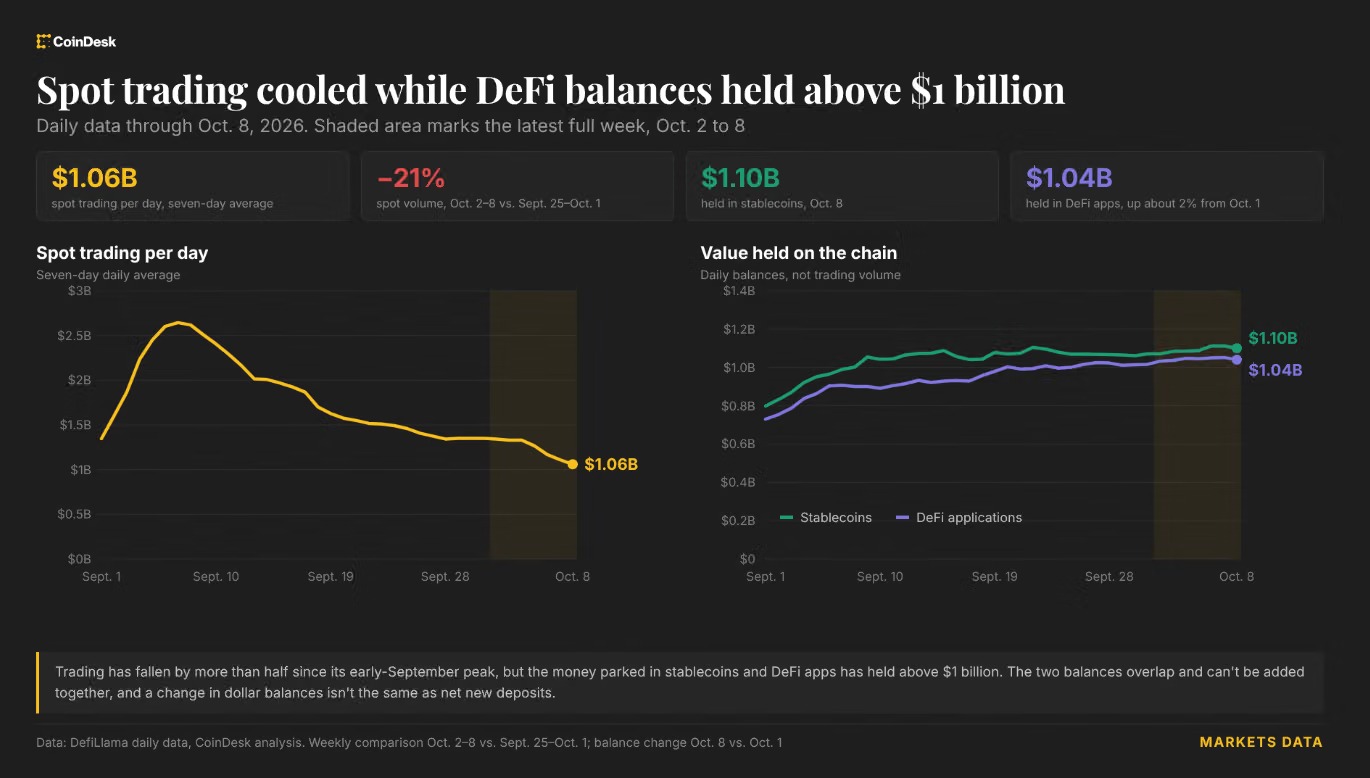
Spot exchanges where users directly buy and sell tokens handled $7.45 billion from October 2nd to 8th, which is a 21% decrease from $9.46 billion the previous week. This is a calculation based on data from DefiLlama by CoinDesk. Approximately 77% of this volume was processed by Uniswap. Uniswap is an application that allows users to exchange tokens with each other without the involvement of intermediary companies.
However, users did not withdraw their funds. The deposits in the lending and trading applications on that chain increased by about 2% within a week, reaching $1.04 billion; the supply of stablecoins also rose slightly to about $1.1 billion. Some stablecoins are stored directly within these applications, so there is an overlap between these two figures.
This means that the same amount of funds is just being traded less frequently, with traders keeping their funds on Robinhood Chain in anticipation.
However, futures are an exception. DefiLlama Rolling seven-day data released on Friday showed that the trading volume of perpetual futures was approximately $7.35 billion, a 26% increase from the previous week. Perpetual futures are a type of contract that allows traders to bet on price trends without holding the underlying tokens.
From October 2nd to 8th, users paid approximately $65,000 per day in network fees, which is a 39% decrease from the previous week. This amount is just a small fraction of the $8 million collected on the busiest day of early September for that blockchain.
Robinhood and its partners have been working hard to keep traders active. The trading platform Arcus started offering additional reward points for stock-token exchanges conducted through Robinhood Wallet on October 1st, and Robinhood has also postponed the fee promotion that was originally scheduled to expire on September 29th.
Robinhood is now extending the period for charging network fees on any exchanges made through its wallet that exceed $0.50 until December 31st. This gives the chain less than three months to revitalize its $1 billion in deposits; otherwise, users will have to start bearing the fees themselves by then.