

Beneath the apparent calm of the U.S. stock market, a rolling bear market is quietly spreading.
Nomura Securities' cross-asset strategist Charlie McElligott warned in a report on October 8 that the S&P 500 index has remained virtually stagnant for nearly two months, but 85% of its constituent stocks have entered a technical adjustment phase. The "calm" of the index is merely an illusion created by an extremely concentrated market structure.
McElligott points out that just ten stocks contributed 70% of the 23% increase in the S&P 500 since March 30, with NVIDIA alone accounting for 13%. Meanwhile, a diesel shortage in Europe is being transmitted throughout the market through interest rate volatility, posing a "fuse" that could detonate at any time.
Within just a few hours of the Nomura report being released, two key variables came into effect: Trump announced that he would not take military action against Iran before the mid-term elections, and oil prices fell in response; shortly thereafter, The Financial Times in the UK disclosed that OpenAI's annual revenue was far lower than the expectations previously communicated to investors. On Thursday, NASDAQ fell by more than 1%, and the AI sector suffered a heavy blow.
The above two pieces of news directly impact the core logic of the market described by McElligott – a “severely distorted” structure where a few AI winners support the index, while the remaining constituent stocks experience significant declines below water. Nomura’s analysis shows that the current level of market correlation is at an extremely low level that has only occurred twice in the past 25 years, and the historical contexts for those two times were on the eve of the global financial crisis in 2007 and during the “Volatility Apocalypse” in 2018 ( Volmageddon ).
The index is "stalling in place," but beneath the surface, it's already a bear market.
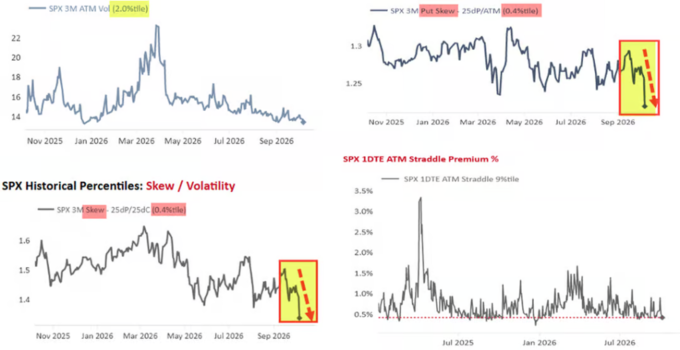
Since the impact of "momentum deleveraging / AI liquidation" in July, the overall gain/loss of the S&P 500 index has been less than 1%, and volatility indicators have been comprehensively compressed: The SPX 10-day volatility has reached only 7, with the 3-month at-the-money implied volatility at the 2nd percentile of the past year, and the 25- delta put/call skew has dropped even further to the 0.4th percentile.
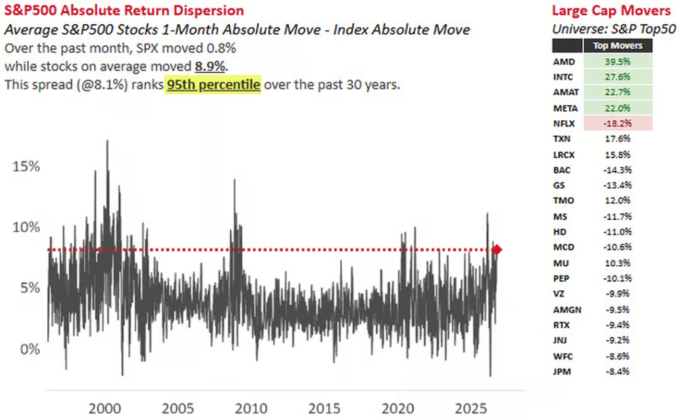
However, this calmness stands in sharp contrast to the intense differentiation at the individual stock level. Over the past month, the S&P 500 index has only moved by 0.8%, while the average volatility of its constituent stocks reached as high as 8.9%, with a difference of 8.1 percentage points between the two, which ranks at the 95th percentile over the past 30 years. AMD saw a monthly increase of 39.5%, with Intel rising by 27.6%; whereas Netflix fell by 18.2%, and bank stocks also faced pressure.
From a more macroscopic perspective, the damage to constituent stocks is shocking:
- 85% of the constituents in the S&P 500 have retreated more than 10% from their historical highs.
- 59% drawdown exceeds 20%
- 41% drawdown exceeds 30%
- 26% drawdown exceeds 40%
- 17% drawdown exceeds 50%
In other words, the index is just one step away from its historical high, but one-sixth of its constituent stocks have seen their values halved. McElligott describes this as a "rolling significant correction" and criticizes those who believe that "the stock market has not reflected interest rate risks"—interest rate-sensitive sectors have been hit hard over the past one and a half months: healthcare -3.5%, non-essential consumer goods -3.6%, utilities -4.6%, industrials -5.8%, finance -7.7%, materials -7.9%, REITs -9.8%. In the past 30 days, only the technology, media, telecommunications ( TMT ), and energy sectors within the S&P 500 have recorded positive returns.
Ten stocks drive 70% of the increase, posing extreme concentration risks
Nomura's data reveals the core mechanism behind this "illusion." Since March 30, the S&P 500 has risen by 23% in total, with ten stocks contributing 70% of that increase: NVIDIA contributed 13% alone, while Micron, Apple, and Microsoft each contributed about 9%, and the remaining 490 stocks combined contributed only 30%.
Since August 3rd, “Mag 7” (the seven major tech giants) has risen by 7.7%, while the S&P 500 has risen by 2.6%, and the equal-weight S&P 500 has fallen by 3%.
McElligott defines this phenomenon as "thematic differentiation" ( Thematic Bifurcation ):
A few AI winners bore the entire upward momentum of the index, while the rest of the stocks continued to lag behind due to capital and emotional factors being "squeezed out," the reversal of expectations regarding AI risks, and the suppression caused by rising interest rates.
The current level of market correlation is so low that there are only two comparable precedents in history. The implied correlation of the S&P 500 over one month is at the 1.8th percentile of the past year, while the realized correlation over one month is at the 0.7th percentile.
According to Bloomberg, Goldman Sachs derivatives strategist Brian Garrett previously noted that in the past 25 years, there have only been two periods with such low realized correlations: one on the eve of the global financial crisis and another during Volmageddon.
The options market "fears only upward movement," Gamma suppresses volatility
The calm at the index level is not accidental, but rather it is actively maintained by structural forces.
McElligott points out that the scale of 'volatility supply' in the index is enormous, especially the selling behavior of 0DTE/1DTE intraday options, which mainly comes from the QIS volatility risk premium (VRP) strategy. This strategy 'fills up' the Gamma positions of market makers, thereby isolating the possibility of significant fluctuations. Nomura estimates that the 0DTE customer Gamma range reaches $14 billion, which is at the 100th percentile.
The returns from selling volatility are astonishing: selling daily 25- delta S&P put options yielded a Sharpe ratio of 13.9 over 10 days, while selling a daily wide spread combination resulted in a Sharpe ratio of 14.2.
Apart from the QIS strategy, the scale of derivative income funds cannot be overlooked either. The asset management scale of derivative/income funds currently reaches $322 billion, an increase of $222 billion since 2020. Together, funds and structured products provide a monthly supply of Vega amounting to 415 million Vega.
Low implementation volatility forms a self-reinforcing cycle: Volatility control strategies, CTA, and the equity exposure of risk-parity funds have rebounded to the 86th percentile, approaching the high of the year.
The most abnormal aspect is the skewness of options: the put skewness is at the 0.4 percentile over the past year, while the call skewness is as high as the 99.6 percentile (Nomura's chart shows it at the 100th percentile). Market participants hardly buy downside protection; "the only fear is the risk of a rise in the right tail." A large number of institutional investors are under pressure to miss out due to insufficient holdings of AI core stocks, and the potential momentum for them to be forced to chase higher prices continues to accumulate.
Diesel shortage: The invisible fuse of interest rate volatility
McElligott identifies energy, particularly the diesel shortage in Europe, as the most vulnerable link in the entire market structure. His core judgment is: diesel cracking spread ( Cracks ) = interest rate volatility.
The logical chain is clear: Europe and Asia are facing energy shortages, and the global refining capacity (except in Asia and India) is severely insufficient. Trump previously threatened with a "diesel ban," forcing Europe to release emergency reserves on a larger scale than expected (France alone released 10 million barrels of diesel), but this can only sustain supplies for about a month and does not address the fundamental bottleneck in refining capacity.
The diesel cracking spread in the EU is currently at 85, and the annual interest rate volatility in the eurozone is 112.6%. Both have moved almost in sync since February – interest rate traders are actually trading diesel as a commodity.
The European energy market is also at a high level for the year: Germany's 1-year forward base electricity price is 138, the Netherlands' natural gas price is nearly 79, the UK's natural gas price is 196, and diesel prices are 1485 US dollars.
Three Trading Paths and Core Risks
In the face of the aforementioned complex situation, McElligott proposes three trading strategies:
First, pursue gains at the right tail. During the financial reporting season in the coming month, buy call options on large tech stocks with strike prices that are higher than the current market price, betting that AI's financial results will once again boost the market and drive the S&P 500 towards 8,000 points. The current skew in option premiums is at the 99th percentile, which offers asymmetric odds for institutions that are still underweight in this sector.
Second, take short positions on energy premiums in a context of peace expectations. If Trump sends signals of willingness to negotiate with Iran before the mid-term elections, volatility in energy prices and interest rates will decline significantly. At that time, one could shift to "undervalued assets" such as gold and Russell 2000 (IWM) upside options.
Thirdly, regardless of interest rate volatility, McElligott suggests hedging by going long on US dollar/euro interest rates Vega and holding long-term Swaption wide-spread options. This is because even if financial report quarters perform well, terminal interest rate expectations may still rise, and the Federal Reserve's policy path will need to be re-priced into a "truly restrictive" range.
Nomura backtesting shows that the USD 20-year Swaption wide spread option has a monthly average return of over 1% in the highest fifth percentile of inflation environments, with almost all of this return coming from Vega earnings.
OpenAI Revenue Data Slams AI Narrative
However, what is even more impactful is that, according to a report by the British newspaper The Financial Times, OpenAI has an annual revenue of about $20 billion, which is significantly lower than the previously communicated expectation of around $70 billion to investors, with a gap of nearly $50 billion. After the news was announced, NASDAQ fell by more than 1% on that day, and the AI sector suffered from concentrated selling.
Analysis suggests that this data directly undermines the core premise that supports the entire market structure—the authenticity of demand for AI and the sustainability of its growth. It also poses a direct challenge to the logic behind chip financing transactions for companies such as NVIDIA and Broadcom ( AVGO ).
The bullish scenario for McElligott is based on the expectation that the "trickle-down effect" of AI capital expenditure will ultimately benefit the remaining 493 stocks – the contribution of these 7 stocks to S&P 500 earnings growth has decreased from 15% to 7%, while the contribution of the remaining 493 stocks has accelerated from 7% to 13% and then to 18%.
But the starting point of this logical chain is precisely the authenticity of the requirements of AI, and this premise has just encountered its first major challenge from the investor documents of OpenAI itself.
Currently, market correlation is at an extremely low level, only seen on the eve of global financial crises and with the emergence of Volmageddon. The put skew is at the 0.4 percentile, meaning that almost everyone is taking short positions on left-tail risks at a cost of a Sharpe ratio of 14. The Swaption wide-spread options of McElligott may be the most cost-effective form of "insurance" available in the current market.