

The order book depths of Bitcoin and Ethereum have significantly improved since before and after the collapse, while the liquidity of altcoins continues to deteriorate, and the volume of spot trading is still far below the peak in October 2025.
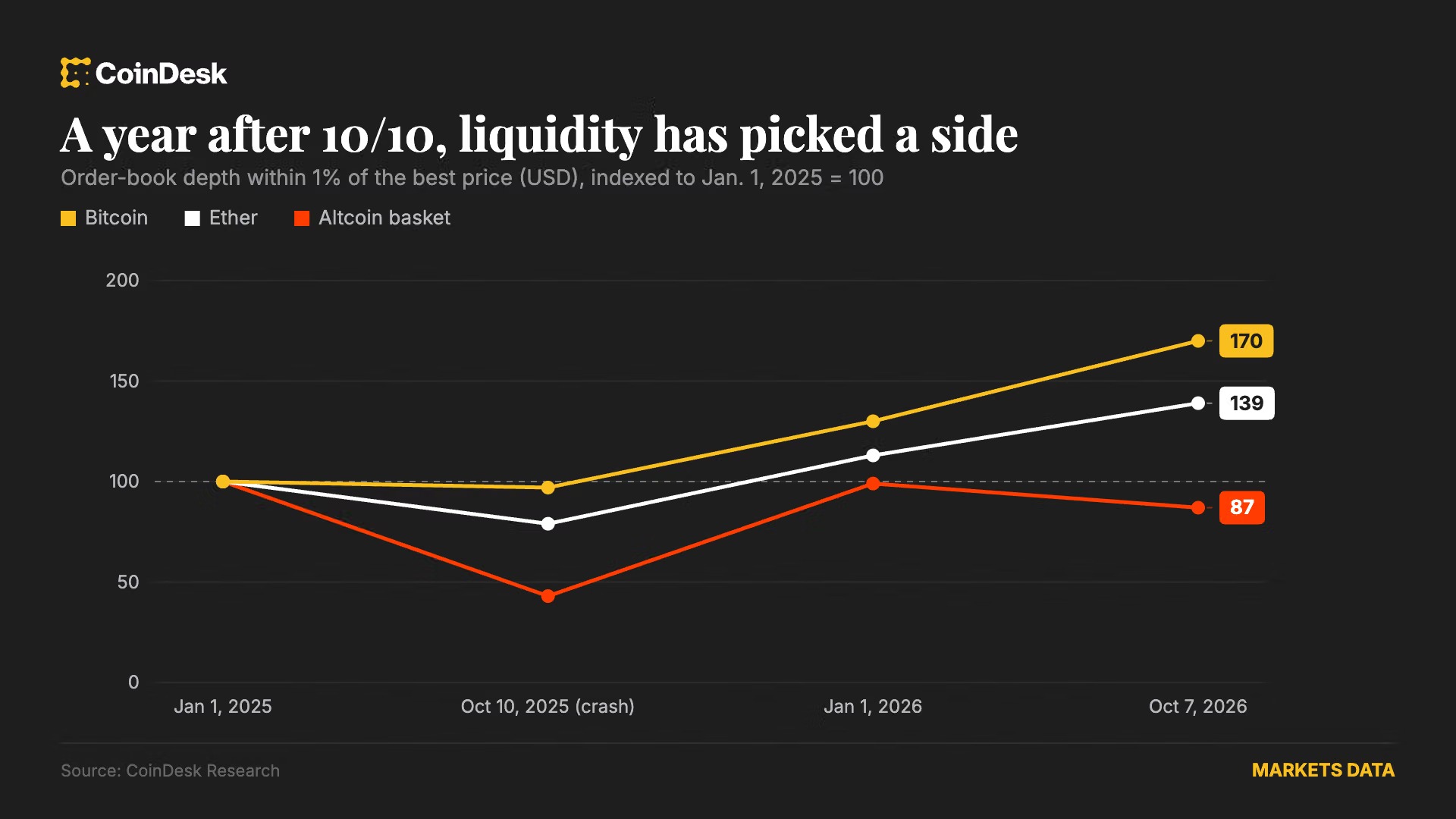
CoinDesk Research indicates that the current order book depth of Bitcoin and Ethereum is not only higher than on the day of the crash, but also higher than at the beginning of 2025 and 2026; moreover, the depth in US dollars has also increased, which reflects that market makers have invested more capital, and it is not merely due to the decrease in coin prices.
In contrast, the liquidity of altcoins has been moving in the opposite direction. Since the beginning of 2025, their depth measured in US dollars has been continuously declining, although the decline in token prices has masked this trend.
The weekly spot trading volume has decreased by nearly two-thirds compared to the week of the collapse, but it has roughly doubled from its lowest point in August.
A year after the largest liquidation event in the history of cryptography, the market “pipeline” has shown a divergent trend. The liquidity of orders in the order books of Bitcoin and Ethereum is now higher than on the day of the collapse, as well as higher than at the beginning of this year; however, smaller market capitalization tokens and spot trading have not yet recovered in tandem.
On the morning of October 10, 2025, just a few days after hitting a new historical high of over $126,000, Bitcoin fell back to $122,600. A few hours later, during the light trading session on Friday evening in US time, after U.S. President Donald Trump announced the imposition of a 100% tariff on Chinese imported goods, Bitcoin briefly dropped below $105,000, with most of that decline occurring within a matter of minutes. More than $19 billion in leveraged positions were liquidated in a single day.
To measure the subsequent recovery, CoinDesk Research compared the market depth of major centralized exchanges on four dates: January 1, 2025; October 10, 2025; January 1, 2026; and this week. By depth, it refers to the value of buy and sell orders around the current price. The deeper the order book, the larger the volume of large transactions that can be absorbed without affecting market prices.
The Bitcoin order book is currently deeper than at any of the earlier dates mentioned above. On October 7th, there were approximately 11.7 million US dollars in pending orders within a 1% price range. This figure is about 75% higher than on the day of the crash a year ago; it is also higher than the approximately 9 million US dollars at the beginning of this year and the approximately 6.9 million US dollars at the beginning of 2025.
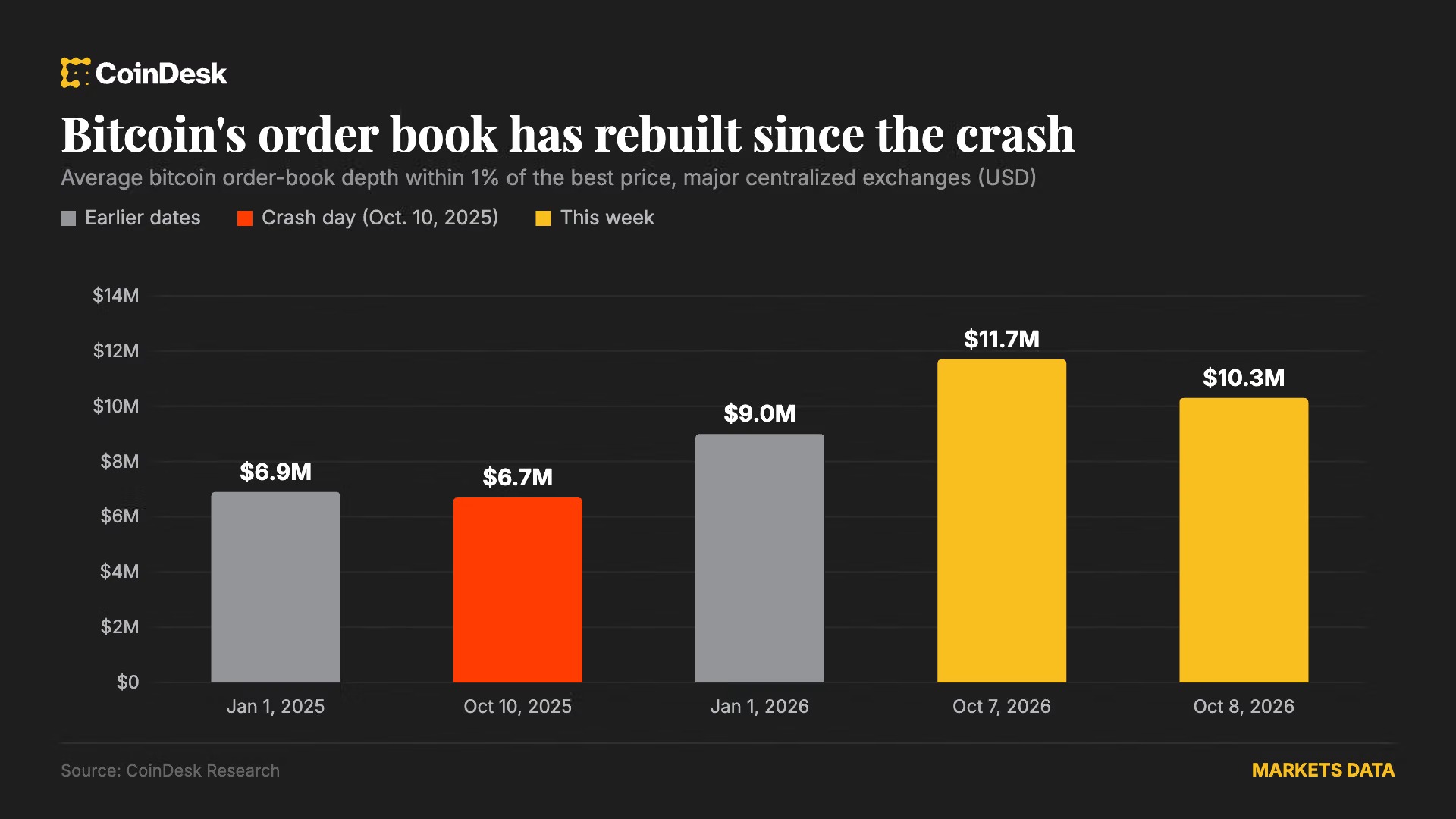
This is not a price effect. The price of Bitcoin is about one-third lower than before the collapse, so a deeper order book measured in US dollars reflects that market makers have invested more capital, rather than just the coin itself becoming cheaper.
The improvements are mainly concentrated in the areas close to the current price, as this is where market makers' most active quotes are usually found. Further away, at a distance of 5% from the current price, the depth is approximately 24 million US dollars, which is roughly comparable to the level in January 2025.
Ethereum’s recovery was stronger in some aspects. The depth of trading within a 0.5% price range more than doubled from the day of the collapse, reaching approximately $4.2 million; within a 1% price range, the depth increased by about three-quarters, to around $5.3 million, which is higher than the readings at two points in January.
Researcher CoinDesk Research and Saksham Diwan stated: "The increased depth of mainstream cryptocurrencies reflects real capital, rather than price effects."
This week, the reconstructed order book underwent a test ahead of time. As the market declined, the depth within 1% of Bitcoin's price fell by about 12% between October 7th and October 8th. The range of Ethereum prices that are closest to the current price became slightly thinner, but the number of orders placed at prices further from the current price increased.
Altcoins are left behind
For altcoins, the situation is exactly the opposite. According to a basket of altcoin samples selected by CoinDesk Research, the depth in US dollars was at its highest on January 1, 2025, and has been lower at each subsequent observation point since then.
At a level 5% below the current price, the depth has decreased by about one-third compared to the beginning of 2025, to around 2 million US dollars. For depths that are closer to the current price, within a range of 1%, the decrease is about one-sixth.
If measured by the number of tokens, the situation of altcoins seems healthier: they peaked on January 1st of this year and have only seen a slight decline since then. However, analysts argue that this recovery calculated on a per-token basis is mainly due to falling prices, which obscures the fact of a continuous loss of invested capital.
Spot trading tends to be light.
Spot trading has not yet resumed. CoinDesk Research data shows that over the four weeks ending September 27, the average weekly spot trading volume on centralized exchanges was approximately $279 billion, which is nearly two-thirds lower than the $801 billion in the week of the collapse.
Trading activity hit a bottom in August, with weekly trading volumes dropping to around $135 billion at that time, and since then they have doubled. However, this level is still significantly lower than the levels seen before and after the collapse.
What does this mean?
On October 10, 2025, liquidity in the crypto market disappeared within a few hours. Where that liquidity went afterward has remained an open question.
CoinDesk Research Manager Joshua de Vos stated: "A year ago, we wrote that liquidity was thin and dispersed, and it was unclear where capital would flow after things settled down. Now we have the answer: Bitcoin and Ethereum. Market makers have returned to the mainstream cryptocurrencies, with liquidity higher than before the collapse; at the same time, the liquidity of altcoins continues to decline overall. Except for a few altcoins, I expect this divergence to continue into next year, as mainstream cryptocurrencies will continue to dominate institutional interest and trading volume."