

The long-term trend line of NEAR is approaching the confirmation level around $6, while the negative CVD indicates that despite some improvement in price trends, selling pressure continues to persist.
The trend of ZRO rebounding to $3.20 depends on whether the buying pressure can continue, while the token unlocking on October 20th may bring potential supply-side risks.
Popular cryptocurrencies NEAR Protocol ( NEAR ) and LayerZero ( ZRO ) have attracted attention after a recent rebound and are approaching a key resistance level. NEAR has broken through a long-term downward trend line, while the price of ZRO is testing the range of $2.30 to $2.37 after rising from recent lows. As increased activity in NEAR Intents provides fundamental clues for the price recovery, traders of ZRO need to make a trade-off between improving technical patterns and the upcoming token unlocks. Therefore, the next move will depend on whether buyers can maintain momentum and push prices above these resistances.
NEAR Breaks through the long-term downward trend, with the $6 resistance level coming into view
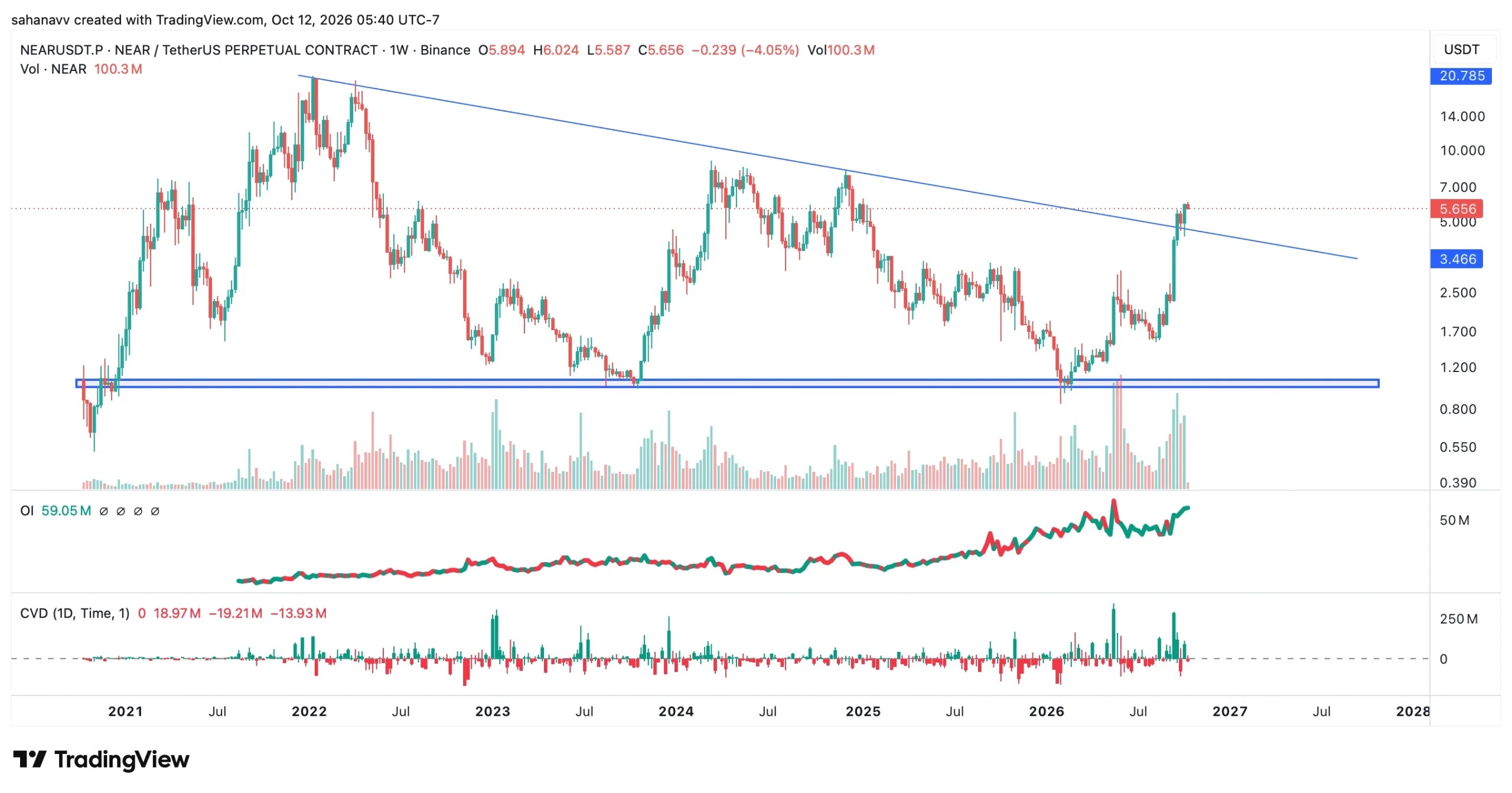
NEAR The price has broken through a downward resistance trend line that has persisted for many years on the weekly chart, putting greater-level bearish structures under pressure. This move suggests that the current trend may be about to change, but whether that change is confirmed still depends on whether buyers can maintain the breakout above the current resistance area. NEAR Currently, trading is around $5.66, and the range from $5.97 to $6 is becoming the next key resistance level. If the weekly chart can continue to close above this area, it will strengthen the bullish pattern and open up room for further rebound.
However, as shown by the derivatives positions, this trend still needs to be viewed with more caution. There are approximately 59.05 million US dollars in open contracts, and the negative cumulative trading volume difference ( CVD ) indicates that despite the price increase, the pressure to sell is still ongoing. This divergence suggests that there may be potential selling pressure behind the rebound. If the price can firmly break through $6 with the support of improved order flow, it will strengthen the conviction of the breakout; if this resistance cannot be overcome, then NEAR may face consolidation and a retest of the previously recovered trend line.
ZRO Resistance in the testing range, $3.20 becomes the focus
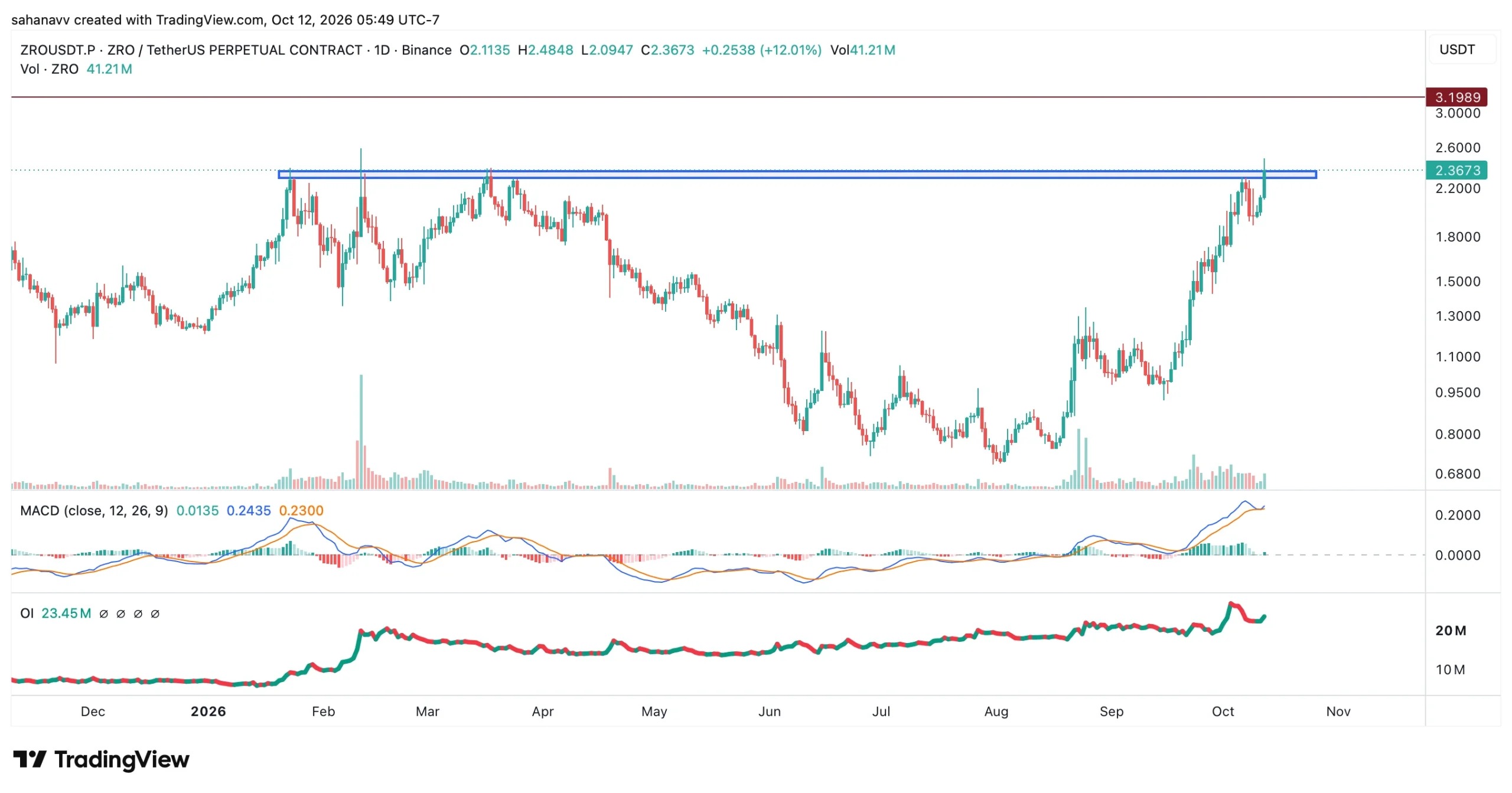
After breaking through the resistance range of $2.30 to $2.37, LayerZero ( ZRO ) is attempting to continue its upward trend; previously, this range had been restricting price increases. The daily chart indicates that bullish momentum is improving, and MACD is still in a positive zone, with prices approaching the next major resistance level of $3.20. However, the narrowing of the MACD bar chart recently suggests that the upward momentum may be slowing down. Therefore, whether it can continue to rise above this breakout range is crucial for sustaining this current market trend.
Derivative positions also add another layer of variability to this trend. The open interest has risen to around $23.45 million, indicating increased participation, but this does not necessarily mean that traders are mainly betting on further increases. ZRO The upcoming token unlocking on October 20th is also worth paying attention to, as the new supply may affect price performance near resistance levels. If the price can remain above $2.37, it will strengthen the scenario for a breakthrough towards $3.20; if it falls back below the recovered range, it will increase the risk of a false breakout and a re-consolidation.
What will happen to the prices of NEAR Protocol and LayerZero next?
In the current altcoin market, NEAR and ZRO offer different opportunities: NEAR attempts to reverse the long-term trend, while ZRO is striving to maintain its upward momentum. In addition to price trends, the growing ecological activities of NEAR and the upcoming token unlocking of ZRO constitute opposing fundamental factors that may affect market sentiment. The broader outlook will depend on whether network adoption can be translated into sustained demand for tokens, as well as whether the improving technical structure can attract subsequent buying interest. For traders, the focus remains on breakout confirmations, derivative positions, and the potential impacts of changes in token supply.