The XRP Ledger payment engine has been hiding a forgery vulnerability since 2015.
Decrypt
48m ago
Ai Focus
The maintainers of XRP Ledger have disclosed and fixed a serious integer overflow vulnerability in the payment engine, which could allow attackers to create XRP out of thin air. Researchers reported this issue through the vulnerability bounty program in September, and developers stated that there is currently no evidence that the vulnerability has been exploited.
Helpful
No.Help

Brief

The maintainers of XRP Ledger have disclosed and fixed a serious payment engine overflow vulnerability. This vulnerability was reported through a bounty program in September and could have allowed attackers to forge XRP.

Developers stated that this flaw went undetected for so long because normal payments did not trigger it, and the security checks in the ledger that are designed to prevent the creation of “XRP” also used problematic arithmetic logic.

XRP Ledger developers have disclosed and fixed a serious vulnerability. If left unaddressed, this vulnerability could allow attackers to create XRP out of thin air; this flaw has been lurking in network code for about ten years.
In the disclosure released on Friday, the ledger maintainer stated that a researcher reported the issue in September through the XRPL bug bounty program. The issue was located in the payment engine, which is the software part that handles payments, and it was a type of integer overflow vulnerability.

When a payment consumes hundreds of specially constructed quotes from the order book, the total amount that the buyer should pay exceeds the maximum value that the system can store, resulting in a number that becomes very small after "wrapping around." The engine makes full payments to each seller, yet charges the buyer almost nothing; the difference is equivalent to newly minted XRP.

Worse still, the built-in security checks in the ledger are designed to ensure that no transaction creates XRP, but they use the same flawed arithmetic, which also results in the same kind of issues and fails to detect such problems. The maintainers stated that attackers could have created a quantity of XRP that far exceeds the total token supply in a single transaction, and then transferred, traded, or sent it to exchanges.

Engineers from RippleX have confirmed that this vulnerability has existed since the current payment engine was developed in 2015; it has simply not been discovered because normal payments are far from sufficient to trigger an overflow.

The team stated that there is currently no evidence indicating that this vulnerability has been exploited. The fix was released on September 25 in version 3.4.1, and on that day, over 80% of network trusted validators were already running that version.

It is worth noting that this patch bypassed the usual revision process of the ledger. Normally, validators would need to vote and wait for two weeks before the changes would take effect. This is the first time in over a decade since the system was launched that changes at the transaction processing level have been intentionally released in this manner. The maintainers stated that they chose this approach because the severity of the issue was sufficient to justify it; if the fix had been made public through the regular process, the vulnerability would have been exposed and could still have been exploited for several weeks.

This revelation reminds people of a fake coin panic that shook Zcash this year. At that time, this privacy coin hurriedly patched a security vulnerability in its shielding pool, which could have allowed the creation of fake tokens. That incident led to a significant drop in ZEC, and it was only after an upgrade to the network's Ironwood that the problem was resolved.

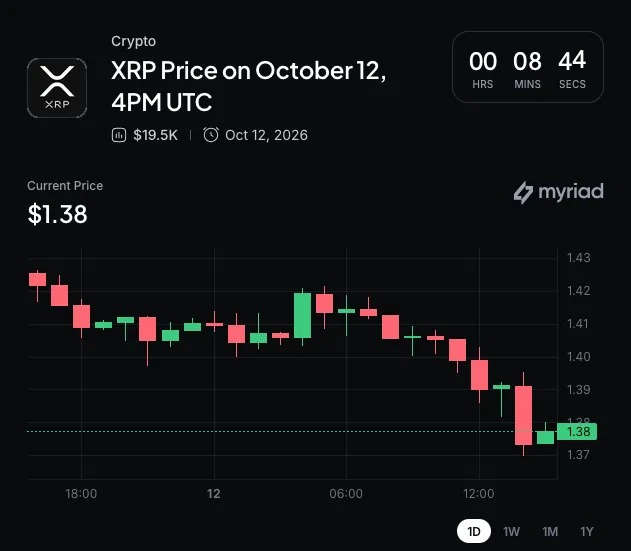
XRP was not spared this week either. On Monday, the token traded at $1.38, showing a 1.6% decline in the past 24 hours, performing the worst among major cryptocurrencies; it has fallen by 9.4% over the past 7 days.

Tip
$0
Like
0
Save
0
Views 20
WalletJYS reminds readers to view blockchain rationally, stay aware of risks, and beware of virtual token issuance and speculation. All content on this site represents market information or related viewpoints only and does not constitute any form of investment advice. If you find sensitive content, please click“Report”,and we will handle it promptly。
Submit
Comment 0
Hot
Latest
No comments yet. Be the first!
Related
Bronstein, Gewirtz & Grossman LLC Urge Webull Corporation Investors to Take Action: Class Action Lawsuit Filed, Alleging Investors Have Suffered Losses
Bronstein, Gewirtz & Grossman, LLC represent that investors have filed a class action against Webull Corporation ( NASDAQ : BULL ) and some of its senior executives, accusing them of making false and/or misleading statements from April 26, 2025, to October 6, 2026, or of failing to disclose important facts related to business operations in Mainland China, data transfer, and compliance structures.
PR Newswire
·2026-10-13 00:51:49
8
Strategy Buys $21 Million in Bitcoin; Corporate Interest in Crypto Buying Shows a Rebound
Strategy announced on Monday that it had purchased over $21 million in Bitcoin last week, bringing its total holdings to approximately $70 billion. The company also raised funds for the purchase by selling common stocks and using cash, and repurchased nearly 2 million STRC. Meanwhile, companies such as Strive, Robinhood, Metaplanet, and Bitmine also disclosed their new crypto asset allocations.
Fortune
·2026-10-13 00:51:47
7
UnitedHealth Stock Price Experiences Abnormal Fluctuations Before Financial Report
According to CNBC Pro, author of the article, Michael Khouw, the implied volatility of UnitedHealth Group before the October 13 quarterly financial report was twice that of the realized volatility, indicating that option prices were on the high side, making it suitable for a strategy of selling option premiums. The article also provides a trading approach that involves selling November 340/420 straddle options to finance the purchase of January 2027 400 call options.
CNBC
·2026-10-13 00:51:46
6
Lyon: China's AI model accounts for approximately 65% of the token usage share
Lyon stated that data from OpenRouter shows a rapid growth in demand for the AI model. As of the end of September, the weekly consumption exceeded 146 trillion, and the model's annual recurring revenue totaled over 1.5 billion US dollars. In September, Chinese models accounted for approximately 65% of the total usage and 30% of the expenditures, benefiting from a price discount of about 80% compared to their American counterparts.
AASTOCKS
·2026-10-13 00:42:16
11
NEXTPredict Spent $12,000 on hedging in the prediction market for its conference
The organizer of NEXTPredict purchased a contract through Kalshi: If the cancellation rate of flights to New York's Kennedy International Airport on October 21st exceeds 50%, the contract will pay out approximately $3 million. The organizer stated that this transaction, undertaken by Susquehanna as a market maker, had a premium of $12,000, which corresponds to their total investment in the event. This marks the first time in the convention and exhibition industry that market forecasting has been used to hedge against conference risks.
Decrypt
·2026-10-13 00:42:15
11
View More